Originally meaning ‘person of ridiculous appearance’, ‘quiz’ (students’ slang, late 18th century) was jocularly derived from the Latin interrogative pronoun ‘quis’ in “Vir bonus est quis?” (“Who is a good man?”)—a good, ingenuous, harmless man being likely to become an object of ridicule or even of harassment.
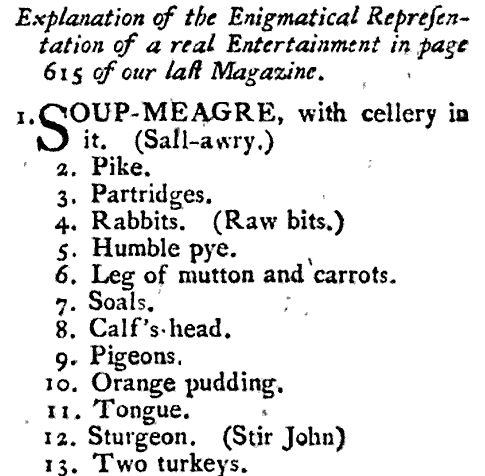
A puzzle published in The Hibernian Magazine, or, Compendium of Entertaining Knowledge (Dublin, Ireland) in 1774 punned on the humble of humble pie, which may indicate that the latter term was already used figuratively at that time. The following is from the October issue: […]
The phrase not to give, care or be worth a tinker¹’s curse, cuss² or damn (or elliptically a tinker’s) is an intensification of not to give, care or be worth a curse, cuss or damn, with reference to the bad language reputedly used by tinkers. The low repute in which tinkers were held is also […]
Sir John Herschel The announcement last Friday of the death, at the age of 81, of the Rev. Sir John Herschel, Bart., which occurred at Observatory House, Slough, revives a host of memories of 18th century Bath. Sir John Herschel was the great-grandson of Sir William Herschel, the famous astronomer, who discovered from his scientific […]
MEANINGS – a person who habitually talks about others, especially maliciously – a conversation involving malicious chatter or rumours about other people – casual and idle chat – light easy communication ORIGIN This word is from the Old English noun godsibb, composed of god and the adjective sib(b), meaning akin, related (cf. the noun sibling, which is composed of sib and […]
The English adjective imbecile is, via French, from the Latin imbecillus, or imbecillis, meaning weak, feeble, in body or mind. In his etymological encyclopaedia Originum sive Etymologiarum (The Origins or Etymologies), the Spanish archbishop and Doctor of the Church St Isidore of Seville (circa 560-636) wrote that the literal meaning of the Latin adjective is quasi sine baculo, as though (walking) without a supporting staff. The […]
the Prisoners (Temporary Discharge for Ill-health) Act, 1913 – image: http://www.parliament.uk The Prisoners (Temporary Discharge for Ill-health) Act, 1913 was rushed through Parliament by Herbert Henry Asquith’s Liberal government in order to deal with the problem of hunger-striking suffragettes, who were force-fed, which led to a public outcry. The Act allowed for the […]
The proper noun Disgusted (with initial capital D) was originally used as a self-designation by a member of the public writing anonymously to a newspaper in order to express outrage about a particular issue—cf. also meaning and history of ‘to write to The Times about it’. The earliest instance of this noun that I have found is […]
A blend of magpie and piety, the word magpiety was originally invented by the English poet and humorist Thomas Hood (1799-1845) to denote talkativeness, garrulity, especially on religious or moral topics and affected piety. This author first used the word in Jarvis and Mrs. Cope, published in The New Sporting Magazine of March 1832; the poem thus begins: JARVIS AND MRS. COPE. A decidedly serious […]




 word histories