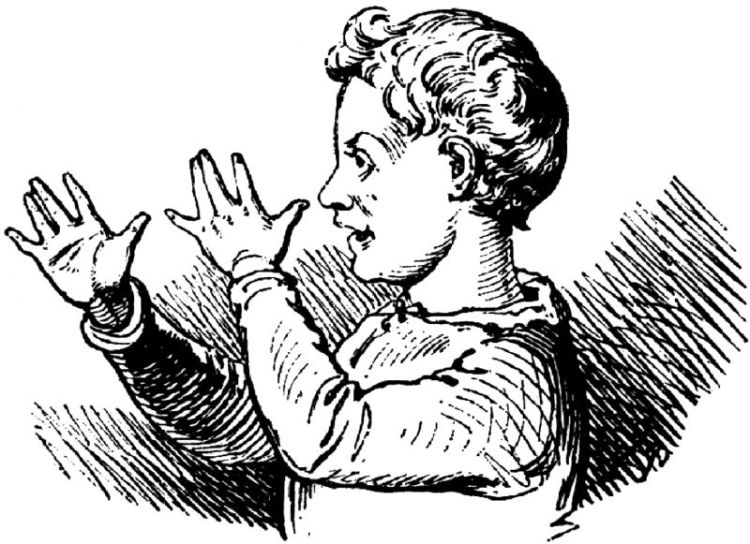
The phrase to cock (also to cut, to pull) a snook, or snooks, means: – literally: to make a gesture of derision by putting one’s thumb to one’s nose and outspreading the fingers; this gesture can be intensified by joining the tip of the little finger to the thumb of the other hand, whose fingers are […]
Literally denoting a mouse which lives in a church, the noun church mouse has long been used figuratively and allusively of a person likened to such a mouse, in terms of its proverbial attributes, especially in being impoverished or quiet. For example, the Anglo-Welsh historian and political writer James Howell (circa 1594-1666) recorded the following […]
The noun marrowsky, which has also been spelt Marouski, Marowsky, morowski and mowrowsky, denotes a variety of slang, or a slip in speaking, characterised by the transposition of the initial letters or syllables of two words. The more usual term is spoonerism (cf. also malapropism and eggcorn). The word is first recorded in the verbal form Marrowskying in […]
To make (both) ends meet means to earn just enough money to live on. It is first recorded in The History of the Worthies of England (1662), by the Church of England clergyman Thomas Fuller (1607/8-61). The author wrote the following about the English Protestant leader Edmund Grindal (1519-83) – in the original text, to […]
‘blarney’: originally an allusion to the lies told by those who, having not reached the Blarney stone (in a castle near Cork), explained how they did reach it
detail from the frontispiece to The Life of an Actor (1825), by Pierce Egan The phrase to get, or to give, the bird means to receive, or to show, derision, to be dismissed, or to dismiss. It originated in theatrical slang and referred to the ‘big bird’, that is, the goose, which hisses as people do when they make a sound of disapproval […]
The adjective teetotal in the sense of choosing, or characterised by, total abstinence from all alcohol seems to have first been used about September 1833 by Richard Turner, a worker from Preston, Lancashire, in a speech advocating total abstinence from intoxicating liquors, in preference to abstinence from ardent spirits only (as practised by some early […]
MEANING The phrase to kick the bucket means to die—synonym: to pop one’s clogs. ORIGIN What is nowadays considered a folk etymology may well be the true origin: to kick the bucket quite possibly refers to suicide by hanging after standing on an upturned bucket. For example, the following was published in Jackson’s Oxford […]
Maconochie Brothers was a company set up in 1873 by Archibald (1854-1926) and James (1850-1895) Maconochie. (Maconochie is a surname derived from the Gaelic Macdonochie, the son of Duncan.) With food processing plants on the Isle of Dogs (London), in Lowestoft (Suffolk), in Fraserburgh (Aberdeenshire, Scotland) and other places, the company was a wholesale provision merchant and manufacturer of pickles, potted meat and […]
The proverb you can’t make a silk purse out of a sow’s ear means you can’t create a fine product from inferior materials. It originated in Scotland, according to its first recorded instance, in A New Dictionary of the Terms Ancient and Modern of the Canting Crew (1699), by “B. E. Gent.”: Luggs, Ears: Hence […]



 word histories