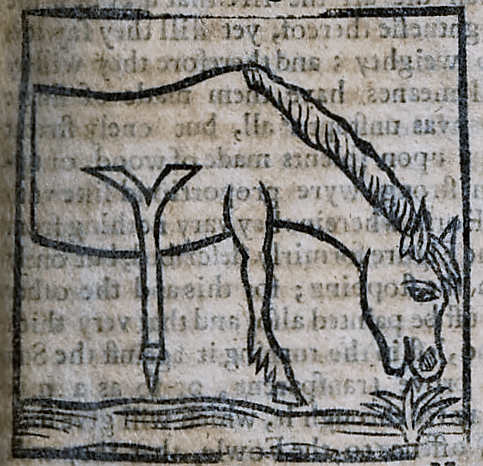
The forme and manner of the Stalking horse of Canuasse stopt. – from Hungers preuention: or, The whole arte of fowling by water and land Containing all the secrets belonging to that arte (1655 edition) The term stalking horse originally denoted a horse trained to allow a fowler to conceal himself behind it or under […]
MEANINGS – attractive articles of little value or use – practices or beliefs that are superficially or visually appealing but have little real value or worth ORIGIN The noun trumpery, first recorded in the mid-15th century, is from the French noun tromperie, which means deception, trickery. This was one of the original meanings in […]
The phrase to teach one’s grandmother to suck eggs means to presume to advise a more experienced person. Raw eggs, with or without a little seasoning, used to be a popular food and were regarded as healthy. Grandmothers obviously needed no instruction about how to drink them. The phrase is first recorded in a translation from Spanish by […]
The Latin noun halcyon, more properly alcyon, was derived from Greek ἀλκυών (= alkuon), incorrectly spelt ἁλκυών (= halkuon), meaning kingfisher. The ancients fabled that the halcyon bred about the time of the winter solstice in a nest floating on the sea, and that it charmed the wind and waves so that the sea was […]
The Ranz des Vaches – from A Complete Dictionary of Music (1779) The term ranz-des-vaches denotes a type of Swiss melody, traditionally played on the Alpenhorn or sung in order to call cows scattered over the mountainside. The melody is characterised by the reiteration of short phrases and usually contains an element […]
Unexpectedly, the words fawn, meaning a young deer in its first year, and fetus (or foetus), meaning an unborn or unhatched offspring of a mammal, are doublets: they go back to the same etymological source but differ in form and meaning. While fetus has remained identical to this source, the form fawn is the result of sound changes—cf. also turban – tulip, clock – cloak, […]
The phrase (as) happy as a clam means well pleased, quite contented—cf. also happy as a sandboy and happy as Larry. In Dictionary of English Phrases (2008), Robert Allen explains: This American simile is more understandable in its full form, happy as a clam in high water (or at high tide). In these conditions, clams […]
The phrase tit for tat means an equivalent given in return or retaliation. The expression seems to be a variation of the obsolete and more comprehensible tip for tap, in which both tip and tap meant a light but distinct blow, stroke, hit. The phrase therefore meant blow for blow. The words tip and tap first appeared combined in Fortunes Stabilnes, by Charles d’Orléans (1394-1465). Context: the letter patent […]
The noun myrmidon denotes a follower or subordinate of a powerful person, typically one who is unscrupulous or carries out orders unquestioningly. This word first appeared in the plural forms Mirmydanes and Murmindones in The Laud Troy book, a poem about the siege of Troy composed around 1400. It is from the classical Latin plural […]
Le Rhesus (Simia Rhesus) – illustration by Jean-Baptiste Audebert for his treatise, Histoire naturelle des singes et des makis (1799) – image: Bibliothèque nationale de France / gallica.bnf.fr This word is from French rhésus, formerly rhesus, and from its etymon, the scientific Latin (Simia) Rhesus. In Histoire naturelle des singes et des makis (Natural […]



 word histories