The phrase tit for tat means an equivalent given in return or retaliation. The expression seems to be a variation of the obsolete and more comprehensible tip for tap, in which both tip and tap meant a light but distinct blow, stroke, hit. The phrase therefore meant blow for blow. The words tip and tap first appeared combined in Fortunes Stabilnes, by Charles d’Orléans (1394-1465). Context: the letter patent […]
The noun myrmidon denotes a follower or subordinate of a powerful person, typically one who is unscrupulous or carries out orders unquestioningly. This word first appeared in the plural forms Mirmydanes and Murmindones in The Laud Troy book, a poem about the siege of Troy composed around 1400. It is from the classical Latin plural […]
Le Rhesus (Simia Rhesus) – illustration by Jean-Baptiste Audebert for his treatise, Histoire naturelle des singes et des makis (1799) – image: Bibliothèque nationale de France / gallica.bnf.fr This word is from French rhésus, formerly rhesus, and from its etymon, the scientific Latin (Simia) Rhesus. In Histoire naturelle des singes et des makis (Natural […]
The noun window is from Middle English windoȝe, a borrowing from Old Norse vindauga, literally wind’s eye, from vindr, wind, and auga, eye. The Scandinavian word replaced and finally superseded Old English éagþyrel, i.e. eyethirl, composed of the nouns eye and thirl. The noun thirl denoted a hole, an aperture, and was derived from Old English þurh, thorough. It was long used in some dialects of English; for instance, […]
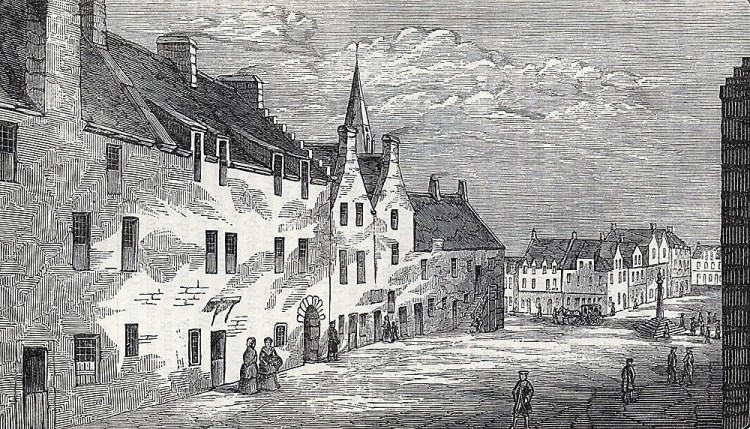
the Rotten-row in Glasgow, circa 1570 image: The Glasgow Story The street name Rotten Row occurs in many different towns. For example, The Caledonian Mercury (Edinburgh) of 10th December 1728 published the following advertisement: There is just come to Leith, a Parcel of fine Figs both in Casks and Frails [= baskets], […]
The French term foie gras, from foie, liver, and gras, fat, fatty, denotes the liver of a specially fattened goose or duck prepared as food. Short for pâté de foie gras, it also denotes a smooth rich paste made from fatted goose or duck liver. Its first known use in English is in The Fudge […]
MEANING outside the limits of social convention ORIGIN The primary meanings of the noun pale are a wooden stake or post used with others to form a fence and a wooden fence made of stakes driven into the ground. This word appeared in the late 14th century and is from Anglo-Norman and Middle French pal, meaning a stake, a palisade, a […]
cover of The Great Panjandrum Himself (1885), a picture book based on the text attributed to Samuel Foote, by the English artist and illustrator Randolph Caldecott (1846-86) – photograph: Aleph-Bet Books MEANING a pompous self-important official or person of rank ORIGIN The word is supposed to have been coined in […]
The word pedigree appeared in the early 15th century in the Latin form pedicru and in English forms such as pe-de-grew and pedegru, from Anglo-Norman French pé de grue and variants (pied de grue in Modern French), meaning literally foot of crane. The Anglo-Norman French word is first recorded during the second Michaelmas term (i.e. during the second session, beginning soon after Michaelmas, of the […]
The words man and mouse have been used in alliterative association in: – neither man nor mouse, to mean not a living creature, great or small, – mouse and man, or mice and men, to mean every living thing. The first known user of neither man nor mouse was the poet and writing-master John Davies […]



 word histories