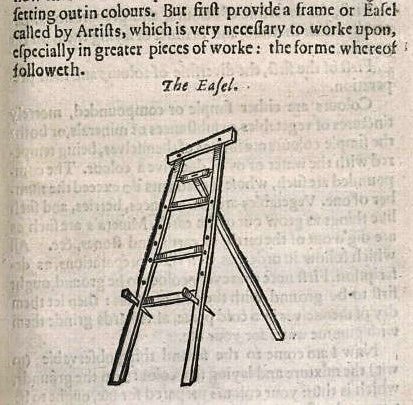
The noun ‘easel’ was borrowed from Dutch ‘ezel’; this sense of ‘ezel’ is a metaphorical extension of its literal meaning, ‘ass’, from the fact that, like a beast of burden, an easel is used to carry things. Likewise, the literal meaning of the synonymous French word ‘chevalet’ is ‘little horse’.
The phrase ‘to turn up one’s toes’, meaning ‘to die’, might have originated in the Irish-English phrase ‘to turn up one’s toes to the roots of the daisies’, first found in the passive form ‘with one’s toes turned up to the roots of the daisies’, meaning ‘lying dead’.
U.S.—‘to see the elephant’: to see life, the world or the sights, as of a large city, to gain knowledge by experience. But in 1842, the original meaning of ‘to see the elephant’ was ‘to get sick and tired of something’.
In British slang, the noun ‘piss-up’ denotes ‘a heavy drinking bout’, and the phrase ‘couldn’t organise a piss-up in a brewery’ and variants mean ‘is’, or ‘are’, or ‘am’, ‘incapable of organising the simplest event, task, etc.’—phrase first recorded in 1980.
Many centuries before becoming a nickname for New York City and the name of a fictional city associated with the Batman stories, Gotham was used in Britain as the name of a (probably fictional) village proverbial for the folly of its inhabitants.
The 1776 French translation of Laurence Sterne’s ‘The Life and Opinions of Tristram Shandy’ gave to French ‘dada’, a child’s noun for ‘horse’, the figurative meaning of ‘favourite pastime’ or ‘pet idea’.
‘Hobby’, diminutive of ‘Hob’, pet form of ‘Robert’, was used to denote a small horse, hence a child’s toy with a horse’s head, hence a favourite occupation—cf. French ‘dada’, child’s word for horse, used to denote a favourite pastime
from army use on the Western Front during World War One: ‘cootie’, ‘body louse’, ‘cooty’, ‘infested with lice’, ‘coot’, ‘louse’, probably ultimately refer to the aquatic bird called ‘coot’, reputed to be lice-infested
some characteristic slang creations of the British, U.S. and French soldiers during World War One, as recorded in ‘Trench Talk’, published in Everybody’s Magazine (New York) of January 1918
USA, 1948—espresso coffee mixed with steamed milk—borrowed from Italian ‘cappuccino’, literally ‘Capuchin’, because the colour of this type of coffee resembles that of a Capuchin’s habit—cf. French ‘capucin’ (= ‘Capuchin’), a name for the hare, from the colour of the animal’s fur