origin of ‘to take time by the forelock’
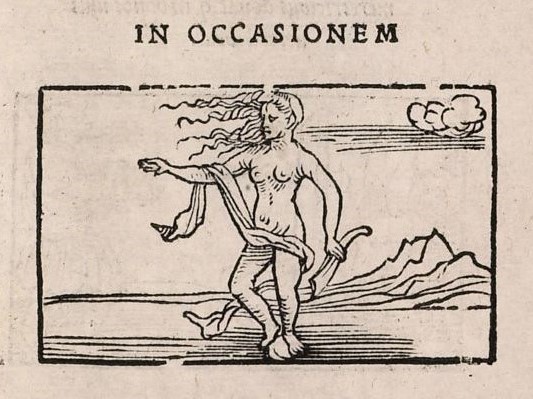
Opportunity was represented as woman completely bald except for a forelock: she can only be seized as she runs towards someone, not be caught thereafter.
Read More
“ad fontes!”
Opportunity was represented as woman completely bald except for a forelock: she can only be seized as she runs towards someone, not be caught thereafter.
Read More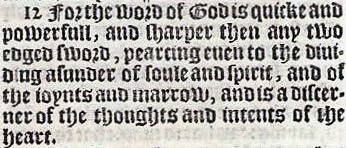
to serve both sides of an argument; to have both good and bad effects—England, early 18th century—refers to a sword which has two cutting edges
Read MoreThis phrase originated in the belief that bear cubs were born formless and had to be licked into shape by their mother.
Read More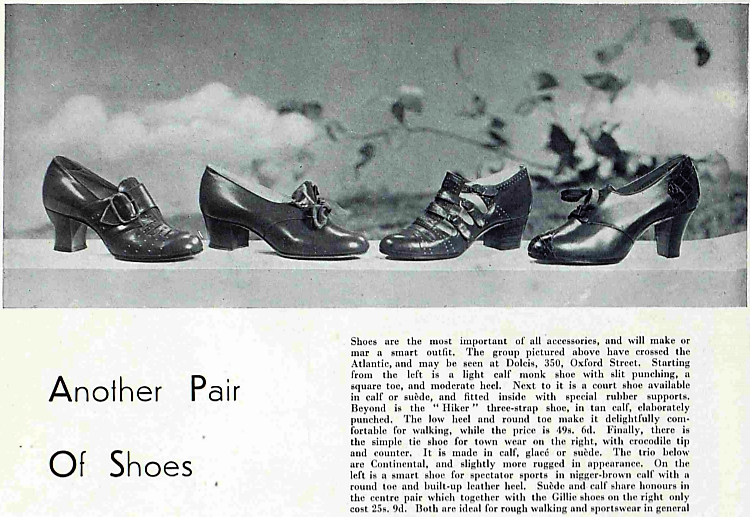
Another Pair Of Shoes Shoes are the most important of all accessories, and will make or mar a smart outfit. The group pictured above have crossed the Atlantic, and may be seen at Dolcis, 350, Oxford Street. Starting from the left is a light calf monk shoe with slit punching, a square toe, and […]
Read MoreTo make (both) ends meet means to earn just enough money to live on. It is first recorded in The History of the Worthies of England (1662), by the Church of England clergyman Thomas Fuller (1607/8-61). The author wrote the following about the English Protestant leader Edmund Grindal (1519-83) – in the original text, to […]
Read MoreMAIN MEANINGS – verb: to behave as though sexually attracted to someone, but playfully rather than with serious intentions – noun: a person who acts flirtatiously ORIGIN The verb flirt is probably onomatopoeic, the phonetic elements /fl-/ and /-əːt/ both suggesting sudden movement. It may therefore be comparable to verbs such as […]
Read More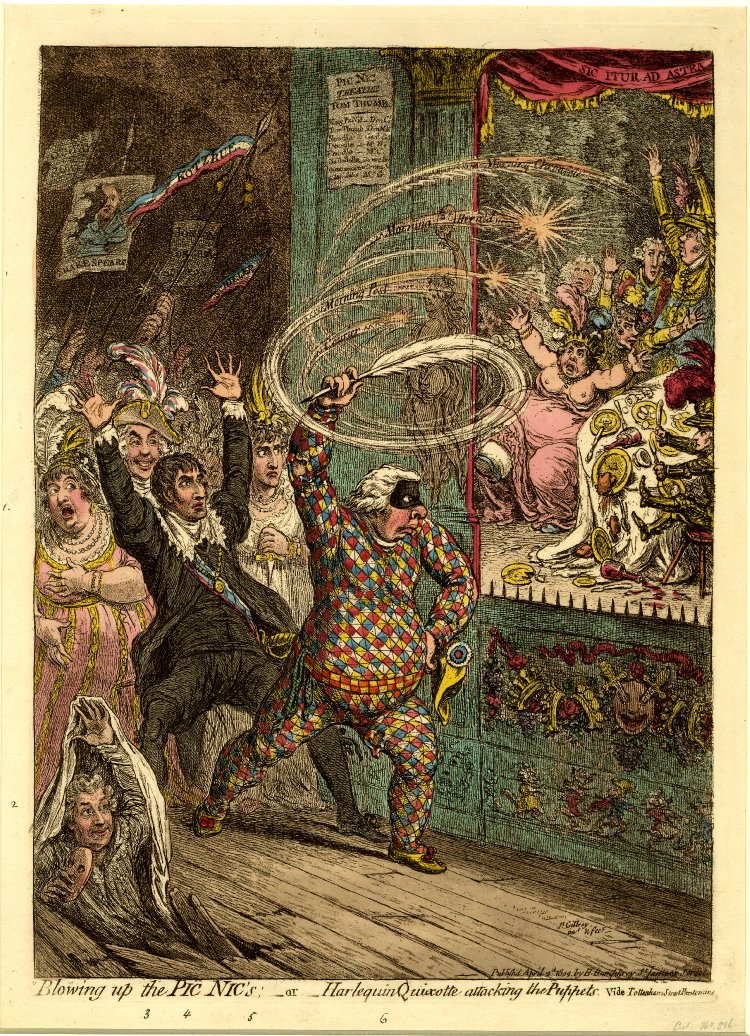
Blowing up the PIC NIC’s:—or—Harlequin Quixotte attacking the Puppets. Vide Tottenham Street Pantomime (1802), by James Gillray (1756-1815) — image: The British Museum MEANING a meal eaten outdoors ORIGIN This word is from French pique-nique, probably formed with reduplication from the verb piquer, to pick. (Similarly, pêle-mêle, the origin […]
Read MoreIn early use, apple was a general term for all kinds of fruits other than berries, including even nuts. In fact, apple and berry are the only Anglo-Saxon fruit names, the rest being of Latin or ‘exotic’ origin. This is why apple was commonly used in describing foreign fruits, which explains for example the word […]
Read MoreThe word teetotum, which dates back to the 18th century, denotes a small four-sided disk or die having an initial letter inscribed on each of its sides, and a spindle passing down through it by which it could be twirled or spun with the fingers like a small top, the letter which lay uppermost, when […]
Read More word histories