In A Dictionarie of the French and English Tongues (1611), Randle Cotgrave gave the following definition of the French word gazette: A certaine Venetian coyne scarce worth our farthing; also, a Bill of Newes; or, a short Relation of the generall occurrences of the Time, forged most commonly at Venice, and thence dispersed, euery month, into most parts of Christendome. […]
Figuratively, a loose cannon is an unpredictable or uncontrolled person who is liable to cause unintentional damage. But in practice, it was one inadequately lashed in place on the deck of a ship, which caused havoc by rolling dangerously and unpredictably. The first known mention of a loose cannon being tossed about the deck of […]
In his comédie-ballet Le Bourgeois gentilhomme (literally The Bourgeois Gentleman – 1670), the French playwright and actor Molière (Jean-Baptiste Poquelin – 1622-73) invented the word Mamamouchi, an imaginary Turkish title that Monsieur Jourdain is gulled into thinking the son of the Grand Turk confers upon him. (Jourdain is a bourgeois whose aim is to be […]
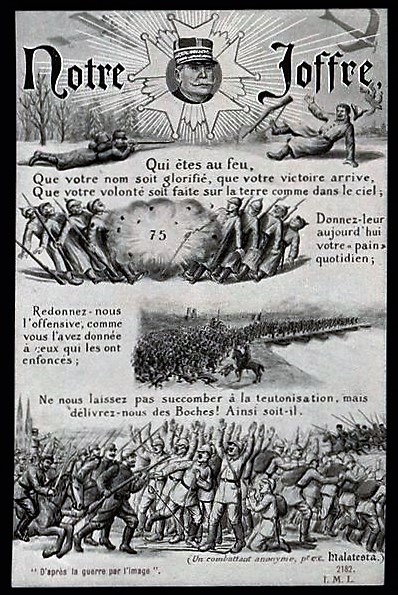
Notre Joffre (parody of the Lord’s Prayer) first published in 1914 in Le Radical de Marseille (75 refers to the French 75-mm field gun.) From 1914 to 1916, Joseph Joffre (1852-1931) was the commander in chief of the French armies on the Western Front. The following parody of the Lord’s Prayer is to be replaced […]
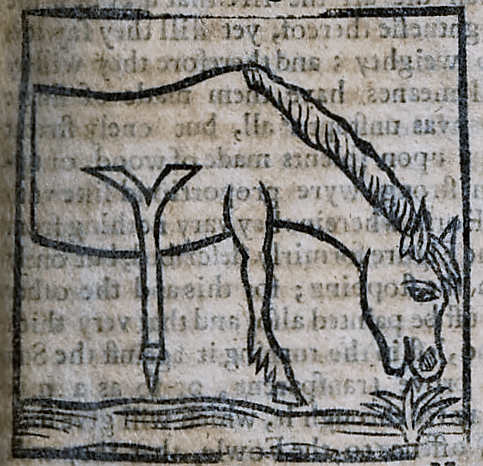
The forme and manner of the Stalking horse of Canuasse stopt. – from Hungers preuention: or, The whole arte of fowling by water and land Containing all the secrets belonging to that arte (1655 edition) The term stalking horse originally denoted a horse trained to allow a fowler to conceal himself behind it or under […]
MEANINGS – attractive articles of little value or use – practices or beliefs that are superficially or visually appealing but have little real value or worth ORIGIN The noun trumpery, first recorded in the mid-15th century, is from the French noun tromperie, which means deception, trickery. This was one of the original meanings in […]
The phrase to teach one’s grandmother to suck eggs means to presume to advise a more experienced person. Raw eggs, with or without a little seasoning, used to be a popular food and were regarded as healthy. Grandmothers obviously needed no instruction about how to drink them. The phrase is first recorded in a translation from Spanish by […]
MEANING the depths of one’s conscience or emotions ORIGIN This anatomically curious but firmly established expression is a variant of the older and more comprehensible heart of heart, meaning very centre of the heart, which was coined by the English poet and playwright William Shakespeare (1564-1616) in The Tragicall Historie of Hamlet, […]
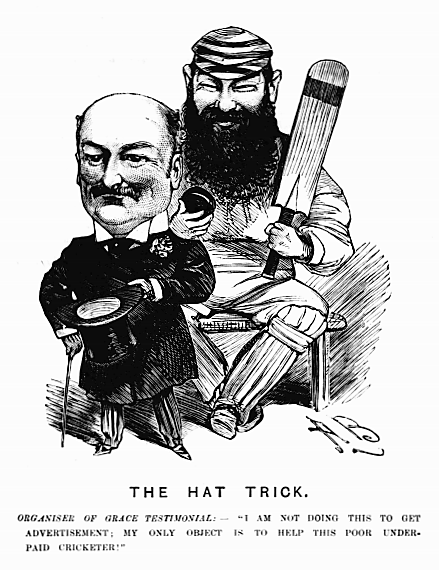
THE HAT TRICK. ORGANISER OF GRACE TESTIMONIAL: — “I AM NOT DOING THIS TO GET ADVERTISEMENT; MY ONLY OBJECT IS TO HELP THIS POOR UNDERPAID CRICKETER!” caricature from The Entr’acte & Limelight (London) – 22nd June 1895 In 1895, a testimonial fund was set up for W. G. Grace (1848-1915), the Grand Old Man […]
The Latin noun halcyon, more properly alcyon, was derived from Greek ἀλκυών (= alkuon), incorrectly spelt ἁλκυών (= halkuon), meaning kingfisher. The ancients fabled that the halcyon bred about the time of the winter solstice in a nest floating on the sea, and that it charmed the wind and waves so that the sea was […]

 word histories