origin of ‘Shrovetide’ (‘les jours gras’)
Etymologically, ‘Shrovetide’ denotes the period during which it was customary to attend confession in preparation for Lent—but this period was also marked by feasting before the Lenten fast.
Read More
“ad fontes!”
Etymologically, ‘Shrovetide’ denotes the period during which it was customary to attend confession in preparation for Lent—but this period was also marked by feasting before the Lenten fast.
Read MoreThe phrase ‘below the salt’ originated in the social differentiations materialised by the former custom of placing a large saltcellar in the middle of a dining table.
Read More
UK, ‘greengrocer’s apostrophe’ – ‘apostrofly’: the mistaken use of an apostrophe, especially its insertion before the final ‘s’ of an ordinary plural form
Read More‘Bombay’: alteration after the city’s name of ‘bummalo’, the name of the fish—‘duck’: common dishes were humorously called by the names of superior ones
Read More‘Welsh’: used disparagingly by the English to denote inferior things; ‘rabbit’: common dishes were humorously called by the names of superior ones
Read More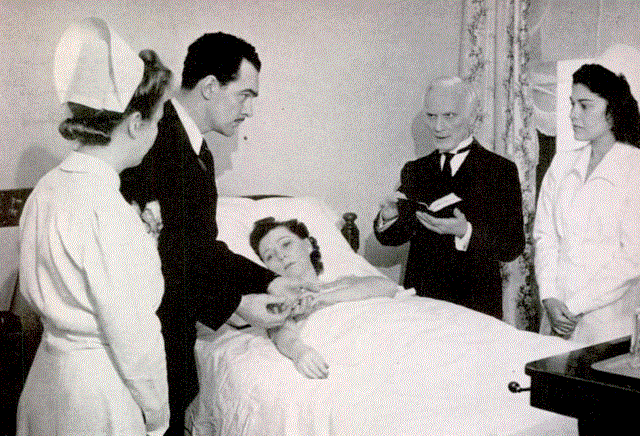
US, 1938—‘soap’: from early sponsors of such radio serials, often soap manufacturers—‘opera’: from the scale of dramatic incident that happens in these programs
Read Moresupposedly an allusion to the preparation of fabric to be worked on: once the shapes have been cut out, the tailor still has a lot of sewing to do
Read MoreFirst recorded in 1590, the term ‘lip service’ originally referred to prayer as a mere formal practice, as a sort of mechanical physical exercise.
Read More
Several English and French words and phrases are ultimately derived the Latin noun ‘pullus’, meaning ‘young animal’, in particular ‘young fowl’.
Read MoreUK, 1919—possibly a mere euphemism for having too much to drink, regardless of the actual number of drinks that have been consumed (‘eight’ probably arbitrary)
Read More word histories