origin of ‘Scouse’ (Liverpudlian)
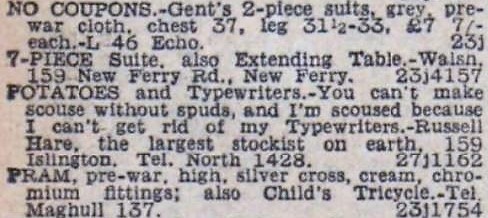
The original sense of ‘Scouse’, denoting a person from Liverpool, is ‘a stew’. The word ‘scouse’ is in turn a shortening of ‘lobscouse’, of obscure origin.
Read More
“ad fontes!”
The original sense of ‘Scouse’, denoting a person from Liverpool, is ‘a stew’. The word ‘scouse’ is in turn a shortening of ‘lobscouse’, of obscure origin.
Read MoreThe word ‘tyke’, a nickname for a person from Yorkshire, originally meant ‘mongrel’. The people from Yorkshire have adopted it as a term of self-reference.
Read More
‘Over the top’, which means ‘excessive’, originated as a WWI expression meaning ‘over the parapet of a trench and into battle’.
Read More
The phrase ‘(with) tongue in cheek’ originally referred to a sign of contempt or derision consisting in sticking one’s tongue in one’s cheek.
Read More‘Mad as a hatter’ might be from ‘like a hatter’, an intensive phrase meaning ‘like mad’, perhaps related to the verb ‘hotter’, expressing motion and emotion.
Read More
plate 19: La Trénis, Contredanse source: gallica.bnf.fr / Bibliothèque Nationale de France from the 1931 reprint of the caricatures published under the title of Le Bon Genre (1827 edition), including Observations sur les modes et les usages de Paris; the following comment about La Trénis accompanies this plate: (Année 1805.) Cette danse porte le […]
Read More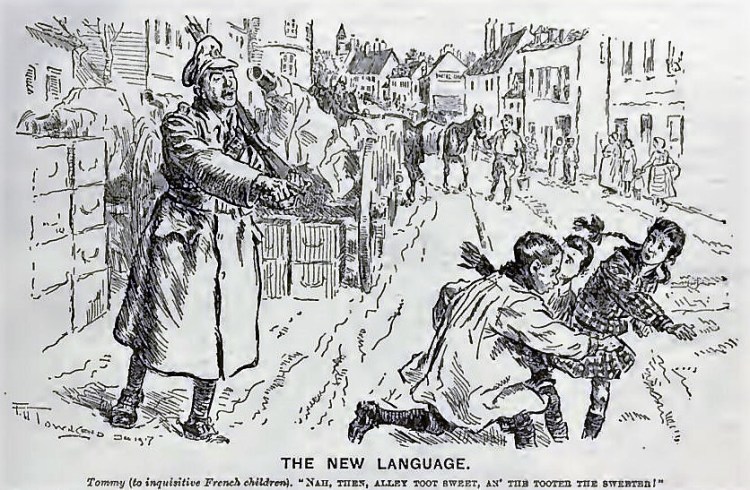
The adverb toot sweet means straight away, immediately. Humorously after the English words toot and sweet, it represents an anglicised pronunciation of the synonymous French adverb tout de suite. Before the First World War, it was only used in representations of French speech. For example, an article titled Galloglossia, published in Sharpe’s London Magazine […]
Read More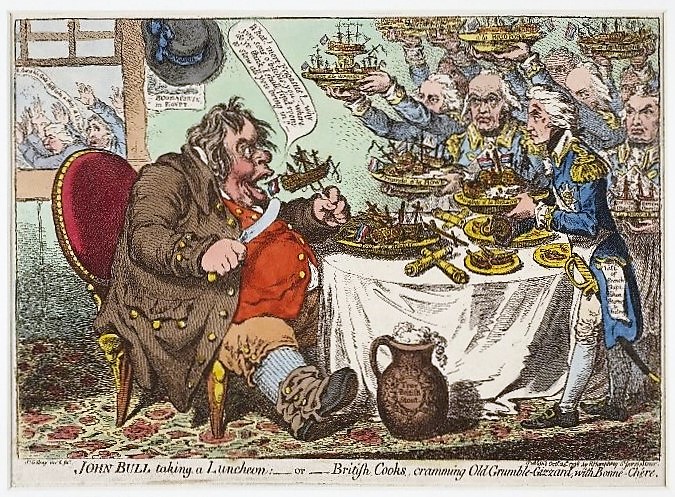
John Bull taking a Luncheon:—or—British Cooks, cramming Old Grumble-Gizzard, with Bonne-Chère. hand-coloured etching by James Gillray, published on 24th October 1798 — © Trustees of the British Museum This print was published just after Nelson’s victory at the Battle of the Nile. He is shown in the forefront of British admirals and naval heroes, serving up […]
Read MoreThe term old chestnut denotes a joke, story or subject that has become tedious and uninteresting through constant repetition. Here, the adjective old is simply an intensifier of the noun. The figurative use of chestnut originated in American-English theatrical slang. Diary of a Daly Débutante: being passages from the journal of a member of Augustin Daly’s […]
Read MoreOriginally meaning ‘person of ridiculous appearance’, ‘quiz’ (students’ slang, late 18th century) was jocularly derived from the Latin interrogative pronoun ‘quis’ in “Vir bonus est quis?” (“Who is a good man?”)—a good, ingenuous, harmless man being likely to become an object of ridicule or even of harassment.
Read More
