‘beer o’clock’: 5 p.m. as the end of the working day
The original meaning of beer o’clock is 5 p.m. as the end of the working day. Its first known user was Stephen King (born 1947), American author of novels of horror and suspense.
Read More
“ad fontes!”
The original meaning of beer o’clock is 5 p.m. as the end of the working day. Its first known user was Stephen King (born 1947), American author of novels of horror and suspense.
Read MoreFrom the 17th century onwards, Grub Street, in Moorgate, London, was inhabited by literary hacks.
Read MoreThe various phrases containing the word ‘mustard’ are based on the image of something which adds heat or pungency.
Read MoreGreek ‘skíouros’, ultimate origin of ‘squirrel’: folk-etymologically interpreted as meaning ‘shadow-tailed’ because when the animal sits erect, it raises its tail up against its back and over its head as if to shade itself
Read MoreThe phrase ‘below the salt’ originated in the social differentiations materialised by the former custom of placing a large saltcellar in the middle of a dining table.
Read More‘Bombay’: alteration after the city’s name of ‘bummalo’, the name of the fish—‘duck’: common dishes were humorously called by the names of superior ones
Read More‘Welsh’: used disparagingly by the English to denote inferior things; ‘rabbit’: common dishes were humorously called by the names of superior ones
Read More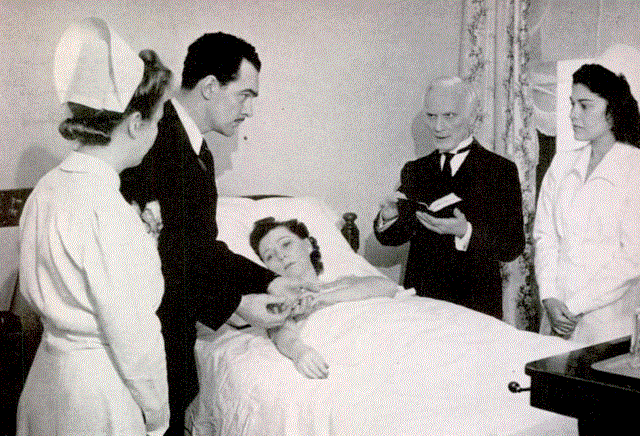
US, 1938—‘soap’: from early sponsors of such radio serials, often soap manufacturers—‘opera’: from the scale of dramatic incident that happens in these programs
Read Moresupposedly an allusion to the preparation of fabric to be worked on: once the shapes have been cut out, the tailor still has a lot of sewing to do
Read MoreFirst recorded in 1590, the term ‘lip service’ originally referred to prayer as a mere formal practice, as a sort of mechanical physical exercise.
Read More
