Twelfth Day denotes the twelfth day after Christmas, i.e. 6th January, on which the festival of the Epiphany is celebrated, and which was formerly observed as the closing day of the Christmas festivities. (Epiphany denotes the festival commemorating the manifestation of Christ to the Gentiles in the persons of the Magi; via Old-French and Anglo-Norman forms such as epyphane (Modern […]
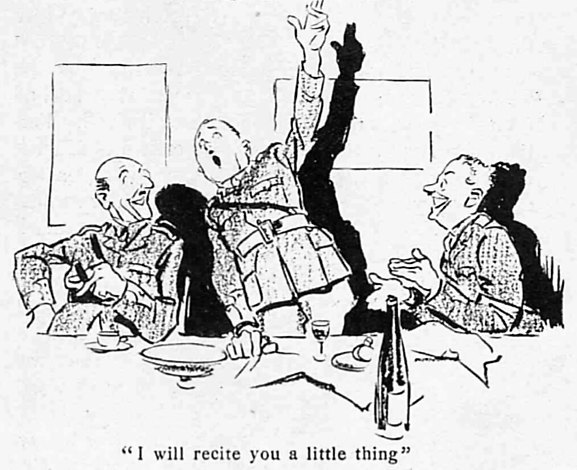
some characteristic slang creations of the British, U.S. and French soldiers during World War One, as recorded in ‘Trench Talk’, published in Everybody’s Magazine (New York) of January 1918
USA, 1948—espresso coffee mixed with steamed milk—borrowed from Italian ‘cappuccino’, literally ‘Capuchin’, because the colour of this type of coffee resembles that of a Capuchin’s habit—cf. French ‘capucin’ (= ‘Capuchin’), a name for the hare, from the colour of the animal’s fur
An expression of indifference to, or resigned acceptance of, a state of affairs, ‘san fairy ann’ jocularly represents the French phrase ‘ça ne fait rien’, meaning ‘that doesn’t matter’. It originated in army use on the Western Front during the First World War.
18th century—origin unknown—perhaps originally imitative and comparable to, or derived from, ‘tantara’, denoting the sound of a trumpet, hence an uproar—or from obsolete French ‘trantran’, synonym of ‘tantara’
Etymologically, a jewel is a little game, a little plaything: ‘jewel’ is from a French diminutive of ‘jeu’, meaning ‘a game’, ‘a play’. The word ‘bijou’ is from Breton ‘bizou’, meaning ‘a finger-ring’, from ‘biz’, ‘finger’.
The name ‘Indian summer’ (late 18th century) reflected the fact that to the Europeans living in the New World, this was a newly-discovered local phenomenon. But similar phenomena were already known in the Old World by various names.
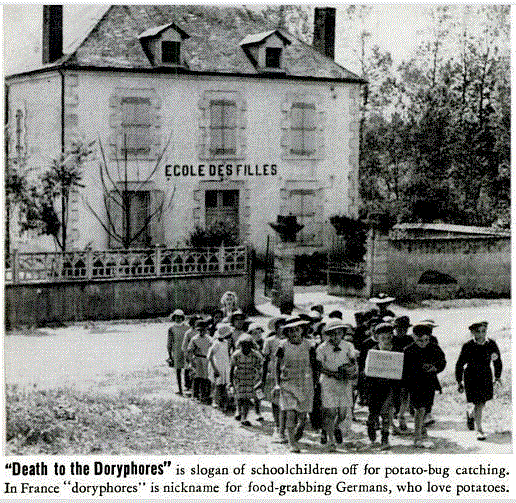
Greek ‘δορυϕόρος’ (‘doruphόros’) meant ‘spearman’; in French, ‘doryphore’ denotes the Colorado beetle and the German occupying forces during WWII; in English, it denotes a pedantic and annoyingly persistent critic.
The verb ‘elope’ now means ‘to run away secretly in order to get married’, but it originated in Anglo-Norman as a legal term meaning, of a wife, ‘to run away from her husband with a paramour’.
The English noun ‘pound’ is from Latin ‘pondō’, short for ‘lībra pondō’, literally ‘a pound’ (= ‘lībra’) ‘by weight’ (= ‘pondō’)—Latin ‘lībra’ meant ‘the Roman pound of twelve ounces’, and ‘pondō’ was a form of ‘pondus’, meaning ‘weight’.