18th century—origin unknown—perhaps originally imitative and comparable to, or derived from, ‘tantara’, denoting the sound of a trumpet, hence an uproar—or from obsolete French ‘trantran’, synonym of ‘tantara’
Etymologically, a jewel is a little game, a little plaything: ‘jewel’ is from a French diminutive of ‘jeu’, meaning ‘a game’, ‘a play’. The word ‘bijou’ is from Breton ‘bizou’, meaning ‘a finger-ring’, from ‘biz’, ‘finger’.
The name ‘Indian summer’ (late 18th century) reflected the fact that to the Europeans living in the New World, this was a newly-discovered local phenomenon. But similar phenomena were already known in the Old World by various names.
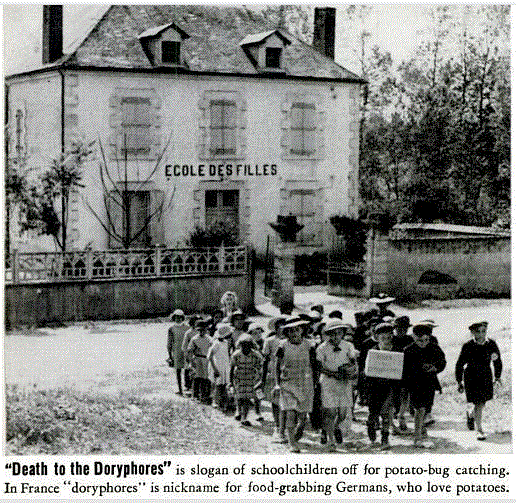
Greek ‘δορυϕόρος’ (‘doruphόros’) meant ‘spearman’; in French, ‘doryphore’ denotes the Colorado beetle and the German occupying forces during WWII; in English, it denotes a pedantic and annoyingly persistent critic.
The verb ‘elope’ now means ‘to run away secretly in order to get married’, but it originated in Anglo-Norman as a legal term meaning, of a wife, ‘to run away from her husband with a paramour’.
The English noun ‘pound’ is from Latin ‘pondō’, short for ‘lībra pondō’, literally ‘a pound’ (= ‘lībra’) ‘by weight’ (= ‘pondō’)—Latin ‘lībra’ meant ‘the Roman pound of twelve ounces’, and ‘pondō’ was a form of ‘pondus’, meaning ‘weight’.
Greek ‘skíouros’, ultimate origin of ‘squirrel’: folk-etymologically interpreted as meaning ‘shadow-tailed’ because when the animal sits erect, it raises its tail up against its back and over its head as if to shade itself
Etymologically, ‘Shrovetide’ denotes the period during which it was customary to attend confession in preparation for Lent—but this period was also marked by feasting before the Lenten fast.
The phrase ‘below the salt’ originated in the social differentiations materialised by the former custom of placing a large saltcellar in the middle of a dining table.



 word histories