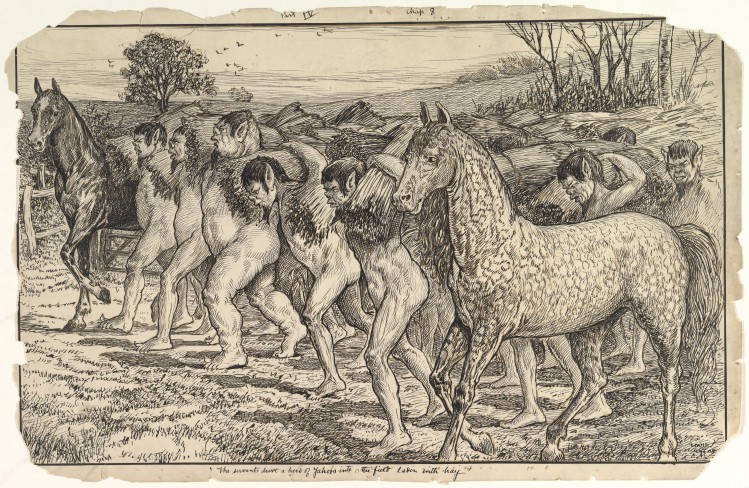
‘yahoo’: rude, noisy or violent person—word invented by Jonathan Swift (1667-1745) as the name of a race of brutish creatures resembling men in Gulliver’s Travels (1726)—came to be applied to the orang-utan
‘Sydney or the bush’: all or nothing (1902)—based on the metaphorical opposition between an easy life in the city and a hard life working in the outback, this phrase was apparently originally used by people risking all on the toss of a coin.
denotes a situation in which the alternatives are considered equivalent—first recorded, as ‘six of the one and half a dozen of the other’, on 24th April 1790 in the journal of Ralph Clark, a British naval officer—synonym: ‘(as) broad as long’
‘to plough a lonely furrow’, or ‘one’s own furrow’ (UK, 1901): to carry on without help, support or companionship—French ‘creuser son sillon’ (‘to dig one’s own furrow’, first used by Voltaire): to carry out with courage and perseverance the task undertaken
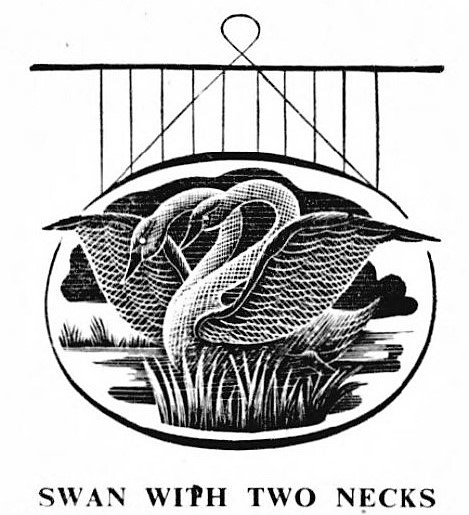
Alteration of ‘the Swan with Two Nicks’—All the Thames swans belong to the Crown, the Vintners’ Company or the Dyers’ Company. A swan with two nicks belongs to the Vintners’ Company, with one nick to the Dyers’ Company, with no nicks to the Crown.
from 1857 onwards in Australian newspapers, but apparently of Irish-English origin—the forename ‘Larry’ was probably chosen as a jocular reinforcement, a variant reduplication, of the adjective ‘happy’
‘happy-clappy’: a member of a Christian group whose worship is marked by enthusiastic participation; composed of ‘happy’ and of the noun ‘clap’ suffixed with ‘-y’—with allusion to the cheerful singing and hand-clapping regarded as typical of charismatic religious services
In British slang, the noun ‘piss-up’ denotes ‘a heavy drinking bout’, and the phrase ‘couldn’t organise a piss-up in a brewery’ and variants mean ‘is’, or ‘are’, or ‘am’, ‘incapable of organising the simplest event, task, etc.’—phrase first recorded in 1980.
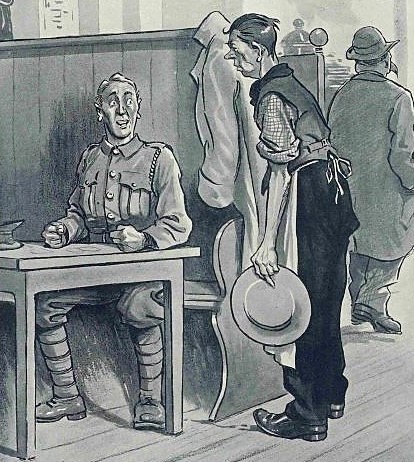
from army use on the Western Front during World War One: ‘cootie’, ‘body louse’, ‘cooty’, ‘infested with lice’, ‘coot’, ‘louse’, probably ultimately refer to the aquatic bird called ‘coot’, reputed to be lice-infested
early 20th century—‘Zeppelins in a cloud’ and variants mean ‘sausage and mash’—during World War One, the phrase was used as a manner of disregarding the fear caused by the bombing raids carried out by Zeppelin airships