
[A humble request: If you can, please donate to help me carry on tracing word histories. Thank you.]
The American-English phrase behind the eight ball means: stuck in a difficult situation, ‘snookered’.
The noun eight ball designates a version of pool played using a cue ball and fifteen numbered object balls consisting of a set of seven solid-coloured balls, a set of seven striped balls, and a black ball (numbered 8), the aim being to pocket each of the seven balls in one of the sets followed by the black ball.
The phrase behind the eight ball is derived from the situation in a game of eight ball in which the ball a player is trying to pocket is positioned in such a way that it cannot be pocketed without also pocketing the eight ball, thus losing the game.
Harold Hadley evoked that situation in Behind The Eight Ball, a short story published in the Daily News (New York City, New York, USA) of Wednesday 4th December 1929 [page 33, column 3]:
“Time for a game of pay ball,” said Tommy. “Fifty cents a ball. I’ll take the six and ten, you take the five and nine. All right?”
“Sure,” said James. “It’s a bet.”
They played. Quickly the balls were run down to the five, and Tommy’s last shot missed James’ five ball. If he sank this one, which stopped near a pocket, James was to win 50 cents. But when he set his cue between his thumb and fingers and took aim he saw a black ball between the cue ball and the five. He was behind the eight ball, and on the bank shot, he missed, Tommy sinking the five.
Ironically enough, when he was shooting at Tommy’s ball, again the eight ball was in the way, a sort of pool stymie.
James cursed and missed a bank shot. So the game went; when he was shooting for money, he was behind the eight ball.
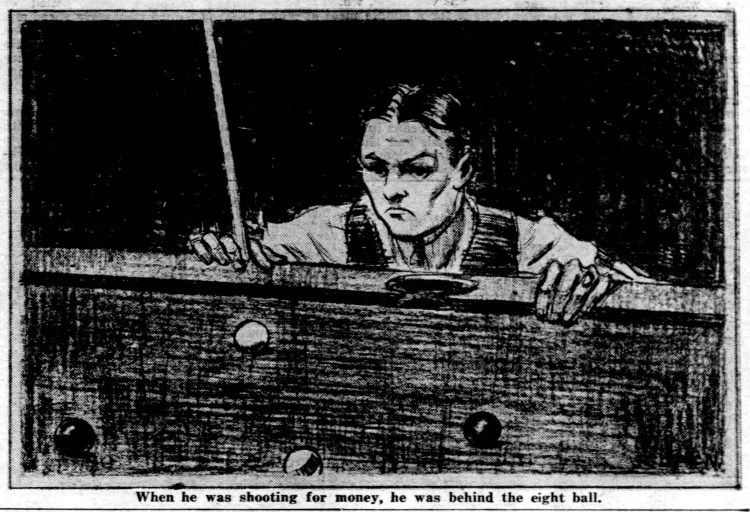
Illustration for Behind The Eight Ball—Daily News (New York City, New York, USA)—4th December 1929 [page 33]:
When he was shooting for money, he was behind the eight ball.
The earliest occurrences of the phrase behind the eight ball that I have found are as follows, in chronological order:
—Note: These early occurrences seem to indicate that this phrase originated in sports parlance in Buffalo, New York, USA:
1-: From Kansas’ Manager Predicts Rocky Will K. O. White. Buffalo Lightweight Leaves for New York for Important Battle, by Billy Kelly (1878-1954), sports editor of the Buffalo Courier (Buffalo, New York, USA), published in that newspaper on Thursday 8th February 1923 [page 9, column 4]—Rocky Kansas (Rocco Tozzo – 1893-1954) was an Italian-born U.S. boxer whose hometown was Buffalo; Charley White (Charles Anchowitz – 1891-1959) was a British-born U.S. boxer:
Rocky does not contemplate for a minute the possibility of losing.
“I can beat White; of that I am certain,” said Rocky as he boarded the train […]. “White will finish where the alleged smart critics of the east figure me to stop—behind the eight ball,” and Rocky smiled.
2-: From an account of the baseball match between Buffalo and Newark that took place in Buffalo on Sunday 6th May 1923—account published in the Buffalo Courier (Buffalo, New York, USA) of Monday 7th May 1923 [page 10, column 2]—Mickey Devine (1892-1937) was playing for Newark:
The Devine charges were so far behind the eight ball at this stage that they couldn’t even muster a single tally from the four hits.
3-: From one of the unconnected paragraphs making up The Daily Hammer: Only Daily Paper Using Macaroni Wireless Telegraph, edited by ‘K. N. Ocker’, published in the Buffalo Evening Times (Buffalo, New York, USA) of Tuesday 25th September 1923 [Sports section, page 10, column 7]:
If Charley Heinz doesn’t stop buying stocks he may wind up behind the eight ball.
4-: From the column Before and After, by Billy Kelly (1878-1954), sports editor of the Buffalo Courier (Buffalo, New York, USA), published in that newspaper on Monday 8th December 1924 [page 12, column 4]:
Christmas but seventeen days away, and most of us still seventeen miles behind the eight ball.
5-: From the column On “the Trail” of Sport, published in the Hamilton Evening Journal (Hamilton, Ohio, USA) of Thursday 19th August 1926 [Sport Page, unnumbered (page 10?), column 1]:
The Phillies ended their season up “behind the eight ball,” as the vulgar saying goes.
6-: From the sports column Runyon Says, by the U.S. journalist and short-story writer Damon Runyon (1880-1946), published in The Evening News (Harrisburg, Pennsylvania, USA) of Monday 18th October 1926 [page 19, column 4]—Aurelio Herrera (1876-1927) was a Mexican-born U.S. boxer:
Herrera was a tremendous hitter for a little man. He was a featherweight, and he gave Terrible Terry McGovern one of the hardest battles of his career. But Herrera was no hand for training, and he wound up behind the eight ball, as the boys say.

