
[A humble request: If you can, please donate to help me carry on tracing word histories. Thank you.]
The colloquial noun kangaroo-ship designates a ship designed to carry submarines and also to act as a floating dock for repairs.
This noun likens the submarines which are carried in such ships to the immature young which are nursed in the abdominal pouch of female kangaroos.
The noun kangaroo-ship occurs, for example, in a correspondence from Hamburg, Federal Republic of Germany, dated Wednesday 26th June 1957, by Omer Anderson, of the North American Newspaper Alliance, published in The Kansas City Times (Kansas City, Missouri, USA) of Thursday 27th June 1957 [page 14, columns 6 & 7]:
Russia is reported using its whaling fleet to help mask stepped-up Russian submarine activity in vital Western ocean defense areas.
Maritime circles here report that the Soviets are employing “kangaroo” ships to sneak submarines close to prowl areas.
The Soviet kangaroo ships are modified whaling factory ships which receive and launch submarines instead of taking in whale carcasses on a one-way trip to the cutting rooms and boiling vats.
Several such kangaroo ships have been observed by German and Norwegian whalers in Arctic and Antarctic waters in recent weeks.
Such mother ships do away with fuel and supply problems for snooping Soviet submarines on distant operations, and give the submarines an operating center.
These are, in chronological order, the earliest occurrences of the noun kangaroo-ship that I have found:
1-: From The San Francisco Examiner (San Francisco, California, USA) of Sunday 15th December 1912 [American Magazine Section, page 11, columns 1 to 7]—however, here, Kangaroo (with capital initial) is the ship’s name:
The New Kangaroo Ship—It Carries a Little One in it’s [sic] Pouch
Built for the French Navy to Solve the Difficult Problem of Carrying Submarines Across the Atlantic Ocean.
The Submarine Going Into the Kangaroo Ship.
The French have constructed an extraordinary ship for the purpose of transporting submarine boats.
It is called the Kangaroo, and is quite properly so called, for it carries a little boat in a pouch, ready to pop out at any time, just as the kangaroo does.
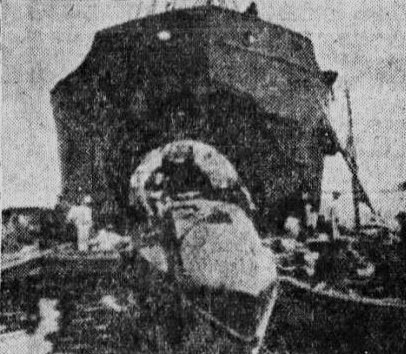
2-: From Telegrams, published in The Telegraph (Brisbane, Queensland, Australia) of Tuesday 7th October 1913 [page 7, column 5]—however, here, kangaroo (although with lower-case initial) is apparently the ship’s name:
KANGAROO SHIP.
An interesting vessel of a novel design has been launched at the port of St. Mandrier, in the south of France. It has been specially built for the Peruvian navy, and is designed to carry submarines across the ocean and also to act as a floating dock for repairs. It is called the kangaroo perhaps because it can carry a little one about with it in its pouch, as a kangaroo carries its young. Submarines can enter and leave the mother-ship, which sinks under water until its dock is filled, the water being subsequently pumped out until the mother-ship has again risen to her normal level.
3-: From a review of The Progress of Warship Engineering, an article by Charles Sells, published in the 1914 issue of the magazine Fighting Ships (London: Sampson Low, Marston and Co. Ltd.)—review published in The Globe (London, England) of Thursday 30th July 1914 [page 9, column 5]:
At the conclusion of his article Mr. Sells says:—“Efforts are being made to produce a highly efficient submarine of handy size, which can be carried to the desired place of combat and quickly launched on its deadly errand from a vessel suitably arranged for carrying as many as possible.” The possibility of this development has long been recognised, but has generally been regarded as impracticable; but there is no doubt that, should the real submarine “mother ship,” or “kangaroo ship,” ever materialise, the terrors of fleet actions at sea will be multiplied.
4-: From John Dene of Toronto: A Comedy of Whitehall (New York: George H. Doran Company, [1919]), by the British author and publisher Herbert George Jenkins (1876-1923) [chapter 2, page 34]:
“There’s one thing I must leave you to supply,” said John Dene […].
“And what is that?” asked Sir Bridgman.
“I shall want a ‘mother’——”
“A mother!” ejaculated Sir Lyster, looking from John Dene to the First Sea Lord, who laughed loudly. Sir Lyster always felt that Sir Bridgman should have left his laugh on the quarter-deck when he relinquished active command.
“A ‘mother,’” he explained, “is a kangaroo-ship, a dry-dock ship for salvage and repair of submarines.”
 word histories
Compare with another term for submarines, pigboat.
What is a Pigboat?
LikeLike
It seems that “Kanguroo” was in fact the official name of the French ship. https://en.wikipedia.org/wiki/SS_Kanguroo
LikeLike
Thank you but I’ve already mentioned it in my article.
LikeLiked by 1 person
Ah my apologies, I didn’t read carefully.
LikeLike