
[A humble request: If you can, please donate to help me carry on tracing word histories. Thank you.]
Of American-English origin, the expression mother-in-law seat designates an uncovered extra seat at the back or on the side of a two-seater motor car.
The following picture and explanations are from Auto Album, by Tad Burness, published in The Fresno Bee (Fresno, California, USA) of Saturday 29th August 2009 [page E3, columns 1 & 2]:
1909 SELDEN
Backseat passengers hung on with white knucklesHere’s a rakish antique roadster of 1909, complete with one of those infamous old “mother-in-law” seats that offered a minimum of safety and a maximum of danger.
These open-air, flimsy and completely hazardous rear seats eventually were replaced with rumble seats in the post-World War I era. And with the end of the 1930s, rumble seats were “out,” and five-passenger, two-door convertibles with all seats within the cab were “in.”
[…]
Who knows who coined the term “mother-in-law seat,” but it may have been someone who disliked his own mother-in-law and hoped she’d fall out when he took a fast corner!
Even more dangerous than that was the positively hazardous running-board seat, a skimpy little thing that folded out for use and hovered precariously above the running board, completely outside the car!
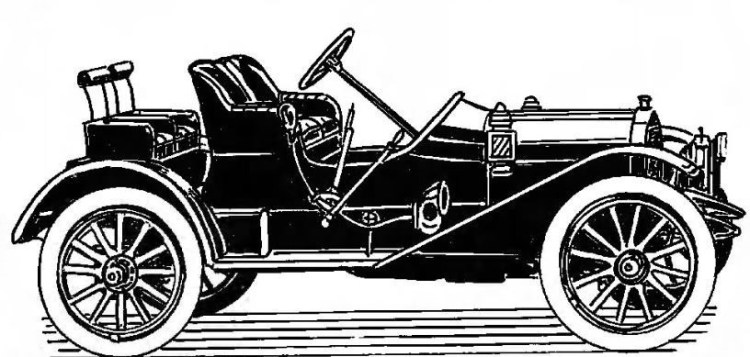
These are, in chronological order, the earliest occurrences of the expression mother-in-law seat that I have found:
1-: From the column Gossip and Personal Mention, published in the San Francisco Chronicle (San Francisco, California, USA) of Wednesday 14th August 1907 [page 6, column 4]:
“He came all the way in on the ‘mother-in-law seat,’ and dust—he was a sight!”
It was Leon Roos talking.
“And what in the world,” inquired a bystander, “is the ‘mother-in-law seat?’ That’s a new one on me.”
“The ‘mother-in-law,’” explained Roos, “is the little single seat perched out behind. All high-class runabouts have ’em.”
“But where did they get that name?”
“Oh, there are really two names for the seat. During the courtship days it’s called the ‘chaperon seat,’ and after the wedding it’s called the ‘mother-in-law seat.’ One ride in one is enough!”
2-: From the column Grave to Gay, published in the Buffalo Evening News (Buffalo, New York, USA) of Monday 14th September 1908 [page 2, column 3]:
THANKS to the New Haven Union—though they have offended us in the past—for calling the “rumble” attachment to the gasoline runabout “the mother-in-law seat.”
3-: From an account of the opening of the 7th Automobile Show, held in Convention Hall, Buffalo, published in the Buffalo Courier (Buffalo, New York, USA) of Tuesday 2nd March 1909 [page 6, column 5]—“a suitable occupant for the left-hand seat” refers to the passenger, the motor car in question being a right-hand drive model:
Many cars are attracting unusual attention. A Stoddard-Dayton runabout, with rumble seat is finished in baby blue with white enameled upholstery. For a bridal trip it would be the car de luxe, and the sales force are endeavoring to outdo each other in finding a suitable occupant for the left-hand seat. They are all agreed, however, that the mother-in-law seat behind must be left off. The paint is very serviceable and will withstand washing and cleansing very well.
4-: From The Dayton Herald (Dayton, Ohio, USA) of Wednesday 3rd August 1910 [page 9, column 1]:
New Auto Appears With “Mother-in-Law” Seat.
“Mother-in-law” seats in the automobile, is the latest novelty for the Dayton motorist.
A very fine Stearns car was seen on the streets here Wednesday which was equipped, in addition to the regular seats, with a small, portable seat resting on the running board or side step of the car. In large red letters, corresponding to the monogram of the owner on the body of the car were inscribed the words, “Mother-in-law seat.”
The name of the owner of the car is not known. His license number, however, is 26,481.
5-: From The Buffalo Commercial (Buffalo, New York, USA) of Thursday 8th December 1910 [page 7, column 7]:
THE CHESTNUT BLIGHT.
There is an automobile circulating about Philadelphia streets which has, beside the driver’s seat, a ridiculous little seat, way off to one side, so placed as effectively to preclude conversation between its occupants and others in the car. On it, in large letters appears this:
“Mother-in-law seat.”—Phila. Ledger.
 word histories
A very interesting article about mother-in-law’s chairs, cushion and the like.
Are you familiar with the concept of mother-in-law door, a very common expression in Newfoundland where I live. Often when a house is newly constructed there are no steps to the front door. The excuse used for this is the house needs to settle first. However, years go by and no steps are built! This front door is now called a mother-in-law door!
The French have a similar concept but the name escapes me now.
Regards,
Stan.
LikeLike
Thank you!
The phrase “mother-in-law door” is new to me. But I don’t understand the reference to the mother-in-law.
All the best,
Pascal.
LikeLike