
[A humble request: If you can, please donate to help me carry on tracing word histories. Thank you.]
Of American-English origin, the expression silent policeman, also silent cop, designates a small structure placed at the centre of a road junction which allows vehicles travelling in different directions to cross the junction safely at the same time by driving around the device in the same direction.
—Cf. also the expression sleeping policeman, which designates a raised band across a road, designed to make motorists reduce their speed.
—Preliminary note: The expression silent policeman has occasionally been used to designate any object designed as, or used as, a road-safety device—these are two examples:
1-: From The Evening Tribune (Des Moines, Iowa, USA) of Monday 7th April 1913 [page 3, column 3]—F. N. Carss was a city engineer at Des Moines:
Carss recommends the adoption of the safety system for pedestrians in service at Kansas City. It consist [sic] of a red light located at the intersection of streets, which, he says, are silent policemen, prevent speeding and regulate traffic.
2-: From The North Devon Herald and General Advertiser for Devonshire, East Cornwall and West Somerset (Barnstaple, Devon, England) of Thursday 26th June 1913 [page 5, column 6]:
Many inhabitants of Braunton are rather concerned to hear that there is a possibility of the splendid old tree which has stood in the Square for over 250 years being taken down as it is considered to be dangerous to the neighbouring houses […]. Braunton looks upon the old Cross Tree, which has served the purpose of the “village pump” for so many years—all open-air social events being held there—as an old friend and neighbour. Standing at the centre of the four cross-roads, it has served as a ”silent policeman,” and has undoubtedly prevented many accidents.
These are, in chronological order, the earliest occurrences that I have found of the expression silent policeman used in the sense of a small structure placed at the centre of a road junction:
1-: From Automobile and Buggy Collide—Upland Woman Thrown Onto Pavement, published in The Pomona Progress (Pomona, California, USA) of Wednesday 4th June 1913 [page 1, column 5]:
The buggy driven by the Upland man was crossing Garey avenue, going east; the auto was crossing Second street going south. Both were on the proper side of the street but near the “silent policeman,” (the white spot) when the collision occurred.
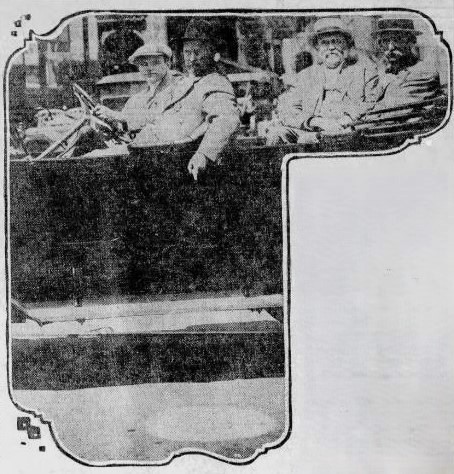
2-: From the Daily Tribune (Los Angeles, California, USA) of Friday 1st August 1913 [page 12, columns 4 & 5]:
‘SILENT POLICEMEN’ ARE SUCCESS
POMONA CHECKS STREET MISHAPSAUTO ABOUT TO MAKE TURN AROUND “SILENT POLICEMAN” IN POMONA
Reading left to right—Front seat—Chief of Police H. P. Tracy, pointing to “white spot.” Rear seat—Police Judge J. A. Gallup and Mayor W. A. Vandergrift of Pomona.
Inanimate Traffic Officers Prevent Accidents at Busy Corners
[Special to The Tribune]POMONA, July 30.—Since “silent policemen” were installed in Pomona’s busiest business streets six months ago there has not been an accident due to short cutting of corners by automobiles.
This unique device, the idea of Chief of Police H. P. Tracy of this city, is an eighteen-inch white disc placed on a post in the center of a street intersection. All automobiles must go around, not cut across in front of this “silent policeman.”
The city council passed an ordinance making offenders subject to arrest and fine and a possible jail sentence. In addition to relieving traffic congestion, the “silent policemen” of Pomona have eliminated collisions, which occurred frequently before their installation.
That the warning of the white spots may be ever present, the discs are repainted every two months. They are having a salutary effect on drivers who used to cut corners. The only ones who do so now are strangers motoring through Pomona.
3-: From an account of the meeting of the Belvidere City Council held on Monday 1st June 1914, published in The Belvidere Apollo (Belvidere, New Jersey, USA) of Thursday 4th June 1914 [page 4, column 2]:
On motion it was ordered that council purchase four silent policemen for Mansfield and Front streets, Mill and Greenwich streets, Water and Market streets, and Water and Prospect streets.
4-: From the Fitchburg Daily Sentinel (Fitchburg, Massachusetts, USA) of Friday 10th July 1914 [page 5, column 2]—this text also contains the earliest occurrence that I have found of the synonymous expression silent cop, as well as the expression dumb policeman:
Silent Policeman to do Duty in Monument Square.
Supt. of Streets A. M. Jackson will soon make a valuable contribution to the Leominster police force. His offering will be a silent policeman which will be set up in position at the intersection of Main, Mechanic and West streets in Monument square.
The silent policeman as constructed by Supt. Jackson consists of a soild [sic] slab of cement in which is set an iron pole, about six feet high. On this pole, near the top, will be set cross arms, six inches wide and two and one half feet long, bearing the inscriptions which will direct the traffic.
At this point in Monument square the traffic congestion is always the worst, and the silent policeman is expected to do yeoman duty in keeping the teamsters and chauffeus [sic] in their proper positions. As nearly as can be learned by Mr. Jackson the silent policeman originated in Baltimore. Concord gleaned the idea from Baltimore and in the former city Mr. Jackson saw a couple of the dumb policemen performing the duties of a traffic officer. After watching the results for a time he was convinced that one of the policemen would be a valuable addition to the Leominster force.
As soon as the cross arms are obtained from the paint shop they will be fastened in place and the silent cop will be placed on duty.
 word histories