
[A humble request: If you can, please donate to help me carry on tracing word histories. Thank you.]
The expression mechanical bull now designates an apparatus that simulates the experience of riding on the back of a bucking animal.
But, originally, this expression designated a mechanised full-size model of a bull, simulating the movement and behaviour of a bull (particularly in a corrida), used in public entertainments.
These are the earliest occurrences of the expression mechanical bull that I have found, in chronological order:
1-: From a correspondence from Paris, France, dated Sunday 2nd May 1869, published in The Daily Telegraph (London, England) of Tuesday 4th May 1869 [page 5, column 2]—here, the expression mechanical bull seems to designate a hypothetical mechanised model of a bull:
Do you wish to hear the last thing in velocipedes? They are to be introduced by the new Government of Spain into the bull-ring. At the next corrida de toros velocipedes are to be used instead of horses, and the arena will run with oil out of wheels instead of life-blood out of bodies. To be sure, to carry out humanity to its real end, you must also have a mechanical bull; but they have forgotten that; yet no doubt they will remember it before the velocipede is presented to indignant Madrid. Imagine rendering a bull-fight in Spain a mere thing of springs and hinges! I will not even look at Madrid or Seville. Just try the thing in any small town in the South of Spain, and revolution would follow humanity. It is not that the bull is the enemy of the Spaniard; no, he is the only friend who “takes him out on a Sunday.”
2-: From a review of Yakie, a stage play by the U.S. journalist and humorist Charles Bertrand Lewis (1842-1924)—review by ‘Cherub’, published in the column Cherub’s Chat, in the St. Louis Post-Dispatch (St. Louis, Missouri, USA) of Saturday 20th October 1883 [page 9, column 2]:
The play calls for fine scenery. There are several good mechanical effects in it, notably a snowstorm, real horses and sleigh, and a mechanical bull. A large live dog is a feature.
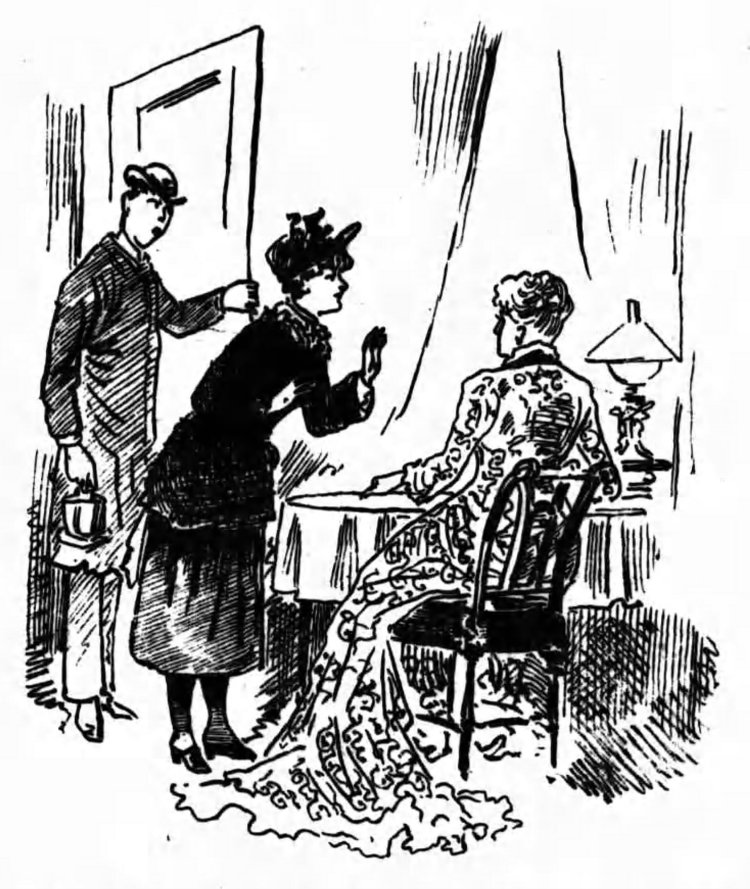
3-: From the caption to the following cartoon, published in The Queensland Figaro (Brisbane, Queensland, Australia) of Saturday 9th January 1886 [page 65, column 2]:
THE DRAMA OF THE DAY.
Jennie (just home from the theatre): “Oh, mamma, dear, it was such a lovely comedy—two revolving houses, and three men falling out of windows, and a mechanical bull that tossed people, oh, so nicely, and a real genuine dynamite explosion. O mamma, I do so love comedy!”
4-: From the following advertisement, published in The Norwich Mercury (Norwich, Norfolk, England) of Saturday 27th April 1889 [page 1, column 5]:
HENGLERS’ GRAND CIRQUE,
AGRICULTURAL HALL, NORWICH.
This (FRIDAY) Evening,
Sixth representation of the New and Original Grand Spectacle, entitled—
A SPANISH BULL FIGHT,
Vividly Portraying
SPANISH SCENES AND COSTUMES.
SPANISH MUSIC. SPANISH DANCES.
MAGNIFICENT COSTUMES!
SCREAMINGLY FUNNY INCIDENTS!!
A NOVELTY WITHOUT PRECEDENT!!!Scene I.—A FETE DAY in SEVILLE.
Scene II. —EN ROUTE to the BULL RING.
SCENE III.—THE BULL RING.
Procession of TORREROS (Espada Bandilleros, Picadors, Monos Sabios, &c.)THE BULL FIGHT,
In Two Parts.Special Notice.—The Laws of our Country rightly forbid the cruelty of torturing and killing the beast, therefore in Part I. an Exact Representation of the Spanish Bull Fight will be given with a MECHANICAL BULL, graphically depicting the modus operandi of “attacking,” “annoying,” “torturing,” “infuriating,” and finally “killing” the animal; while in Part II. a
REAL BULL
will be introduced, and some of the exciting scenes of Spain’s National Sport (WITHOUT CRUELTY to the animal and with slight dangers to the Bull Fighters) will be portrayed. GRAND FINALE.
Notice.—ln order to prevent any possibility of danger to the audience during the Bull Fight the Arena will be surrounded with Iron Fencing, 8ft. high.
 word histories