
MEANING
The Australian-English phrase molly the monk (and its abbreviated form molly) is rhyming slang for drunk (i.e., intoxicated with alcohol).
This phrase occurred, for example, in the column Spy, by Lawrence Money, published in The Age (Melbourne, Victoria, Australia) of Sunday 10th September 2000 [page 18, column 5]:
Express check-out
SMALL problem at Marriner’s Westin Hotel. There’s a guy on the fifth floor saying he can’t get into his room. They check his name: you do not appear to be registered, sir. He says it might be under another name: that’s not registered either, sir. They bring him down to reception. That was when they discovered he was molly the monk. Actually, his room is at the Windsor.
ORIGIN?
This phrase may have originally alluded to Molly the Monk, the name given in Australia to various primates kept in captivity or used for entertainment—here, monk is the abbreviation of the noun monkey, used loosely in the sense of any primate except man.
This name was given, for example, to a monkey that was kept in Melbourne’s Zoo in the early 20th century; the following is from The Sun News-Pictorial (Melbourne, Victoria, Australia) of Thursday 6th September 1923 [No. 308, page 11, column 5]—Mr. Wilkie was the director of Melbourne’s Zoo:
Sydney’s Zoo expert (Mr. Le Seouf) is in Melbourne. Molly the Monk faced him yesterday, but she would not have been so sociable had not her great friend, Mr. Wilkie, been present.
[…]
Molly is the oldest of her tribe in captivity, having been under Mr. Wilkie’s care for 23 years. She arrived at the Zoo at the mewling age of 12 months and is now an elderly woman of 24.
The name Molly the Monk was also given to a female orang-outang used for entertainment in Australia in the second half of the 1920s. The following, for example, is from The Geraldton Express (Geraldton, Western Australia, Australia) of Monday 14th February 1927 [Vol. 48, page 2, column 6]:
Molly the Monk.
Molly the human Ourang-Outang, is the only performing Ourang-Outang ever known in Australasia. Molly was torn from the arms of her mother in the dense jungle of Borneo by big game hunter Ellis S. Josephs, just as an enormous python crushed the life out of the mother ape. Molly has been reared and educated like a human being. She possesses the latest Eton crop as executed by Eugene Ossian, famed for ladies’ tonsorial effects. As a trapeze artist she emulates the celebrated Flying Jordans, and, like all modern ladies, she smokes with gusto. Molly comes to Geraldton with the World’s Entertainers, a troop of acrobats and Indian Entertainers, and will appear at the King’s on Friday and Saturday next.
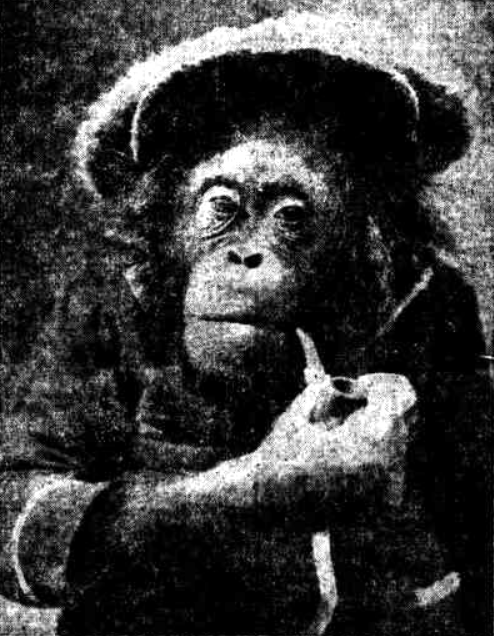
The following photograph of Molly the Monk is from The Westralian Worker (Perth, Western Australia, Australia) of Friday 31st December 1926 [No. 1,056, page 7, column 3]:
“MOLLY THE MONK.”
A performing ourang-outang, which is to be seen at Uglieland nightly.
And Molly the Monk was the name given to a toy in an advertisement for M. W. Malkin, Pharmaceutical Chemist, published in The Weekly Times (Melbourne, Victoria, Australia) of Wednesday 27th October 1954 [No. 4,453, page 59, column 2]:
For Baby! RUBBER ANIMALS. Percy Pig, Pedro the Donkey, Abdul the Bull, Aubrey the Rabbit, Freddie the Fox, Mollie the Monk, 8/6 ea.
EARLY OCCURRENCES
The earliest occurrences that I have found of the rhyming-slang phrase molly the monk (and of its abbreviated form molly) are as follows, in chronological order:
1-: From The slang we hoisted and then improved, by Neil Appleford, published in The Argus (Melbourne, Victoria, Australia) of Friday 13th June 1952 [No. 33,003; Magazine: page 4, column 2]:
Australian rhyming slang [is] a form of slang which was originated by London’s cockneys, but which has been developed out of all recognition in Australia.
[…]
Why has rhyming slang become such an integral part of Australianese?
It haunts a man from the time he gets out of bed in the morning.
[…]
For instance, after work he probably joins a few friends for a drop of refreshment.
If, however, he consumes too much “pig’s ear” or “thick and thin,” he may finish up “mollies” or “elephants.”
Now, these latter expressions bring us to one of the most remarkable features of the idiom.
They are, so to speak, corruptions of corruptions.
Like many other frequently used examples of rhyming slang, they have been abbreviated or contracted from their original—“mollies” from “mollie the monk,” “elephants” from “elephant’s trunk.”
2-: From King’s Cross Whisper (Sydney, New South Wales, Australia)—as quoted in Australian Words and their Origins (Melbourne: Oxford University Press, 1989), edited by Joan Hughes [page 340, column 1]:
1966 [xxvi. 6/1]: Now the basic type of booze . . and that which induces the most popular result (gets you molly the monk) is—wait for it—beer.
3-: From The Australian Jewish News (Melbourne, Victoria, Australia) of Friday 30th July 1971 [Vol. 37, No. 44, page 4, column 4]:
Dining out recently we heard a client ask for a “Chatter of Please.”
Just as well he didn’t want a “Wass of Glater” or a “Bot of Peer.”
Must have been a bit “Molly the monk”?
4-: From King’s Cross Whisper (Sydney, New South Wales, Australia)—as quoted in Australian Words and their Origins (Melbourne: Oxford University Press, 1989), edited by Joan Hughes [page 340, column 1]:
1973 [cliv. 2/4]: Ophelia was more than a little bit Molly the Monk after Parkinson had been loosening her up a bit with three bottles of Quelltaler hock.
 word histories