
Of American-English origin, the phrase the buck stops here, also the buck-passing stops here, means: the final responsibility lies with a particular person.
In this phrase, the noun buck, of unknown origin, designates, in the game of poker, any object in the jackpot to remind the winner of some obligation when his or her turn comes to deal—hence the phrase to pass the buck, used figuratively in the sense: to pass to someone else a responsibility that one should properly take oneself.
—British-English synonym: to pass the parcel.
The metaphor of a point at which the buck-passing must stop (i.e., a point at which someone must take responsibility) existed before the phrase the buck(-passing) stops here itself first appeared.—The following are four texts in which this metaphor occurred:
1-: From the account of a meeting between James Rolph Jr. (1869-1934), Mayor of San Francisco, and the members of the Board of Public Works, published in the San Francisco Chronicle (San Francisco, California, USA) of Thursday 1st August 1912 [page 4, column 2]:
Supervisor A. H. Giannini of the Streets Committee declared that members of that committee had been doing the work of inspectors in many cases themselves.
“We have had to hold up work time and again to get the contractors to do the work properly. At various points where the high-pressure pipes were laid we had to ring up the contractors after the pipes had been laid to get the trenches filled and the streets put to shape. The Engineering department inspectors should have done that work, not the members of the Streets committee.”
“I am going to see that this ‘passing the buck’ stops,” said Mayor Rolph.
2-: From an article about Captain James T. Scott, of Atlanta, who was in charge of G-4 for base section number one, in St. Nazaire, France—article by Ward Greene, The Atlanta Journal’s staff correspondent, published in The Atlanta Journal (Atlanta, Georgia, USA) of Sunday 9th March 1919 [page 7, column 2]:
G-4 is the army term for the coordination department, and the coordination department, as the word indicates, is the balance wheel between all other departments, the clearing-house for all the difficulties and troubles that arise over this question and that, in the matter of transportation, labor and all the multitudinous activities going on in a base section.
Another way to put it is to say that G-4 is the terminus of the buck. Passing the buck, as everybody knows, is the greatest indoor sport in the American army. The colonel passes it to the major, the major passes it to the captain, the captain shoves it along to the lieutenant, and the loot shifts it to the top-cutter. The cutter then bucks it on to the next man and so on down the line, until it reaches the acting private, who starts passing it back again. Going in the other direction, the buck has been known to reach heights that are better unmentioned. But when it gets to G-4 the buck stops. No matter how buckish it is, G-4 has got to do something with it. And it takes a mighty good G-4 to handle most of the bucks that are passed in his direction.
3-: From the column Lowdown on Sports, by Charles Johnson, published in the Minneapolis Daily Star (Minneapolis, Minnesota, USA) of Tuesday 26th July 1927 [page 10, column 3]:
The usually disgruntled public was pretty sick of the boxing game in general after it had poured more than a million dollars into the laps of Jack Dempsey, Jack Sharkey and Tex Rickard last Thursday night. A couple of more millions changed hands on the outcome of the scrap. When it was all over the public was loser and the only one. As usual, it looked around for some one to blame.
The newspapers and critics came in for a major share of the criticism. Those who spent as high as $100 for a ringside seat and then had some one in front of him stand up just as Dempsey wielded the knockout blow were especially peevish at every one. The gamblers and ordinary folks who just bet for the fun they get out of it were sore when their man lost.
Now where the newspapers and writers got their worst razz is for giving fighters so much publicity that these million dollar purses are made possible. Then the critics catch it because they liked a certain fighter and booted their guess. The public rides the writers and that’s where the buck passing stops.
4-: From The Seattle Daily Times (Seattle, Washington, USA) of Friday 16th September 1927 [page 34, column 1]:
“Buck-Passing” Stops; Judge Orders Hearing
Federal Judge George M. Bourquin refuses to take hazards which attorneys of litigants dodge. He so informed lawyers representing the American Can Company and the Seattle Can Company yesterday.
An order striking from the calendar the suit of the American company against the Seattle concern was presented to the court for signature. The case was set for trial September 16, but by written stipulation, legal representatives of the litigants asked that the assignment be stricken “subject to reinstatement within one year.”
In his bold flowing handwriting Judge Bourquin wrote across the bottom of the order:
“Denied.
The case is set on sufficient notice. The court has the time now to try it, may not later, and the business of the court requires it shall be disposed of now. If the parties are assured of settlement of their difference they can dismiss the case and still settle. The court will not take hazards they will not.”
The earliest occurrences of the phrase the buck stops here, also the buck-passing stops here, that I have found are as follows, in chronological order:
1-: From the column I May Be Wrong, by John Bentley, published in the Evening State Journal (Lincoln, Nebraska, USA) of Wednesday 2nd October 1929 [page 13, column 1]:
John “Jug” Brown, manager of the Husker football team, with head in hands, moaning over fact that his associates and himself take all the grief without so much as an agate line in the daily prints. . . . It’s not hard to hit the eight-point type when you cultivate the right people, Jug. . . Capt. Joe Lehman tells a story that Jug should hear. . . . It’s about the second lieutenant in the war department whose desk was back in the corner among the boxes and barrels. . . . Above this desk the second looey had placed a card which read: “The buck stops here” . . . and he didn’t mean buck private.
2-: From Builders Beat Contract Dates at Badger Powder Plant, by Harold E. McClelland, State Journal State Editor, published in The Wisconsin State Journal (Madison, Wisconsin, USA) of Sunday 26th April 1942 [page 4, column 1]:
“Time is Short, Let Us Work,” say the signs at army headquarters at Baraboo, where Capt. Spencer Z. Hilliard, adjutant, issues the press passes. Prize sign, however, also above his desk, is—
“The buck stops here.”
There’s no buck passing in evidence at the plant site, however, for every contractor we met told his story of beating schedules, setting up tough goals only to knock ’em down ahead of time.
3-: From Col. Warfield Is Ranking Officer Here, by Irvine Sprague, published in the Stockton Daily Evening Record (Stockton, California, USA) of Wednesday 2nd September 1942 [page 13, column 5]:
“Action”—his motto and his record.
There you have Col. A. B. Warfield, veteran of 43 years’ army service, a Wold [sic] War hero, highest ranking officer In the Stockton area, and commandant of the new Lathrop Holding and Reconsignment Depot.
A well used and battered sign rests on the colonel’s desk to announce his philosophy to all visitors. The sign reads “The buck stops here.”
He explained that he has discovered if someone comes to you for help, telling them to “go see so and so” won’t do much good. “I always do what I can to help and don’t pass the buck,” said the colonel.
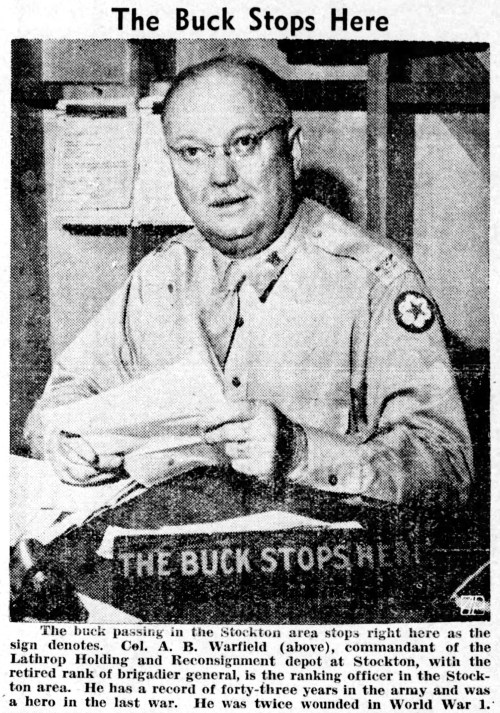
4-: From the title of the following photograph, published in the Supplement to the Reno Evening Gazette (Reno, Nevada, USA) of Thursday 1st October 1942 [page 19? (unnumbered), column 2]:
The Buck Stops Here
The buck passing in the Stockton area stops right here as the sign denotes. Col. A. B. Warfield (above), commandant of the Lathrop Holding and Reconsignment depot at Stockton, with the retired rank of brigadier general, is the ranking officer in the Stockton area. He has a record of forty-three years in the army and was a hero in the last war. He was twice wounded in World War 1.
5-: From the Stockton Daily Evening Record (Stockton, California, USA) of Tuesday 27th October 1942 [page 9, column 7]:
Col. Warfield Will Talk to Rotary
Col. A. B. Warfield, commandant of the Lathrop Holding and Reconsignment Depot, will address the Rotary Club tomorrow noon at Hotel Stockton.
Col. “The Buck Stops Here” Warfield is a veteran of 43 years in the army. Entering the service in 1898 as a private he made his way to the rank of brigadier general before retiring. He returned to active service this year as a colonel, requesting the local station in order to be near his daughter, the wife of Col. Lloyd Tull, Stockton Field.
6-: From the column Pull Up a Chair, by Elaine Brandstad, published in the Stockton Daily Evening Record (Stockton, California, USA) of Saturday 2nd January 1943 [page 5, column 6]:
OVERHEARD—Two prominent business men talking after a recent meeting.
First Man: “What have they done about the housing situation in Stockton?”
Second Man: “I haven’t heard of anything being accomplished. Why?”
First Man: “Well then, they ought to get someone like ‘The Buck Stops Here’ Warfield to take charge so that something will be done.”
7-: From a story by the Associated Press, published in several newspapers on Thursday 25th November 1943—for example in The Evening Star (Washington, District of Columbia, USA) [page B-2, column 2]:
Capt. Clifford M. Alexander has real hate for both buck passing and paper work.
Sitting behind a desk at headquarters of the Fourth Service Command on which there is a sign proclaiming, “the buck stops here,” the captain recalled the building of a prisoner-of-war camp from kitchen to barracks in a single day.
He is fond of a once little-used Army regulation which provides for the trading-in of an unserviceable article for a new one “when accompanied by a certificate of fair wear and tear,” but which permits the necessary details of paper work to be handled afterward.
He recalled that the Command’s supplies section, of which he is executive officer, received notice that a contingent of war prisoners would arrive the next day at a place where there was no camp. On verbal orders—not a single paper was signed—the camp was completely equipped and smoke was rolling out of the kitchen chimney when the prisoners arrived.
Now known as the Army Exchange System, the idea of using the authority of the trade-in regulation was put to work at Camp Shelby, Miss., where Capt. Alexander was stationed before his transfer here, he said, and since has spread to all Army forces.
The captain, who enlisted in the Army at San Diego, Calif., in 1924, now directs the distribution of food, clothing and other equipment to troops training in the Southeast.
8-: From Censorship Hits Truax Library, published in The Wisconsin State Journal (Madison, Wisconsin, USA) of Sunday 18th June 1944 [page 3, column 1]:
GI Joes of Truax Field won’t be able to find all of the magazines they formerly chose in the field’s library.
Congress has required censorship of the reading matter which the government supplies for the armed forces to prevent “pernicious political activities.”
[…]
[…] The State Journal inquired of Truax authorities for the reason behind the withdrawal of these publications. The inquiry was referred to the Sixth service command at Chicago, and Chicago referred it to Washington for authoritative comment.
That, of course, is “the old army game.” But we couldn’t blame any of the officers along the way for “passing, the buck” back to Washington where it originated. How would you feel if you were in their place and under the threat of heavy fine or prolonged imprisonment in case you were responsible for allowing the distribution of any publication “containing political argument or political propaganda of any kind designed or calculated to affect the result of any election” for president or member of congress? Probably you would shut the boys in their barracks without a scrap of printed matter, and say, “Don’t peek.” That would be playing it safe.
We saw an adjutant in the army once who had a sign above his desk, “The buck stops here.” It probably was correct, and all the unwanted tasks from higher up that could be passed on eventually reached him. And so the special service division of the army with headquarters in Washington and New York has undertaken to handle this problem of censorship.
9-: From Roundup of State News, published in The Casper Tribune-Herald (Casper, Wyoming, USA) of Friday 24th August 1945 [page 5, column 2]:
Governor Doesn’t Like Buck Passing
CHEYENNE—A neat, new sign stands on the desk of Gov. Lester C. Hunt. It reads: “The Buck Stops Here.”
10-: From the column Washington Merry-Go-Round, by Drew Pearson (1897-1969), published in several newspapers on Sunday 21st October 1945—for example in The Bradenton Herald (Bradenton, Florida, USA) [page 4, column 3]:
President Truman’s * desk is slowly getting littered up with the same kind of gadgets that cluttered the desk of the late President. One Truman favorite is a sign saying “Scram,” used for signaling the end of a Presidential conference. The same sign says “Yes” or “No” at a twirl of the Presidential forefinger.
Recently Truman, who knows how much White House visitors like souvenirs, has been giving out clips of matches marked, “Swiped from Harry S. Truman.” These have been going like hot cakes. However, Truman’s latest gadget indicates the new determination of the new Chief Executive to speed Government efficiency. It’s a little wooden sign saying, “The buck-passing stops here.”
* The U.S. Democratic statesman Harry S. Truman (1884-1972) was the 33rd President of the USA from 1945 to 1953; he succeeded Franklin Delano Roosevelt (1882-1945), 32nd President of the USA from 1933 to 1945.
 word histories