
The colloquial expression checkout chick designates a female employee who works at a supermarket checkout counter—here, the noun chick designates a young woman.
But, with changes in the gender makeup of the supermarket workforce, the expression checkout chick is also occasionally applied to males. The following, for example, is from Jobs for the Boys, by Julie Delvecchio, published in The Sydney Morning Herald (Sydney, New South Wales, Australia) of Thursday 21st July 1994:
Titles don’t concern Martin Stenning. He works as a checkout operator at a Jewel supermarket at Castlecrag and, in case you’re wondering, he doesn’t mind being called a checkout chick. In fact, he’s a fan of the term.
“I’ve grown up with the term ‘checkout chick’ so it doesn’t bother me,” Stenning says. “Customers like it, they laugh sometimes, especially when there are guys on register.”
The earliest occurrences of the expression checkout chick that I have found are as follows, in chronological order:
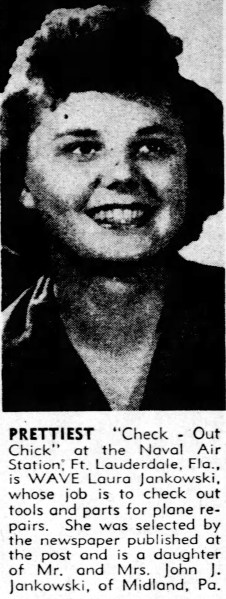
1-: From the caption to the following photograph, published in The Pittsburgh Press (Pittsburgh, Pennsylvania, USA) of Friday 14th July 1944—however, here, the expression checkout chick designates a woman who “check[s] out tools and parts for plane repairs” on a naval air station:
PRETTIEST “Check-Out Chick” at the Naval Air Station, Ft. Lauderdale, Fla., is WAVE Laura Jankowski, whose job is to check out tools and parts for plane repairs. She was selected by the newspaper published at the post and is a daughter of Mr. and Mrs. John J. Jankowski, of Midland, Pa.
2 & 3-: From advertisements for Sparkle Super Markets, published in the Pittsburgh Sun-Telegraph (Pittsburgh, Pennsylvania, USA):
2-: Of Wednesday 26th January 1949:
CHECK-OUT CHICKS—you’re the last smile the customer gets as she steps out of a Sparkle Market . . . so make it a good one . . . help in every way you can . . . with wrapping packages . . . supplying information . . . even diapering the baby if necessary . . . and when you ring that register . . . let it register with our customers that we appreciate their business as much as they appreciate Sparkle savings . . . and let them know that all Sparkle prices are low like the items below . . . and that they stay low every day.
Illustration from the advertisement for Sparkle Super Markets, published in the Pittsburgh Sun-Telegraph (Pittsburgh, Pennsylvania, USA) of Wednesday 26th January 1949:

3-: Of Wednesday 21st September 1949:
NO MISTAKES
NO SHORTS
NO ERRORS
Our “Checkout Chicks” Bat 100%
We threw a lot of curves at you gals in the past few weeks . . . inspectors checked every store . . . bought large amounts . . . fussed and fumed at you when checking out with their purchases . . . deliberately tried to distract your attention . . . but, you all kept your smiles . . . and what’s even better . . . not a single check-out gal made a single, solitary mistake . . . we’re very proud of that record . . . it took years of training and it paid off . . . now we’re more than sure that no customer need fear any mistakes, shorts, or errors at Sparkle . . . we know that our check-out gals will never miss.
4-: From an advertisement for Wegmans Super Markets, published in the Democrat and Chronicle (Rochester, New York, USA) of Wednesday 5th March 1969:
Congratulations to Patricia DePauw
OF WEGMANS NEWARK MARKET, OUR
“Checker of The Year”
GRAND PRIZE WINNER FROM AMONG WEGMANS 460 CHECKOUT CHICKS

5-: From the Dayton Daily News (Dayton, Ohio, USA) of Tuesday 18th March 1969:
Overheard at a Liberal Market (Salem near Grand) checkout lane Sunday afternoon, Bonnie Johnson, cute checkout chick, was assisting a check-writing customer who wanted to know the correct date.
Bonnie, sort of musing to herself: “Let’s see . . . yesterday was the Ides of March . . . that makes today the 16th of March.”
The customer dated, and finished, the check without thanking Bonnie for the brief refresher course in Roman history and Shakespeare’s “Julilus [sic] Caesar.”
I’d call it “a Liberal education.”
6-: From The Forecast: A Blizzard in the Supermarket, by Anne Christmas, published in The Evening Star (Washington, District of Columbia, USA) of Wednesday 7th January 1970:
It is only 11 a.m. or so, the snow is advertised for a slow start around 3 p.m. But the womanhood of suburbia is ready for the worst.
The local supermarket, usually a haven of tranquillity at this hour, resembles the day before Thanksgiving.
They’re all there, trudging along with overladen carts, grabbing at the large eggs (85 cents a dozen) and the bread and the ketchup and the hot dogs. All those staples, that’s what they need.
“Look at them,” sighs the check-out chick. “I’ll bet every single one of them already has enough food at home to last her family all winter. But they hear about snow coming, so they rush in here and buy five times more than they’ll ever need.”
The earliest Australian-English uses of the expression checkout chick that I have found refer to the second season of The Norman Gunston Show, broadcast on ABC TV in 1975. (Norman Gunston was a satirical television character interpreted by the Australian comedian Garry McDonald (born 1948).)
The second season of The Norman Gunston Show featured a recurring segment called Checkout Chicks, set in a supermarket, which parodied Australian television soap operas such as Number 96.
The earliest occurrence of the expression checkout chick that I have found in Australian English is from the review of The Norman Gunston Show, by Sandra Hall, published in The Bulletin (Sydney, New South Wales, Australia) of Saturday 15th November 1975:
What Norman and team have done to Tonight shows is almost matched by their rape of Number 96, cliche by cliche, in the Checkout Chicks segment.
Number 96, I had always imagined, made life as compact as it could ever get: More than most people can accommodate in action, dreams and/or fantasies in seven flats, a wine bar, a laundrette, a delicatessen and the most deadly flight of stairs in the world. Yet in its first five-minute episode, Checkout Chicks made its parent seem as verbose as Bellbird, as passe as Certain Women.
It doesn’t bother with characters. Nor does it need to when its cast comes equipped with so many ready-made associations.
The best thing about it is the neatness of the metaphor: the checkouts are Number 96’s stairway suddenly given six lanes—the world as supermarket. It’s such sour irony for Number 96 abruptly rendered into shorthand at a time when it can least afford the indignity.
The following is from Norman G’s silent partner, an interview of Bill Harding (born 1949), by Robert Drewe, published in The Bulletin (Sydney, New South Wales, Australia) of Saturday 3rd April 1976:
Harding’s favorite Gunston segment was Checkout Chicks, that little slice of supermarket melodrama in the second series. “That’s the only thing I wrote purely for myself. I loved it. I’d like to buy all those segments from the ABC and play it as a continuous film at home. There’s an untapped melodramatic side to me, I guess, although I’ve never written anything else but comedy.”
 word histories