
The noun Popemobile is from:
– the noun Pope, designating the Bishop of Rome, head of the Roman Catholic Church;
– the suffix -mobile, forming nouns denoting vehicles of a particular type or function, as in bookmobile, or associated with a particular person or type of person, as in pimpmobile.
The noun Popemobile now designates a specially designed vehicle with a raised viewing platform surrounded by bulletproof glass, used by the Pope in processions or parades, especially on official visits to a foreign country.
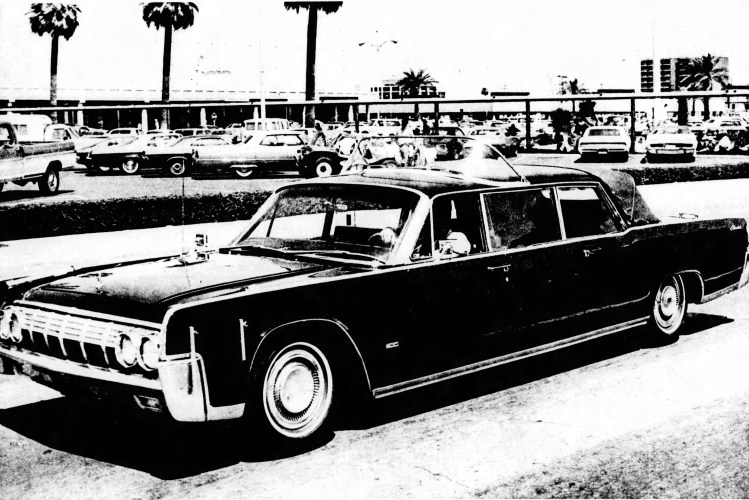
However, this noun originally designated the 1964 Lincoln Continental specially built and equipped for Pope Paul VI’s 1965 visit to the United States.
The following photograph and explanations are from an article about the original Popemobile, by ‘D. G.’, published in The Arizona Republic (Phoenix, Arizona, USA) of Sunday 17th June 1973:
The Popemobile was built by Lehmann Peterson Inc., a Chicago coachbuilding firm which cut apart a ’64 Lincoln sedan and added a new midsection with two custom interiors, one black, one red, and special electronic gear and mechanical gadgetry. Result: a 21-foot-long, 6,000-pound car that seats eight and has two airconditioners, two stereos, three tops, flag holders, its own public address system and removable running boards on the sides and back to carry six security guards. The security guards must be purchased separately.
Ford Motor Company owned the car originally and had it remade to Vatican specifications. The horn was the one found most pleasing to the Pope’s ear. A special seat was put in that could be hand-cranked twelve inches higher than the rest for the Pope’s use, since the Pope must sit at least that much higher than everyone else when society plays by Catholic rules.
The earliest occurrences of the noun Popemobile that I have found are as follows:
1-: From an article by Gordon Gammack about Dr. Eric M. Swanson, an ophthalmologist at Fort Dodge, Iowa, published in the Des Moines Sunday Register (Des Moines, Iowa, USA) of Sunday 10th August 1969:
Last January an item in the Wall Street Journal intrigued him—and he wound up buying the $50,000 custom-built Lincoln Continental that was outfitted especially for the 1965 visit to New York City by Pope Paul VI and thus acquired the name, Popemobile.
Dr. Swanson won’t say what he paid for the super car he’s scarcely driven but he does say he’d sell it for $24,500 today—and for $29,500 after Apollo 11 astronauts Armstrong, Aldrin and Collins have ridden in it, as they are scheduled to do.
After the astronauts are released from quarantine, they will be honored at mammoth celebrations in New York, Chicago and Los Angeles—all in one day—and the Fort Dodge opthalmologist’s [sic] car will be flown from city to city for them to ride in. The car’s is in Chicago now, awaiting the occasion.
When Pope Paul rode in the car in New York and again in Bogota, Columbia [sic], last year, the rear seat complex included a throne-like seat for His Holiness.
But an alternate red velour complex will be substituted for the Apollo 11 astronauts, as it was for Apollo 10 astronauts Eugene Cernan and Thomas Stafford.
2-: From the following advertisement, published in the Des Moines Tribune (Des Moines, Iowa, USA) and in The Des Moines Register (Des Moines, Iowa, USA) on Saturday 25th October 1969:
Astromobile
PopemobileFamous parade limousine built especially for Pope Paul VI for his visit to the United States used by Gemini and Apollo moon astronauts now scheduled to be used again by the Apollo 11 crew on November 8th after their world tour. You can have the thrill of owning this auto and be a part of the festivities while the moon landing astronauts are using it again. Price $32,500. Eric M. Swanson, M.D., Fort Dodge, Iowa.
The original Popemobile was eventually bought in September 1972, for $14,000, by Del Remme, an Arizona businessman.
 word histories
Have you already done “dog-whistling” Pascal? I just don’t get it.
Eileen
LikeLike
No, I’ve not done anything on that yet (but I’m working on it). What is it you don’t understand?
LikeLike
—Cf. meaning and origin of the political term ‘dog whistle’.
LikeLike