
CONTENTS
CONTEXT IN WHICH THE BIKINI WAS CREATED
TWO RECEIVED IDEAS
REFUTATION OF THE FIRST RECEIVED IDEA
REFUTATION OF THE SECOND RECEIVED IDEA
EARLY INSTANCES OF THE COMMON NOUN BIKINI IN ENGLISH
NOTES
The noun bikini denotes a woman’s very brief two-piece swimming costume created in 1946 by the French automobile engineer and clothing designer Louis Réard (1897-1984). He named it after Bikini, an atoll in the Marshall Islands made famous for being the site of two U.S. atomic-bomb tests on 1st and 25th July 1946.
Those nuclear tests were announced beforehand and therefore appeared in the news before they took place; for example, the magazine Regards (Paris, France) of 14th June 1946 published a two-page article by John C. Allison devoted to the subject, entitled Bikini, laboratoire géant (Bikini, giant laboratory).
The research that I have made contradicts two received ideas about the choice of the name bikini by Louis Réard:
– First received idea: Réard chose the name bikini from a comparison between the devastating effect of an atomic blast and the ‘explosive’ effect caused by the daring piece of swimwear of his invention.
– Second received idea: The first person who reinterpreted bikini as containing the prefix bi- (meaning two, twice) was the Austrian-born U.S. fashion designer Rudolf ‘Rudi’ Gernreich (1922-1985), who, in 1964, launched what he called monokini, denoting a woman’s one-piece swimsuit consisting of the lower half of a bikini—the prefix mono- means one, once.
REFUTATION OF THE FIRST RECEIVED IDEA
It was not to suggest the explosive effect of the two-piece swimming costume on the viewer that Louis Réard named it bikini—at least according to an interview that he gave to United Press International, published in The Cincinnati Enquirer (Cincinnati, Ohio, USA) of 3rd November 1974 under the title of Creator Of Bikini Laments Perversions.
He is quoted in this interview as saying that he named the swimming costume after the atoll not because of the connotation of explosiveness, but because of the connotations of pleasure, beauty and tininess: it seems that he did not associate the atoll and his own creation with the atomic bomb, but with a celebration of the life that was starting again at the conclusion of the Second World War.
This is the complete text of Creator Of Bikini Laments Perversions, published in The Cincinnati Enquirer of 3rd November 1974:
Paris (UPI) — Twenty-seven years ago Louis Reard draped two tiny strips of cloth across a Paris show girl and thus invented the bikini.
Reard, now 79, bared its conception in an interview and commented on its perversions.
This summer’s styles for “string” bikinis, topless bikinis and no bikinis at all were not pretty, he complained.
“The string and nude styles will fail of themselves,” predicted designer Reard, who still makes custom swim wear in his boutique on the Avenue de L’Opera.
“Girls attract men that way, but that’s traffic, not beauty. A woman is like a beautiful package, you want to untie the ribbon, take off the beautiful paper, open it and see what’s inside. A woman semi-nude has lost a lot of her attraction.”
Reard, a soft-spoken, gentle man, pulled out from the desk in his shop a mammoth book of newspaper clippings recording the impact of his invention.
“In 1946 France had just come out of the war and people had need to live again,” he said. “I felt I had to design something that would make people understand that life can start over and be beautiful.
“At that time everybody spoke of the island of Bikini in the Pacific, enchanted, tiny, fine sand, a paradise. The idea came to me to make a swim suit tiny like that island.”
Before he went into the swim suit business, Reard had been a designer of cars for the Peugeot auto firm. He didn’t design the bikini like an automobile but, he said, “it did take some engineering to design a bikini that would stay on.”
The designer could not find any fashion mannequin willing to model such a swim suit. Finally he had to recruit a nude show girl from the Casino de Paris music hall [cf. footnote 1].
The girl wore the first bikini at a press party at a swimming pool on June 26, 1946 [cf. footnote 2]. One newspaper described it as “four triangles of nothing.”
Some beaches around the world announced they would ban Reard’s invention. A Protestant church organization next to his shop, then on the Rue de Clichy, forced him to move on grounds of indecency. Movie star swimmer Esther Williams, one of Reard’s customers, refused to wear a bikini.
“Things certainly have changed since then,” Reard said.
One or two years later young girls began to wear bikinis. In 1958 Esquire magazine hailed Reard as “the man who saved the prestige of France.”
His invention was starred in a 1966 song, “Itsy Bitsy Teeny Weeny Yellow Polka Dot Bikini” [cf. footnote 3] and in 1968 the bikini entered the LaRousse [sic] dictionary of France as “a bathing suit in two pieces, dimensions very reduced.”
Although the bikini grew in sales and was copied around the world, it has shrunk. Reard has tried still smaller models known as the sexy-kini. He has made suits of everything from fur to coins.
“I still make bikinis, they change from year to year only in the little details,” he said. “And oh, yes, my first bikini was priced around four or five francs (around a dollar) and now they’re 250 francs ($55 dollars).”
However, even if Louis Réard did not name the swimming costume he created in reference to the atomic-bomb experiments conducted on the atoll of Bikini, others immediately associated the effect caused by his creation with the effect of those experiments—as illustrated by the following three texts:
1-: Experts Poo-Poo Test, published in the New York Herald Tribune (Paris, France) of 6th July 1946—cf. full quotation below in early instances of the common noun bikini in English:
The first showing of the Bikini suit here today started a chain reaction among the throng of sports-wear experts who penetrated the Molitor lagoon shortly after the explosive exhibition.
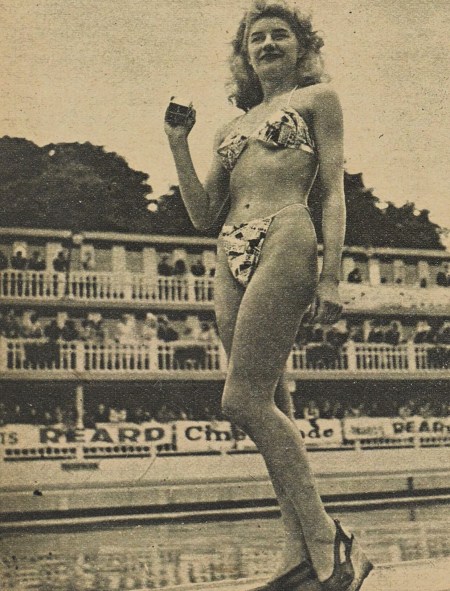
2-: The caption to a photograph of the woman who modelled the newly-created bikini [cf. footnote 1], published in La Femme (Paris, France) of 24th July 1946:
Au concours de la plus jolie baigneuse, qui a eu lieu à Paris, à la piscine Molitor, ce maillot a eu son succès de sandale. La jeune personne qui le présentait tenait à la main la petite boîte pour le contenir tout entier.
Il a été baptisé aussitôt le maillot Bikini…
Mais Bikini a soulevé moins d’émotion que ce costume n’en provoquera sur les plages de famille.
translation:
At the contest for the prettiest swimmer, which took place in Paris, at the Molitor pool, this swimsuit had its success of scandal. The young person who presented it was holding in her hand the small box intended to contain it all.
It was immediately christened the Bikini swimsuit.
But Bikini caused less emotion than this swimsuit will on the family beaches.
3-: This passage from Lettre de Paris: Grand-père Zig à Rididine, by the French journalist and author Alexandre Breffort (1901-1971), published in But (Paris, France) of 6th August 1946:
Vous avez fait sensation avec votre maillot « Bikini », tout indiqué pour les expériences anatomiques.
translation:
You caused a sensation with your “Bikini” swimsuit, just the thing for anatomic experiments.
More generally, the name of the atoll was used as a metaphor for any ‘explosive’ effect—as illustrated by the following about a speech by the French politician André Le Troquer (1884-1963), published in La Presse (Paris, France) of 24th December 1946:
Ce fut une véritable bombe—un Bikini politique.
translation:
It was a real bomb—a political Bikini.
REFUTATION OF THE SECOND RECEIVED IDEA
I think that it was Louis Réard himself who first reinterpreted bikini as containing the prefix bi-.
On 12th July 1972, the magazine Femmes d’Aujourd’hui (Today’s Women – no 1419 – Bruxelles, Belgium) published the following:
Dans un récent shopping maillots de bain (no 1411 du 17 mai), nous avons, par distraction, utilisé le mot « Bikini » comme synonyme de « deux pièces ». A la suite de ce « lapsus », on nous communique : « La Maison Réard, 9, avenue de l’Opéra, Paris, spécialiste des maillots de bain une pièce et deux pièces, rappelle qu’il est absolument interdit de se servir du terme Bikini ou de ses dérivés pour désigner un article quelconque qui ne soit pas de sa propre fabrication. En effet, Bikini et ses dérivés tels que Monokini, Sexykini, etc., sont des marques déposées dans de nombreuses classes par Louis Réard, le 20 juin 1946, sous le no 368.289 au Greffe du Tribunal de la Seine. Il en est donc le seul et unique propriétaire n’ayant jamais accordé de licence à quiconque. »
translation:
In a recent swimwear shopping section (no 1411 of 17th May), we inadvertently used the word “Bikini” as a synonym for “two-piece swimming costume”. Following this “lapsus”, we have received this communication: “The Maison Réard, 9, avenue of the Opera, Paris, specialists in one-piece and two-piece swimming costumes, remind that it is absolutely forbidden to use the term Bikini or its derivatives to designate any article that is not of their own fabrication. As a matter of fact, Bikini and its derivatives such as Monokini, Sexykini, etc., are trademarks registered in numerous classes by Louis Réard, on 20th June 1946, under the no 368.289 at the Clerk’s Office of the Tribunal of the Seine Department. He is therefore the sole and unique proprietor of them having never granted licence to anyone.”
(In Les Mots de l’histoire (Éditions Robert Laffont, S.A. – Paris, France, 1990), Jacques Boudet too writes that Louis Réard registered the name bikini on 20th June 1946.)
The fact that Louis Réard used mono- and sexy- as prefixes to coin the words monokini and sexykini indicates that he probably named his creation bikini:
– not only because of the connotations that he attached to the atoll of Bikini,
– but also because he was reinterpreting the first syllable of bikini as the prefix bi-, with allusion to the fact that the swimming costume consisted of two pieces.
EARLY INSTANCES OF THE COMMON NOUN BIKINI IN ENGLISH
The earliest instances that I have found of bikini in a text in English are from the New York Herald Tribune (Paris, France) of 6th July 1946:
Paris Bares World’s Smallest Bathing Suit And Consensus from Every Angle Is—Wow!
EDITOR’S NOTE
For the first time in history, the entire staff of the European Edition and the foreign service of the New York Herald Tribune now in Paris insisted yesterday on covering the same assignment. Each was so determined to do the job that, for the sake of organizational morale, they were all assigned to the same story. It turned out to be an exhibition of the world’s smallest bathing suit, modeled at the Piscine Molitor. Most of their stories are printed below, although some of them are still writing.
[…]
Disrobement Race Seen
By William J. Humphreys
Political Correspondent
Developments shifted yesterday from the Quai d’Orsay to the Piscine Molitor where Micheline Bernardini proved that existentialism is here to stay. Miss Bernardini was certainly all here. It is understood from sources fairly close to the French government that international notes, couched in only the essential diplomatic terms but conveying worlds of meaning, are to be exchanged and there is considerable danger of a disrobement race among the big powers. Meanwhile, it was learned from other informed sources that the French are hastening to include the Bikini bathing suit in their five-year plan. In that event observers agree that this phase of the plan should take much less than five years.
Five Francs on the Nose
By Eddie Snow
Sports Columnist
Snow was there, too. The track was extremely fast and considerable form was displayed on all sides. On basis of pure form it would be logical to bet on that Number 7 in the beauty contest. But Snow is putting a hard-earned five-franc note on the Bikini suit, or at least he would if the suit was big enough to put a five-franc note on. Well, better luck next time, folks.
Big Four Ponder Zones
By Walter Kerr
Diplomatic Correspondent
The Foreign Ministers of Great Britain, France, the United States and Soviet Russia reached agreement on reparations on the eve of a new international complication, namely, the world’s smallest bathing suit. This suit is divided into two zones, the northern zone and the southern zone. The northern zone is divided into two enclaves. Designated as the Bikini, the suit, when not worn, is carried in a blue box one and a half inches square. Experts appointed are studying the report that the suit may be passed through an ordinary finger ring. The suit has not been put on the agenda, but there is general agreement that it looked snappy on Micheline Bernardini.
[…]
Experts Poo-Poo Test
By William Attwood
Atomic Energy Correspondent
The first showing of the Bikini suit here today started a chain reaction among the throng of sports-wear experts who penetrated the Molitor lagoon shortly after the explosive exhibition. Although most seemed stunned and incoherent, there were a few who maintained that the suit wasn’t really so revolutionary.
“We’ll find ways of making more spectacular suits than this one,” a rival manufacturer of sports clothes asserted. “Just give us time.”
Another protested that no one concern should have a monopoly of the manufacture of such suits. “We all have a right to know how so little material can conceal so much,” he said.
Officials in charge of today’s test declared they were satisfied with the results of the experiment. They added that the effect on the spectators was just as predicted, and vigorously denied rumors that the Bikini suit will render the so-called bathing beauty obsolete. “It will just mean that she will have to be better built,” they pointed out.
The noun bikini then occurs in the account by United Press of “a showing of the Beard [misprint for Reard] beachwear collection at the fashionable Molitor Natatorium” (Paris) that took place on 21st June 1947; this account was published in many U.S. newspapers the following days—for example in The San Diego Union (San Diego, California) of 23rd June:
Some of France’s shapeliest models strutted around the edge of the pool showing the latest fashions in French bathing suits.
First came the famous Bikini model, worn by a shapely blonde. The Bikini model consists of three small triangles of cloth.
Susanne Peletier, a sultry brunet who plays siren roles in French movies, modelled the Tahiti suit. It has a grass skirt. […]
Then Suzanne [sic] dropped the grass skirt, revealing the bathing part of the suit. It was made of loosely-woven grass.
[…]
The orchestra cued the next number with a fanfare of trumpets. The announcer said Mlle. Jacqueline Rouquine would model the new “breathless” number. The announcer explained that the suit is without straps and that the bra is held up by two hidden steel springs.
Mlle. Rouquine, curvaceous and with long auburn hair, appeared at the edge of the pool.
“The ‘breathless’ model is guaranteed never to cause the wearer the least embarrassment,” the announcer said.
To prove it, Mlle. Rouquine, who is something of an acrobat, turned a cartwheel.
[…]
Mlle. Rouquine came out of the cartwheel with her head hanging and her long hair streaming down both sides of her face. A sympathetic audience gasped. It seemed possible that perhaps the announcer had been a little too sure about the guarantee.
[…] The spectators looked at Mlle. Roquine [sic]. She was not embarrassed.
The bikini is said to be already “famous” in the above-quoted account of the fashion show that took place at the Molitor pool on 21st June 1947. But, curiously, the bikini is said to be only “planned” in an article by Robert Richards, United Press Staff Correspondent, published in several U.S. newspapers on 26th June 1947, where appears the second-earliest instance that I have found of bikini in English—the following, for example, is from The Democrat and Leader (Davenport, Iowa):
(Editor’s Note: Each year women’s bathing suits become skimpier. But this year, in addition to being as scanty as possible, they are artistic. United Press correspondents have made a check on bathing suits at some of the most famous beaches around the world and their findings are contained in the following dispatch.)
If you think the bathing suits that girls are wearing on the American beaches this season are scanty, listen, brother . . .
On the French Riviera an American suit would be almost a full-length dress for the mademoiselles.
Over there they’re wearing a new little number called the “diaper pantlet.” It’s good enough to catch any masculine eye at distances up to a mile and a quarter.
After seeing one of them at Cannes, an English woman wired her husband:
“Don’t worry, dear. You still see everything.”
United Press correspondents have just completed a survey of the world’s top beaches and they report there’s plenty of bare skin to be seen—but the tiny suits are also artistic.
In France, for instance, they also have a white one-piece suit that is so tight-fitting it’s often mistaken for the lady-wearer’s epidermis.
The suit is loosely woven so that you may see clear thru it in several places.
Cannes authorities said they would not object if female bathers appeared on the beaches wearing absolutely nothing.
“After all,” one asked, “how could we tell the difference?”
At famous Waikiki, in the Hawaiian islands, even six-foot males are parading about in white corduroy homemade diaper suits.
The women bathers at Waikiki prefer nifty two-piece suits that are glamorized with hand-painted flowers. They also wear form-fitting aloha prints that make it difficult to tell just where the suit ends and the flesh begins. From a distance, they resemble tattooed women.
“But we won’t kick,” Waikiki police promised, “so long as they wear both tops and bottoms.”
At Malibu Beach, in California, a woman bather said:
“This year, we’re simply trying to protect the property without obstructing the view.”
The Hollywood women are accomplishing this by wearing narrow two-piece suits with bra and pants. Many also are going in for strapless suits, but these aren’t too revealing because the skirts are longer.
New York girls also have made it firmly known that they object to the fancy strapless models. They claim such suits are no good for swimming. They slip down around your knees in the water.
The wired tops were also vetoed. The bathers feel like Brooklyn bridge inside them.
We saved the best report for last.
The French, it seems, have a new suit planned that is about twice as wide as a piece of string.
It’s so explosive that they call it the Bikini.
Finally, the following is from the Fall Fashion Section of The Montclair Times (Montclair, New Jersey, USA) of 25th September 1947:
Beachwear Very Brief
The Bikini is established on French beaches and has been for some reasons. It is that wisp of a two-piece swim suit which spreads its popularity over there just as some of the smart American beaches are reviving interest in one-piece types. Here is brevity for beachwear carried to the ultimate.
Note 1: The French nude dancer at the Casino de Paris who agreed to model the bikini was Micheline Bernardini (born 1927).
Note 2: There has been confusion as to when Louis Réard introduced the bikini.
[Preliminary remark: Unfortunately, the above-quoted caption to the photograph published in La Femme (Paris, France) of 24th July 1946 does not specify when the contest at the Molitor pool took place.]
According to the above-quoted 1974 interview of Réard, the “nude show girl from the Casino de Paris music hall […] wore the first bikini at a press party at a swimming pool on June 26, 1946”.
However, in Histoire du costume (Collection Que sais-je ? – Presses Universitaires de France – Paris, France, 1999), François-Marie Grau wrote that the bikini was first presented on 3rd June 1946, whereas, according to Les 1000 immanquables du 20e siècle, sous la direction de Jacques Marseille (Larousse – Paris, France, 2000), the presentation took place on 18th July 1946.
What is certain is that, on 11th July 1946, Les Actualités Françaises released the following film, made on 5th July during a swimwear contest at the Molitor pool in Paris, film in which Micheline Bernardini, evidently not participating in the contest, is wearing a bikini—but the film does not specify whether the bikini was introduced on that occasion; in fact, the commentator does not even use the word bikini.—Watch Fête de l’eau et concours de maillots à la piscine Molitor—source: INA (Institut National de l’Audiovisuel).
The above-quoted article from the New York Herald Tribune (Paris, France) of 6th July 1946 confirms that the contest took place on 5th July.
The following photograph and caption (in which the word bikini does not appear either) probably refer to the swimwear contest that took place on 5th July 1946 at the Molitor pool in Paris—from the Bergen Evening Record (Hackensack, New Jersey, USA) of 13th July 1946:
PARIS BEAUTIES ON PARADE FOR POSTWAR CONTEST JUDGES
French bathing beauty contestants, wearing the latest in fashionable swimming suits and carrying identifying entry numbers, line up for the judges at the Molitor pool in Paris.
Note 3: The correct date is 1960. The following is from Catalog of Copyright Entries: Third Series, Volume 14, Part 5, Number 1: Music: January-June 1960 (Copyright Office, The Library of Congress, Washington, 1961):
ITSY BITSY, TEENIE WEENIE, YELLOW POLKADOT BIKINI; w & m Paul J. Vance & Lee Pockriss. © George Pincus & Sons Music Corp.; 9Jun60; EU627862.
__________
[Edited on 5th August 2023, with the addition of quotations from But (Paris, France) of 6th August 1946, from La Femme (Paris, France) of 24th July 1946, and from La Presse (Paris, France) of 24th December 1946. Edited on 6th August 2023 with the addition of Note 3. Edited on 9th August 2023 with the addition of the quotation from the New York Herald Tribune (Paris, France) of 6th July 1946, and remarks related to it.]
 word histories