The phrase hell hath no fury like a woman scorned is a misquotation from The mourning bride, a tragedy by the English playwright and poet William Congreve (1670-1729), produced and published in 1697: Vile and ingrate! too late thou shalt repent The base Injustice thou hast done my Love. Yes, thou shalt know, spite of thy past Distress, […]
There are two Valentines, both Italian, one a priest and the other a bishop, who were martyred and used to be commemorated in the Roman Catholic calendar on 14th February. However, they have no romantic associations and the modern customs linked with St Valentine’s Day arise from a tradition according to which it is the day when the […]
The white cliffs of Dover— to which the name Albion did not originally refer [cf. note]. (photograph: Wikimedia Commons/Fanny) The name Albion first appeared in English in the very first sentence of the first Book of the 9th-century translation of Historia ecclesiastica gentis anglorum (The Ecclesiastical History of the English People) originally written by the English monk, […]
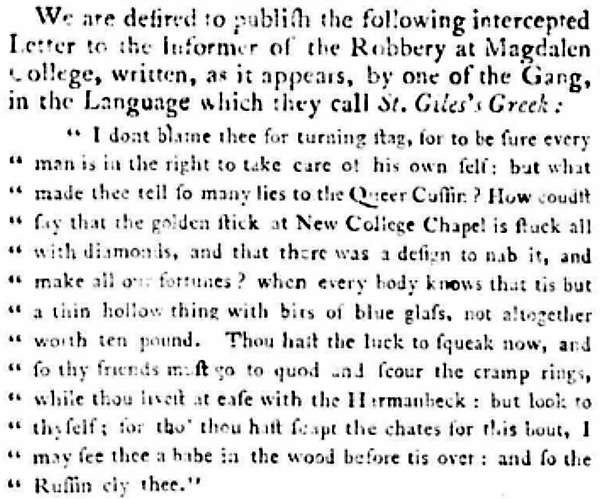
The noun Greek has long been used in the sense of unintelligible speech or language, gibberish, and the phrase it’s (all) Greek to me means I can’t understand it at all. This expression is well known from The Tragedie of Julius Cæsar (1599), by the English playwright and poet William Shakespeare (1564-1616): (Folio […]
The expression cold comfort means inadequate consolation for a misfortune. The adjective cold has long been used to mean felt as cold by the receiver, chilling, damping, discouraging. For example, the English poet Geoffrey Chaucer (circa 1342-1400) wrote, in The Nun’s Priest’s Tale: (interlinear translation – Harvard College) Wommennes conseils been ful ofte colde; Women’s counsels […]
In The Tragedie of Macbeth (around 1603), by the English poet and playwright William Shakespeare (1564-1616), Gray-Malkin is the name of a fiend in the shape of a grey she-cat, the cat being the form most generally assumed by the familiar spirits of witches according to a common superstition: (Folio 1, 1623) […]
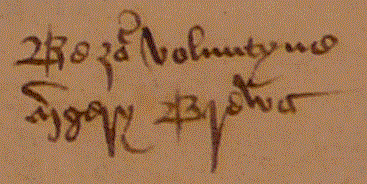
MEANING foolish or fanciful talk, ideas, plans, etc. ORIGIN It is a shortening of moonshine in the water, meaning appearance without substance, something unsubstantial or unreal. In this phrase, moonshine means moonlight. The 15th-century correspondence between members of the Paston family of Norfolk gentry, and with others connected with them in England, […]
The word kidney, which is attested around 1325, is of unclear origin. The second element of the Middle-English form kidenei, plural kideneiren, is apparently ey, plural eyren, meaning egg (cf. German Eier, literally eggs, used to mean testicles). The first element remains uncertain; it is perhaps identical with cud. The Anglo-Saxon name for kidney was […]
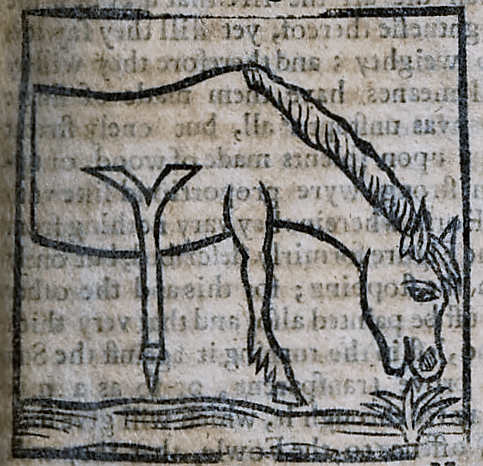
The forme and manner of the Stalking horse of Canuasse stopt. – from Hungers preuention: or, The whole arte of fowling by water and land Containing all the secrets belonging to that arte (1655 edition) The term stalking horse originally denoted a horse trained to allow a fowler to conceal himself behind it or under […]
MEANINGS – attractive articles of little value or use – practices or beliefs that are superficially or visually appealing but have little real value or worth ORIGIN The noun trumpery, first recorded in the mid-15th century, is from the French noun tromperie, which means deception, trickery. This was one of the original meanings in […]



 word histories