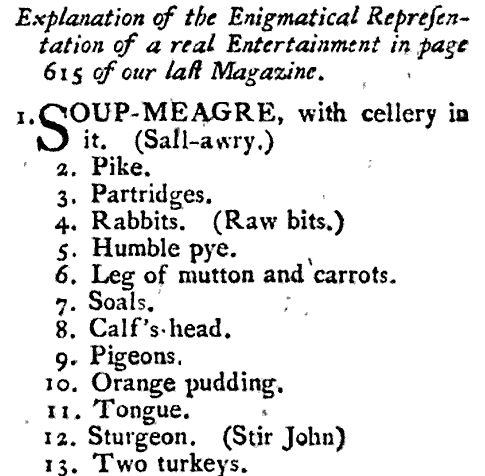
A puzzle published in The Hibernian Magazine, or, Compendium of Entertaining Knowledge (Dublin, Ireland) in 1774 punned on the humble of humble pie, which may indicate that the latter term was already used figuratively at that time. The following is from the October issue: […]
The noun gooseberry denotes a round edible yellowish-green or reddish berry with a thin translucent hairy skin and the thorny shrub which bears these berries. Attested in the first half of the 16th century, it is probably based on Middle-French forms such as grosselle and groiselle (Modern French groseille), perhaps altered because of an unexplained […]
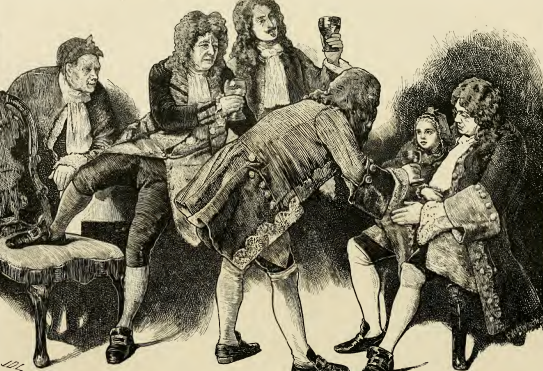
Lady Mary Wortley Montagu and the Kit-Kats – illustration from Old and New London: A Narrative of its History, its People, and its Places (1873), by Walter Thornbury (The Kit-Cat, or Kit-Kat, Club in London was a club of Whig politicians and men of letters founded in the reign (1685-8) of James II; its […]
The word daisy is from Old English dæges éage, meaning day’s eye. This name alludes to the fact that the flower of this plant opens in the morning and closes at night, as the human eye does. Perhaps its petals, which close over its bright centre at the end of the day, were also thought to resemble human eyelashes. But the […]
Several colloquial phrases associate daisies with being dead: under the daisies, which means dead and buried, to push up (the) daisies and to turn one’s toes up to the daisies, which mean to be in one’s grave, to be dead. The Clare Journal, and Ennis Advertiser (Ireland) of 9th August 1838 published this poem: […]
Sir John Herschel The announcement last Friday of the death, at the age of 81, of the Rev. Sir John Herschel, Bart., which occurred at Observatory House, Slough, revives a host of memories of 18th century Bath. Sir John Herschel was the great-grandson of Sir William Herschel, the famous astronomer, who discovered from his scientific […]
The expression to amputate one’s mahogany is a jocular elaboration on to cut one’s stick, which means to take one’s departure. The following definition is from A Dictionary of Modern Slang, Cant, and Vulgar Words (2nd edition – 1860), by the English publisher and author John Camden Hotten (1832-1873): Cut one’s stick, to be off […]
A New Song, sung by Mr. Champness in Harlequin’s Invasion from The Universal Magazine of Knowledge and Pleasure – March 1760 The phrase heart of oak denotes a person with a strong, courageous nature, especially a brave and loyal soldier or sailor, and a courageous or valorous spirit. Its literal meaning is the heartwood of the oak. The heartwood […]
mandragoras – from Stirpium historiae pemptades sex sive libri XXX (1583), by Rembert Dodoens The term hand of glory originally denoted a charm made from, or consisting of, the root of a mandrake. A calque of French main de gloire, it was first used in Curiosities of nature and art in husbandry […]
MEANING any plant of the European genus Reseda, including mignonette and dyer’s rocket, which has small spikes of greenish, yellowish or whitish flowers ORIGIN Through translations of Naturalis Historia (Natural History – 77), a vast encyclopaedia of the natural and human worlds by the Roman statesman and scholar Pliny the Elder […]



 word histories