According to the post-biblical Christian tradition, the apple is the fruit of the tree of knowledge of good and evil eaten by Adam and Eve in the Garden of Eden in defiance of God’s commandment. However, in the Book of Genesis, the type of fruit eaten by Adam and Eve is not specified. In the King James Version (1611), the two […]
The French term foie gras, from foie, liver, and gras, fat, fatty, denotes the liver of a specially fattened goose or duck prepared as food. Short for pâté de foie gras, it also denotes a smooth rich paste made from fatted goose or duck liver. Its first known use in English is in The Fudge […]
cover of The Great Panjandrum Himself (1885), a picture book based on the text attributed to Samuel Foote, by the English artist and illustrator Randolph Caldecott (1846-86) – photograph: Aleph-Bet Books MEANING a pompous self-important official or person of rank ORIGIN The word is supposed to have been coined in […]
The noun galaxy is from post-classical Latin galaxias, denoting the Milky Way, from Hellenistic Greek γαλαξίας (= galaxias), short for γαλαξίας κύκλος (= galaxias kuklos), milky circle, from ancient Greek γάλα/γαλακτ- (= gala/galakt-), milk. Originally therefore, galaxy, often with the and capital initial, denoted the Milky Way, that is, the diffuse band of light stretching across […]
MAIN MEANINGS – verb: to behave as though sexually attracted to someone, but playfully rather than with serious intentions – noun: a person who acts flirtatiously ORIGIN The verb flirt is probably onomatopoeic, the phonetic elements /fl-/ and /-əːt/ both suggesting sudden movement. It may therefore be comparable to verbs such as […]
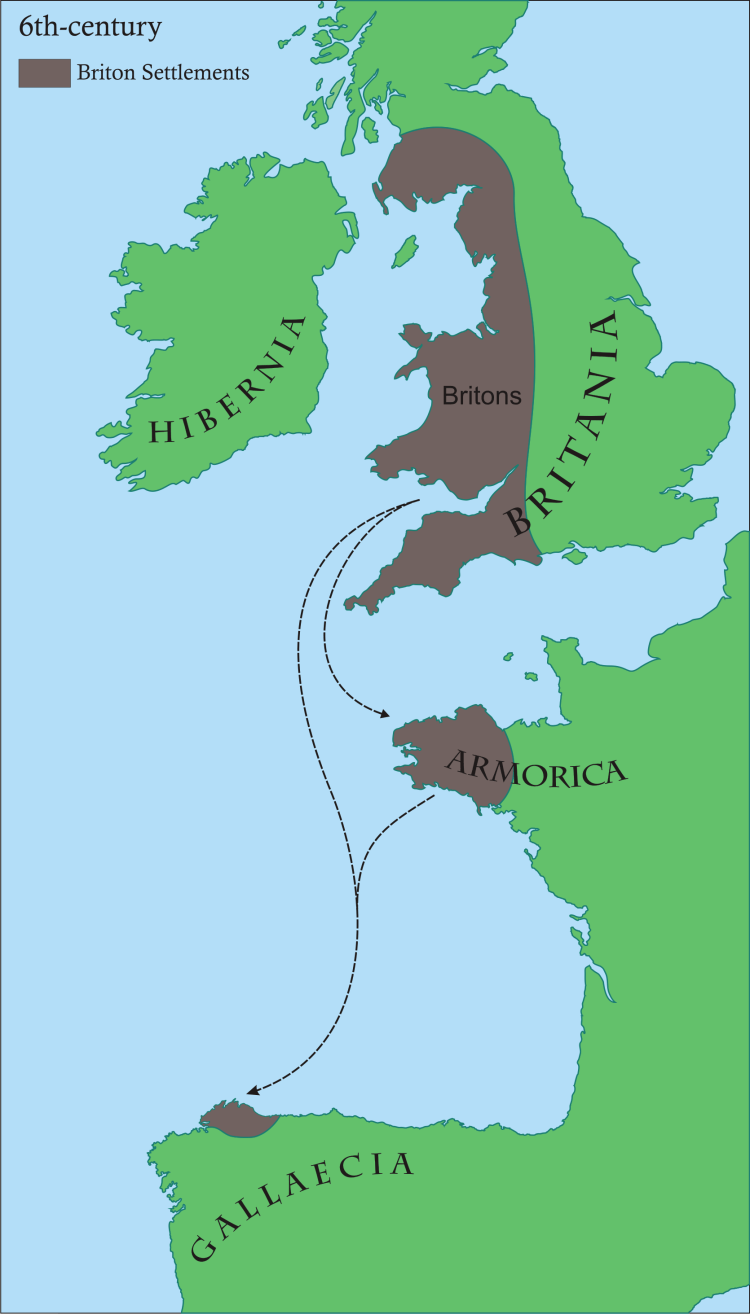
Briton settlements in the 6th century – settlements of the Angles, Saxons and Jutes in Britain, circa 600 In the following, Briton will refer to the Celtic Brittonic-speaking peoples who inhabited Britain south of the Firth of Forth, and who, following the arrival of the Anglo-Saxons in the 5th century, gradually retreated until the […]
cloak: twin roses designs The nouns clock and cloak are doublets, or etymological twins: they are of the same derivation but have different forms and meanings. Despite the notion of ‘two’ implied by doublet, the term is also applied to sets of more than two words. In this case, cloche, a borrowing from French, […]
The English words turban and tulip are doublets. Doublets (or etymological twins) are words in one given language that go back to the same etymological source but differ in form and meaning—cf. also lobster – locust, fawn – fetus, pastiche – pastis and clock – cloak. The word turban is from tul(i)pant, […]
the 1905 edition of Le Petit Larousse illustré, a French-language encyclopaedic dictionary published by the Éditions Larousse In 1890, Eugène Grasset (1845-1917) designed the image of la Semeuse (the Sower) blowing dandelion seeds, which accompanies the motto of the Éditions Larousse, Je sème à tout vent (I sow to the four winds). The word […]
In early use, apple was a general term for all kinds of fruits other than berries, including even nuts. In fact, apple and berry are the only Anglo-Saxon fruit names, the rest being of Latin or ‘exotic’ origin. This is why apple was commonly used in describing foreign fruits, which explains for example the word […]





 word histories