1890s—to use extravagant words or language not substantiated by fact; to talk nonsense—occurs in particular in stories by the British authors Ernest William Hornung (1866-1921) and Pelham Grenville Wodehouse (1881-1975)
a word with two opposite or contradictory meanings—coined by Jack Herring in 1962—Joseph T. Shipley had developed the same notion in Playing With Words (1960); he called it ‘autantonym’
with reference to the Jewish prohibition of the eating of pork—‘as scarce as pork chops in a Jewish boarding house’ (USA, 1907) means ‘extremely rare’—‘like a pork chop in a synagogue’ (USA, 1915) means ‘out of place’; also ‘unwelcome’ or ‘unpopular’
Australia, 1985—a person who espouses socialist ideals while enjoying a wealthy lifestyle—coined after the synonymous expression ‘champagne socialist’—popularised by Emerald City (1987), by the Australian playwright David Williamson
Australia, 1928—an outstandingly good person or thing—variant of the synonymous jocular expressions, of U.S. origin, based on various parts of animals’ real or fanciful anatomy and other attributes, such as ‘the bee’s knees’ and ‘the cat’s whiskers’
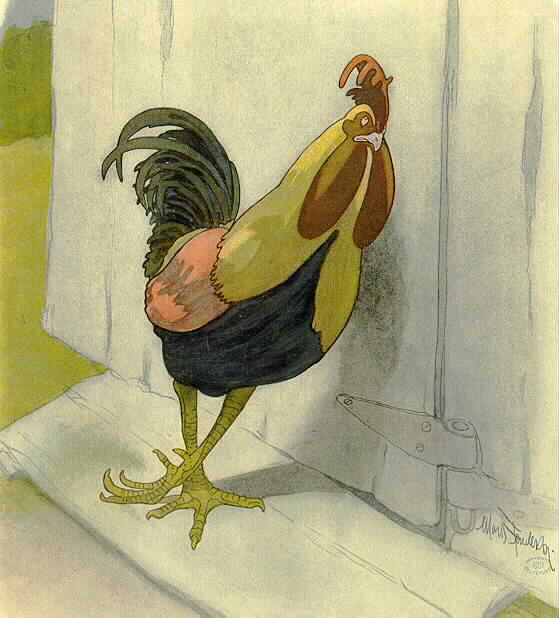
USA 1907—used of the inanity of life and of the transitoriness of success—originated in the captions to a cartoon known as ‘The Dejected Rooster’, by Mark Fenderson, published by the weekly magazine Life (New York City) in 1907
USA, 1876—‘extremely cold’—cf. ‘as hard as Pharaoh’s heart’ (USA, 1829), meaning ‘extremely hard’—both phrases refer to the hardening of Pharaoh’s heart in the Book of Exodus, 7:13-22
USA, 1896—one-word form representing a colloquial pronunciation of the phrase ‘hell’s a poppin’’ (1875)—meaning: ‘events are unfolding in a chaotic manner’; ‘a state of confusion and disarray is taking hold’—the verb ‘pop’ means ‘to suddenly break open’
USA, 1893—utterly despicable—jocular extension of ‘lower than a snake’—refers to the use of ‘low’ to mean ‘despicable’, and to the use of ‘snake’ to denote ‘a treacherous or deceitful person’
USA, 1982—a catchy song or melody that keeps repeating in one’s mind, especially to the point of irritation—loan translation from German ‘Ohrwurm’—original meaning (1598): an earwig

 word histories