‘drama queen’: meaning and origin
(derogatory) a person who is prone to exaggeratedly dramatic behaviour—UK, 1978
Read More
“ad fontes!”
(derogatory) a person who is prone to exaggeratedly dramatic behaviour—UK, 1978
Read Moreused conversationally to declare, often ironically, that one shares the opinion, sentiment, predicament, etc., of the previous speaker—USA, early 20th century
Read Morereal events and situations are often more remarkable or incredible than those made up in fiction—first occurred as ‘truth is always strange, stranger than fiction’ in Don Juan (1823), by George Gordon Byron
Read Moreto be caught off-guard; to be surprised in an embarrassing or compromising situation—USA, 1886
Read Morea ruse or stratagem that is still effective although it has been used for a long time—USA, 1929—seems to have originated in sports
Read More
alludes to the belief that such a hat or cap protects the wearer from mind control, surveillance or similar types of threat—USA, 1972 as ‘tinfoil-lined hat’
Read Morein French contexts: a young person, especially a young man, belonging to a youth subculture of the 1950s and 1960s—UK, 1959—from the noun ‘blouson’ (a short jacket) and the adjective ‘noir’ (black)
Read Morescarce; infrequent; difficult to find or to come by—one early use in 1668—but popularised by the Irish author Thomas Campbell in The Pleasures of Hope (1799)
Read More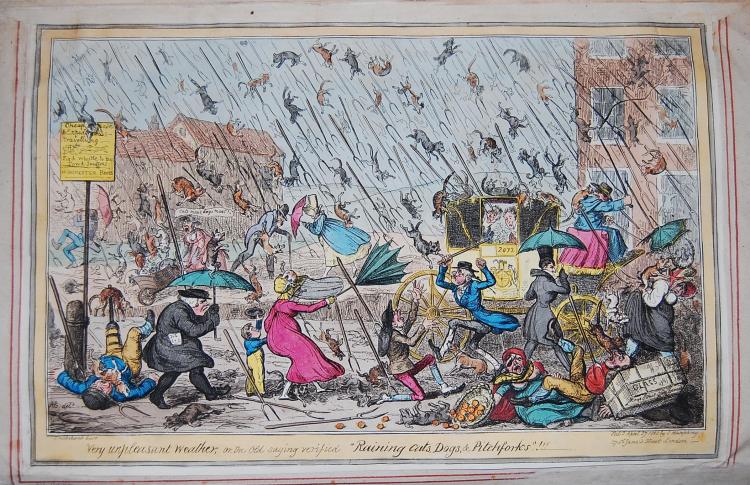
to rain very heavily—UK, 1820—sometimes appended to the phrase ‘to rain cats and dogs’
Read Moreto be glad of minor benefits, especially in an otherwise unpleasant or troublesome situation—first recorded in The Heart of Midlothian (1818), by Walter Scott
Read More
