MEANING The phrase to be barking up the wrong tree means to be pursuing a mistaken or misguided line of thought or course of action—cf. also origin of ‘gone coon’. ORIGIN In Americanisms, Old and New. A Dictionary of Words, Phrases and Colloquialisms peculiar to the United States, British America, the West Indies, […]
The proper name Guy is derived, via French, from the Old German Wido, either from wit, meaning wide, or from witu, wood. Wido has become Guy in French because in words of Germanic origin, when initial, the labio-velar approximant /w/ has regularly become the velar /g/. For instance, in the French noun loup-garou, the element garou corresponds to English werewolf—in fact, loup was added when the […]
MEANING foolish or fanciful talk, ideas, plans, etc. ORIGIN It is a shortening of moonshine in the water, meaning appearance without substance, something unsubstantial or unreal. In this phrase, moonshine means moonlight. The 15th-century correspondence between members of the Paston family of Norfolk gentry, and with others connected with them in England, […]
Figuratively, a loose cannon is an unpredictable or uncontrolled person who is liable to cause unintentional damage. But in practice, it was one inadequately lashed in place on the deck of a ship, which caused havoc by rolling dangerously and unpredictably. The first known mention of a loose cannon being tossed about the deck of […]
MEANINGS – attractive articles of little value or use – practices or beliefs that are superficially or visually appealing but have little real value or worth ORIGIN The noun trumpery, first recorded in the mid-15th century, is from the French noun tromperie, which means deception, trickery. This was one of the original meanings in […]
The phrase (as) happy as a clam means well pleased, quite contented—cf. also happy as a sandboy and happy as Larry. In Dictionary of English Phrases (2008), Robert Allen explains: This American simile is more understandable in its full form, happy as a clam in high water (or at high tide). In these conditions, clams […]
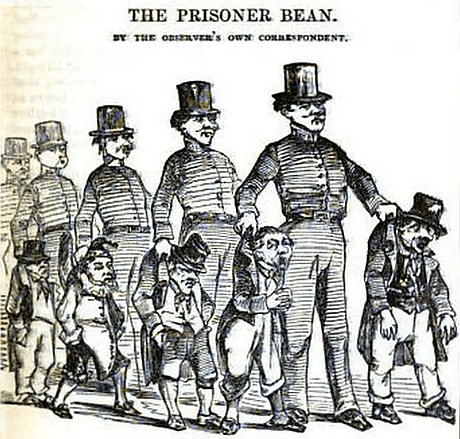
The term human bean is a humorous alteration or mispronunciation of human being, frequently used as part of an extended pun relating to beans. It is first recorded in Punch, or The London Charivari (1842): This little wretch is exciting the most intense interest, (Faugh!) and we have bribed the authorities in all directions to obtain information regarding him. It […]
The verb nail is used to mean to expose or reveal the falsehood of an allegation, assertion, etc., especially to prevent further dissemination. This use is first recorded in An Oration delivered at the Celebration in Philadelphia of the 106th Anniversary of the Birthday of Thomas Paine, by John Alberger, published in The North American […]
The phrase to miss the bus, or the boat, etc., means to be too slow to take advantage of an opportunity. In A Concise Dictionary of Phrase and Fable (1993), B. A. Phythian explained: This expression is said to originate in an Oxford story of the 1840s about John Henry Newman, fellow of Oriel College, […]
“HUNS KILL WOMEN AND CHILDREN!” “TELL THAT TO THE MARINES!” First-World-War US recruiting poster by James Montgomery Flagg image: Disappearing Idioms This poster, which attracted a great deal of attention, portrays an angry-looking young man in the act of pulling off his coat as though he were anxious to get into a fight. The […]


 word histories