‘the (little) man in the boat’: meaning and origin
UK, 1896—the clitoris—likens the clitoris, placed between the inner labia of the vulva, to a person in a boat
Read More
“ad fontes!”
UK, 1896—the clitoris—likens the clitoris, placed between the inner labia of the vulva, to a person in a boat
Read More17th century—contrasts what the mind remembers with what it forgets (with reference to the opposition between the coarser particles, which are retained by a sieve, and the finer ones, which pass through it)—denotes an extremely poor memory (with reference to the fact that a sieve does not hold all its contents)
Read More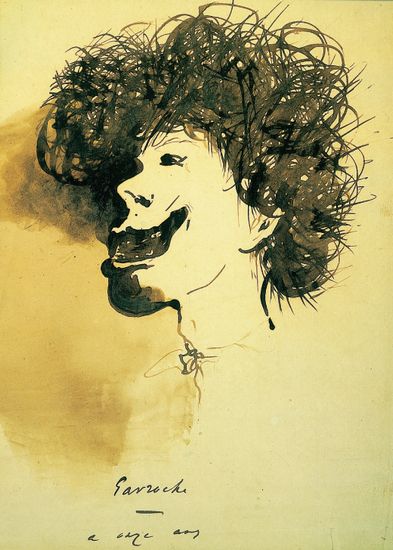
USA, 1863—a street urchin, especially in Paris, France—from ‘Gavroche’, the name of a street urchin in Les Misérables (1862), a novel by Victor Hugo
Read MoreUK and USA, late 19th century—‘parlour socialist’: a middle- or upper-class person claiming to be committed to the cause of socialism but not actually involved in the achievement of that cause—‘parlour socialism’: the claimed commitment of a middle- or upper-class person to the cause of socialism without actual involvement in the achievement of that cause
Read More‘parlour patriot’ (1797)—the earliest of the phrases in which ‘parlour’ is a depreciative attributive modifier used of a person claiming to be committed to a cause but not actually involved in the achievement of that cause—‘parlour’ is also used of the claimed commitment to a cause without actual involvement in the achievement of that cause
Read MoreThe noun ‘armchair’ is used as an attributive modifier meaning: 1) based or taking place in the home as opposed to the world or environment outside; hence, chiefly depreciatively: 2) lacking or not involving practical or direct experience of a particular subject or activity.
Read More
On the pattern of phrases such as ‘nom de guerre’, ‘nom de théâtre’ and ‘nom de plume’, ‘nom de —’ is used, often humorously, to form phrases denoting a pseudonym, an alternative name.
Read More1947—the unauthorised dumping of waste, especially while in the process of transporting it—‘fly’ refers to ‘on the fly’, meaning ‘while in motion or progress’—‘tipping’ is the gerund of the verb ‘tip’, in the sense ‘to dump’
Read More1687—used in negative and interrogative constructions, ‘bread and butter’ denotes a matter which one has the right to express an opinion on, involve oneself in, etc.
Read MoreUK—literally, 1919: a dish consisting of meat served with two varieties of vegetable, seen as typical of traditional or unimaginative British cooking—figuratively, 1951: something simple and unsophisticated, or something indicative of simple and unsophisticated tastes
Read More
