‘penny-a-line’: meanings and origin
UK, early 19th century, derogatory—used attributively of a journalist who was paid at the rate of a penny a line, hence also of low-quality writing
Read More
“ad fontes!”
UK, early 19th century, derogatory—used attributively of a journalist who was paid at the rate of a penny a line, hence also of low-quality writing
Read MoreUK, mid-19th century—a circular curl of hair (sometimes artificial), usually pressed flat against the temple or forehead
Read Moremid-19th century—a small bonnet standing far back on the head, which was then fashionable—also occasionally in the extended form ‘kiss-me-quick, mother’s coming’
Read MoreAustralia & UK, 1856—a circular curl of hair (sometimes artificial), usually pressed flat against the temple or forehead
Read Moreto live in excessively close proximity or interdependence—1762: “the company squeezed themselves into one another’s pockets” in a letter by Horace Walpole
Read Morea drink made from black coffee and brandy, cognac or other liquor—‘royale’ means: first-rate—‘café royale’ (USA, 1882): probably a Frenchification of earlier ‘coffee royal’
Read MoreUK, 1904—refers to the action of making someone stop chattering—from the colloquial imperative phrase ‘cut the cackle (and come to the horses)’, meaning: stop talking (and get to the heart of the matter)
Read MoreUK, 1930—one who is born into the Roman Catholic Church (i.e., a Catholic ‘from the cradle’)
Read More‘stop talking (and get to the heart of the matter)’—UK, 1878—said to have been coined by circus proprietor Andrew Ducrow when apostrophising equestrian performers
Read More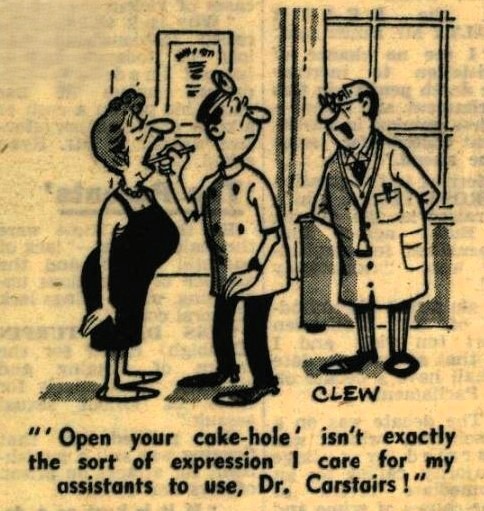
a person’s mouth—British-Army slang, 1916
Read More word histories