‘that makes two of us’: meaning and origin
used conversationally to declare, often ironically, that one shares the opinion, sentiment, predicament, etc., of the previous speaker—USA, early 20th century
Read More
“ad fontes!”
used conversationally to declare, often ironically, that one shares the opinion, sentiment, predicament, etc., of the previous speaker—USA, early 20th century
Read Morea ruse or stratagem that is still effective although it has been used for a long time—USA, 1929—seems to have originated in sports
Read Moreto abandon or betray someone in order to protect or advance one’s own interests—originally (British politics, 1971) ‘to push someone under a bus’—derived from ‘to walk under a bus’ (British politics, 1966)
Read Moresmartly dressed—from the verb ‘fig out/up’, meaning ‘to smarten up’—this verb is probably an alteration of the verb ‘feague’, of uncertain origin, meaning ‘to make (a horse) lively’
Read More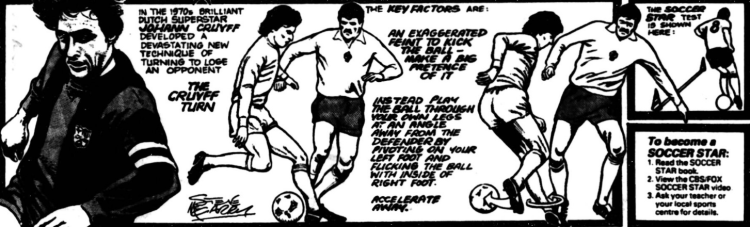
in soccer: a manoeuvre used by one player to evade another—UK, 1980s—refers to Dutch footballer Johan Cruyff, who first brought this manoeuvre to public attention by performing it in 1974
Read Morethe action, excitement or trouble starts—USA, late 19th century—originally alluded to the release of a balloon to mark an event
Read Morean event or occasion at which the expected principal participant is not present—coined after ‘Hamlet without the Prince’—‘Lear without the King’ 1904—‘Henry V without the King’ 1964
Read MoreUSA, 1981—said to have been invented by cheerleader ‘Krazy George’—popularised worldwide during the 1986 FIFA World Cup in Mexico, as a translation of Spanish ‘ola’—hence the British phrase ‘Mexican wave’ (1986)
Read More
various meanings, in particular: something with a larger capacity than its outward appearance suggests—UK, 1968—the name, in TV series Doctor Who, of a time machine outwardly resembling a police telephone box, yet inwardly much larger
Read More(the type of) something easy, effortless or pleasant—USA, 1937—originally denoted, in golf caddies’ slang, a nine-hole round, with some reference to the literal sense of the phrase
Read More
