a hypothesis as to the origin of ‘mad as a hatter’
‘Mad as a hatter’ might be from ‘like a hatter’, an intensive phrase meaning ‘like mad’, perhaps related to the verb ‘hotter’, expressing motion and emotion.
Read More
“ad fontes!”
‘Mad as a hatter’ might be from ‘like a hatter’, an intensive phrase meaning ‘like mad’, perhaps related to the verb ‘hotter’, expressing motion and emotion.
Read More
This advertisement for the second season (2014) of comedienne Amy Schumer’s sketch show, Inside Amy Schumer, highlighted both the “hot” and “mess” sides of her personality — photograph: Jamey Welch Creative The primary meanings of the noun mess are a serving of food, a course, a meal, a prepared dish of a specified […]
Read More
The phrase not to give, care or be worth a tinker¹’s curse, cuss² or damn (or elliptically a tinker’s) is an intensification of not to give, care or be worth a curse, cuss or damn, with reference to the bad language reputedly used by tinkers. The low repute in which tinkers were held is also […]
Read MoreThe phrase cock-and-bull story denotes an implausible story used as an explanation or excuse. The French expression sauter du coq à l’âne, literally to jump from the cock to the (male) ass, means to skip from one subject to another, the image being that incoherent talking is like switching abruptly from the topic of the cock to that of […]
Read More
The phrase the cup that cheers but not inebriates and its variants refer to tea as a drink which invigorates a person without causing drunkenness. It is from The Winter Evening, the fourth book of The Task. A Poem, in six Books (1785), by the English poet and letter-writer William Cowper (1731-1800): Now stir the fire, and close the […]
Read MoreIn the United Kingdom, especially in the mid-1950s, a Teddy boy was a young man characterised by a style of dress and appearance held to be characteristic of Edward VII’s reign (1901-10), typically a long velvet-collared jacket, drainpipe trousers and sideburns (Teddy is a pet form of Edward (VII)). The term first appeared in print […]
Read More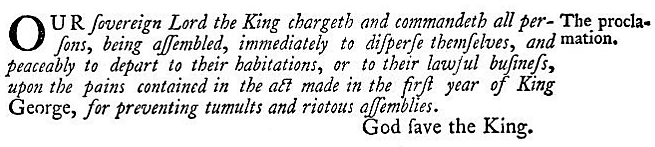
Our sovereign Lord the King chargeth and commandeth all persons, being assembled, immediately to disperse themselves, and peaceably to depart to their habitations, or to their lawful business, upon the pains contained in the act made in the first year of King George, for preventing tumults and riotous assemblies. […]
Read More
Maconochie Brothers was a company set up in 1873 by Archibald (1854-1926) and James (1850-1895) Maconochie. (Maconochie is a surname derived from the Gaelic Macdonochie, the son of Duncan.) With food processing plants on the Isle of Dogs (London), in Lowestoft (Suffolk), in Fraserburgh (Aberdeenshire, Scotland) and other places, the company was a wholesale provision merchant and manufacturer of pickles, potted meat and […]
Read More
Old Long Syne – broadside ballad (probably 1701) The Scots lang syne means long since, long ago. Conversely, short syne means a short time ago, recently. Especially in recalling old experiences shared with friends, auld lang syne, literally old long-ago, is used as a noun to mean the years of long ago, old times, memories of the past, and for auld lang syne is used to mean for old times’ […]
Read MoreThe proverb you can’t make a silk purse out of a sow’s ear means you can’t create a fine product from inferior materials. It originated in Scotland, according to its first recorded instance, in A New Dictionary of the Terms Ancient and Modern of the Canting Crew (1699), by “B. E. Gent.”: Luggs, Ears: Hence […]
Read More word histories