‘a fox in the henhouse’: meaning and early occurrences
a sly, treacherous or deceitful person, especially one who is secretly acting against the interests of the community or organisation to which he or she belongs—mid-19th century
Read More
“ad fontes!”
a sly, treacherous or deceitful person, especially one who is secretly acting against the interests of the community or organisation to which he or she belongs—mid-19th century
Read Morea person who behaves as if he or she knows everything—UK, colloquial, 1860—the irony of the expression lies in the fact that clogs are mere functional pedestrian objects
Read Moredominated by a woman or by women—UK, 1809—past participle of ‘ride’, ‘ridden’ combines with nouns to form adjectives meaning: afflicted, affected or dominated by something or by someone specified
Read MoreBritish, 1771—as an adjective: emaciated; weak and starving—as a noun: an emaciated or starving person
Read MoreEngland; also: the British Parliament—UK, 1857—popularised in 1865 by the British politician John Bright
Read Morecrowded or confined tightly together—Britain, 1706—in early use, this phrase often referred to the transatlantic slave trade
Read More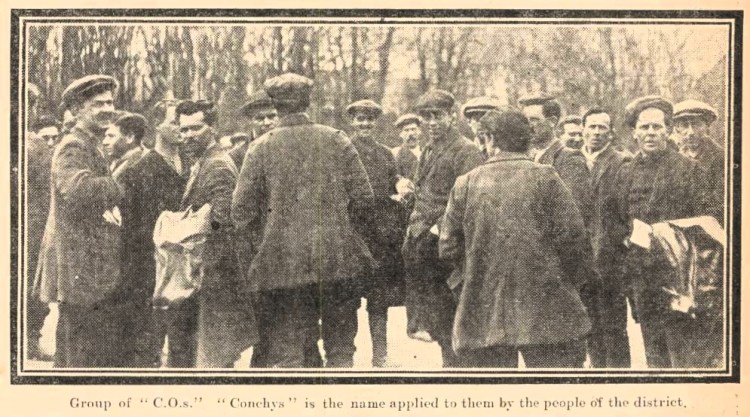
a conscientious objector—UK, 1916—from the initial syllable of the noun ‘conscientious objector’ and the suffix ‘-ie’, used to form familiar diminutives
Read Morea container used to store for posterity a selection of objects thought to be representative of a particular moment in time—USA, 1938—coined to specifically designate the container built by the Westinghouse Electric and Manufacturing Company for the 1939 New York World’s Fair
Read Morethe benefits of an endeavour are enough to outweigh the effort of pursuing it—USA, 1959—refers to the labour-intensive process of squeezing fruit to produce fresh juice
Read Moreone is no longer rational or sane—USA, 1983
Read More
