‘Hooray Henry’: meaning and origin
a lively but ineffectual young upper-class man—UK, 1959—apparently coined in the 1950s by the British jazz manager James Godbolt after ‘Hoorah Henry’, coined in 1936 by the U.S. author Alfred Damon Runyon
Read More
“ad fontes!”
a lively but ineffectual young upper-class man—UK, 1959—apparently coined in the 1950s by the British jazz manager James Godbolt after ‘Hoorah Henry’, coined in 1936 by the U.S. author Alfred Damon Runyon
Read MoreAustralia, 1834—used in various phrases, in particular as a type of someone or something in a very bad state or condition—also in the phrase ‘all behind like Barney’s bull’, meaning ‘very delayed’ or ‘backward’—origin unknown
Read MoreAustralia—also ‘to bang like a shithouse door’—used of an exceptional sexual partner—plays on two meanings of the verb ‘bang’: ‘to make a loud noise’ and ‘to have sexual intercourse’
Read MoreAustralia, 1972—a jocular curse—the Australian National Dictionary Centre explains that this phrase “recalls an earlier time when many Australians kept chooks (domestic chickens) in the backyard and the dunny was a separate outhouse”
Read MoreThe noun ‘dunny’ denotes a toilet, especially an outside toilet. This noun has been used in various phrases expressing notions such as conspicuousness, loneliness, ill luck, etc.
Read MoreThe proverbial phrase ‘if it should rain pottage, he would want his dish’, and its many variants, are used of a person who is characterised by bad luck or by an inability to be organised or prepared.
Read More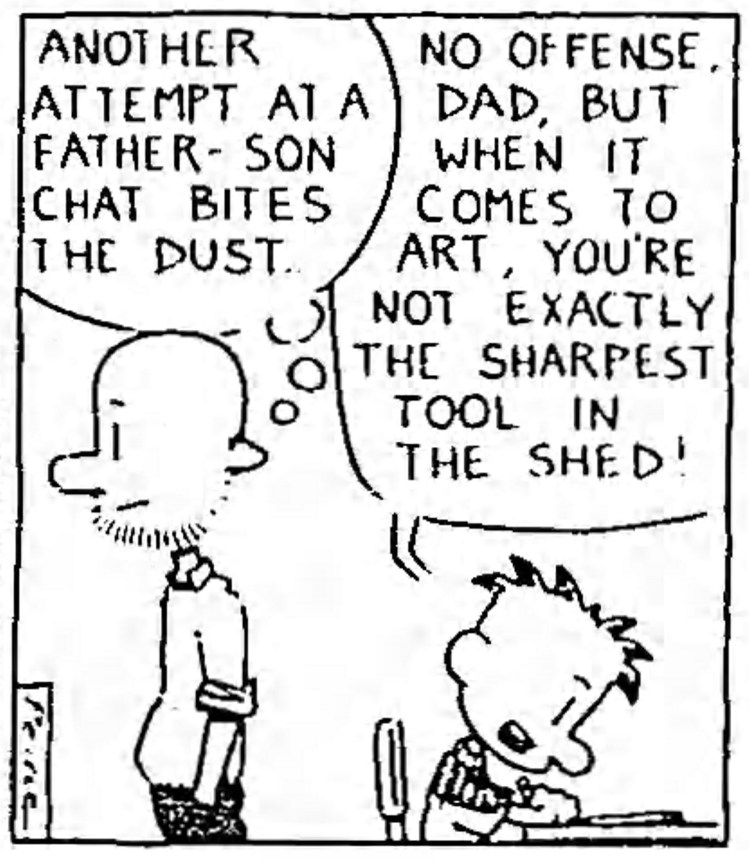
The adjective ‘sharp’ is colloquially used in the superlative, in various phrases of the form ‘not the sharpest —— in the ——’, indicating that a person is not very intelligent or perceptive, especially in comparison to others.
Read MoreUK, 1866—used as an observation, a reproof or a warning implying over-cleverness—plays on two meanings of the adjective ‘sharp’: a) literal meaning: ‘cutting’; b) figurative meaning: ‘keen-witted’
Read Moreused of a person who is implicated in an activity but accepts no responsibility for it—it was used in particular during the Watergate scandal by Senator William Saxbe to characterise President Richard Nixon
Read Morediarrhoea suffered by travellers, especially in Egypt—USA, 1973—does not seem to have been coined after the synonymous ‘Montezuma’s Revenge’—may somehow allude to the legendary curse of the pharaohs
Read More
