‘the morning after the night before’: meanings and early occurrences
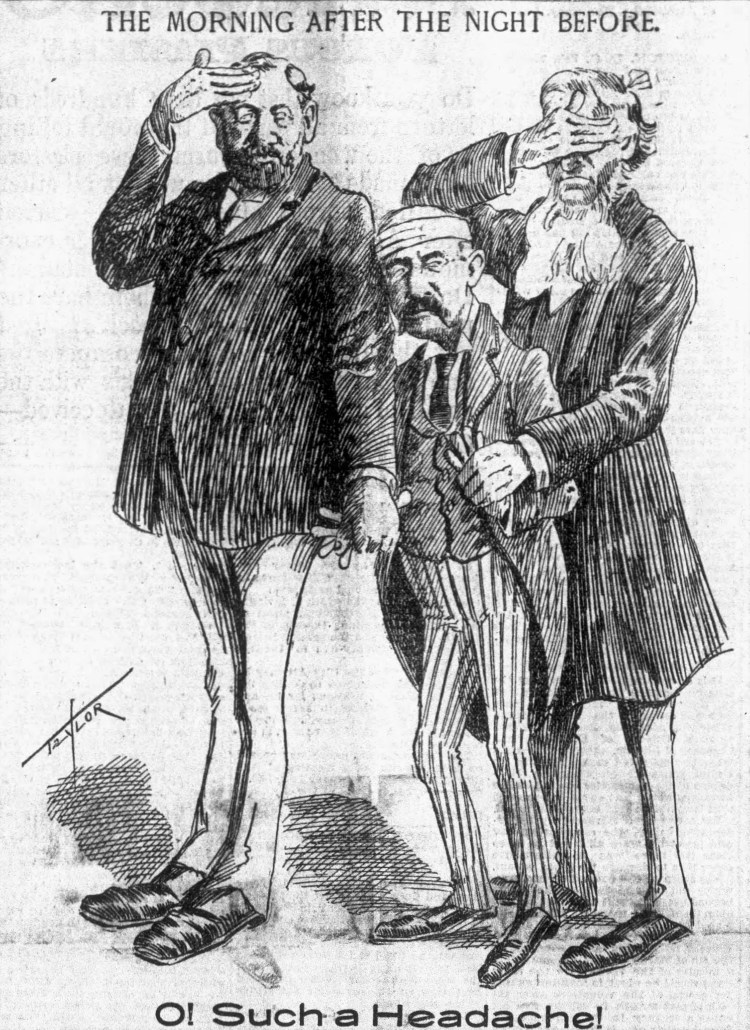
UK, 1860—the morning after an evening of drinking, when one has a hangover—in extended use: the morning after any night of excessive revelry
Read More
“ad fontes!”
UK, 1860—the morning after an evening of drinking, when one has a hangover—in extended use: the morning after any night of excessive revelry
Read More1607, as ‘as snug as pigs in pease-straw’—especially in ‘(as) snug as a bug in a rug’, phrases built on the pattern ‘(as) snug as [animal name] (in —)’ mean ‘in an extremely comfortable position or situation’
Read MoreAustralian soldiers’ slang, 1917—literally: to fall heavily; figuratively: to suffer a failure or defeat—‘gutser’ (Scotland, 1901): originally denoted a belly flop—derived from ‘gut’ in the sense of the belly
Read More1922—‘like death warmed up’ (also ‘like death warmed over’): extended form of ‘like death’, attested in the mid-17th century and meaning ‘extremely ill’, or ‘exhausted’
Read More1922, slang of high-school and university students in Kansas City (Missouri) and in Kansas: a fashionable young man who enjoys socialising with women at tea parties or other social events—1924: a diplomat employed by the U.S. State Department, regarded as being excessively occupied with entertaining dignitaries and doing little meaningful work
Read Moremeaning: ‘what is appropriate in one case is also appropriate in the other case in question’—earliest occurrence in A Collection of English Proverbs (1670), by John Ray
Read Moreincreasingly strange—alludes to Alice’s Adventures in Wonderland (1865), by Lewis Carroll—first occurs from 1878 onwards in novels by Margaret Wolfe Hungerford
Read More1762: the time of night when it is said that witches are active and supernatural occurrences take place—alludes to ‘the witching time of night’ in Shakespeare’s Hamlet—also (1985): the last hour of trading each month when exchange-traded stock options expire
Read More1793—probably ultimately after post-classical Latin ‘mille viae ducunt homines per saecula Romam…’ (‘a thousand roads lead for ever to Rome the men…’)—the metaphor occurred in A Treatise on the Astrolabe (ca 1391), by Geoffrey Chaucer
Read More(1836) stormy ocean tracts between latitudes 40° and 50° south—(1867) the fifth decade of life—(1888) the 1840s—(1913) the stretch of Broadway through Times Square, in New York City—(nautical slang) naval commanders aged between 40 and 50 who ‘roar’ commands
Read More word histories