The expression cold comfort means inadequate consolation for a misfortune. The adjective cold has long been used to mean felt as cold by the receiver, chilling, damping, discouraging. For example, the English poet Geoffrey Chaucer (circa 1342-1400) wrote, in The Nun’s Priest’s Tale: (interlinear translation – Harvard College) Wommennes conseils been ful ofte colde; Women’s counsels […]
MEANING The phrase (straight) from the horse’s mouth refers to information and means from the person directly concerned or another authoritative source. ORIGIN This phrase is from horse racing, and alludes to the presumed ideal source for a racing tip. The earliest instance that I have found is from Bell’s Life in […]
Frequently used in the passive, the phrase to sell someone a pup means to swindle someone, especially by selling something of little worth on its supposed prospective value. And to buy a pup means to be swindled. The expression is first recorded in 1901. That year, several newspapers gave its most likely origin; for example, the column From Day to Day of The Daily […]
The phrase the cold shoulder denotes a show of intentional and marked coldness or of studied indifference. Because the two earliest instances of this phrase recorded in the Oxford English Dictionary (2nd edition – 1989) are from the Scottish novelist and poet Walter Scott (1771-1832) and do not refer to food, Robert Allen writes in Dictionary of English Phrases (2008) that […]
Executioner argues with King about cutting off Cheshire Cat’s head – illustration by John Tenniel (1820-1914) for Alice’s Adventures in Wonderland (1865) The executioner’s argument was, that you couldn’t cut off a head unless there was a body to cut it off from. The phrase a cat may look at a king means even a person of low […]
Tip-Cat in A Little Pretty Pocket-Book, Intended for the Instruction and Amusement of Little Master Tommy, and Pretty Miss Polly (1787 edition) The phrase to see which way the cat jumps means to see what direction events are taking before committing oneself. One of its earliest instances is from The Berkshire Chronicle […]
The proper noun Disgusted (with initial capital D) was originally used as a self-designation by a member of the public writing anonymously to a newspaper in order to express outrage about a particular issue—cf. also meaning and history of ‘to write to The Times about it’. The earliest instance of this noun that I have found is […]
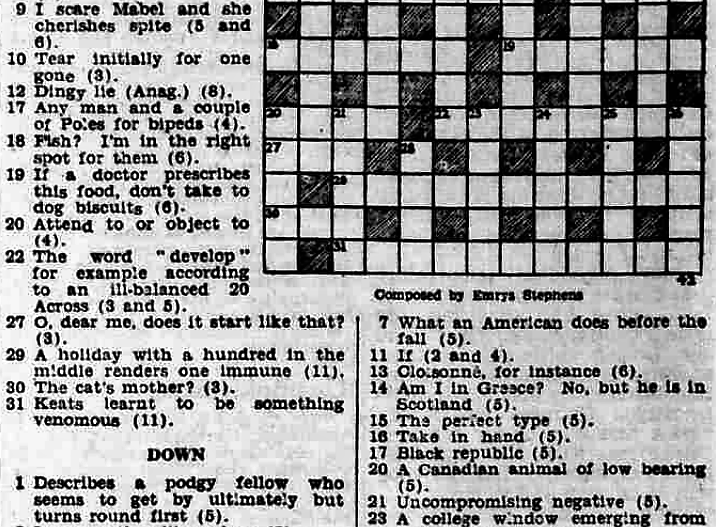
crossword in The Yorkshire Post and Leeds Mercury of 23rd January 1950 30 across: The cat’s mother? (3). The phrase who’s ‘she’—the cat’s mother? and variants are said to a person, especially a child, who uses the feminine third person singular pronoun impolitely or with inadequate reference. The earliest use of the phrase that I found is from The White […]
The proverb every cloud has a silver lining means that every difficult or sad situation has a comforting or more hopeful aspect, even though this may not be immediately apparent—cf. also the pessimistic reversal every silver lining has a cloud. In 1840, the Irish novelist known as Mrs S. C. Hall (Mrs Samuel Carter Hall, […]
The phrase like a cat on hot bricks and its American-English equivalent like a cat on a hot tin roof mean very agitated or anxious. An earlier form of the phrase was recorded by the English naturalist and theologian John Ray (1627–1705) in A Collection of English Proverbs (2nd edition – 1678): To go like […]