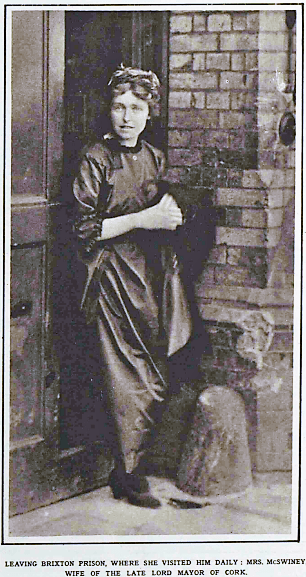
the Prisoners (Temporary Discharge for Ill-health) Act, 1913 – image: http://www.parliament.uk The Prisoners (Temporary Discharge for Ill-health) Act, 1913 was rushed through Parliament by Herbert Henry Asquith’s Liberal government in order to deal with the problem of hunger-striking suffragettes, who were force-fed, which led to a public outcry. The Act allowed for the […]
The phrase the cold shoulder denotes a show of intentional and marked coldness or of studied indifference. Because the two earliest instances of this phrase recorded in the Oxford English Dictionary (2nd edition – 1989) are from the Scottish novelist and poet Walter Scott (1771-1832) and do not refer to food, Robert Allen writes in Dictionary of English Phrases (2008) that […]
Tip-Cat in A Little Pretty Pocket-Book, Intended for the Instruction and Amusement of Little Master Tommy, and Pretty Miss Polly (1787 edition) The phrase to see which way the cat jumps means to see what direction events are taking before committing oneself. One of its earliest instances is from The Berkshire Chronicle […]
The proper noun Disgusted (with initial capital D) was originally used as a self-designation by a member of the public writing anonymously to a newspaper in order to express outrage about a particular issue—cf. also meaning and history of ‘to write to The Times about it’. The earliest instance of this noun that I have found is […]
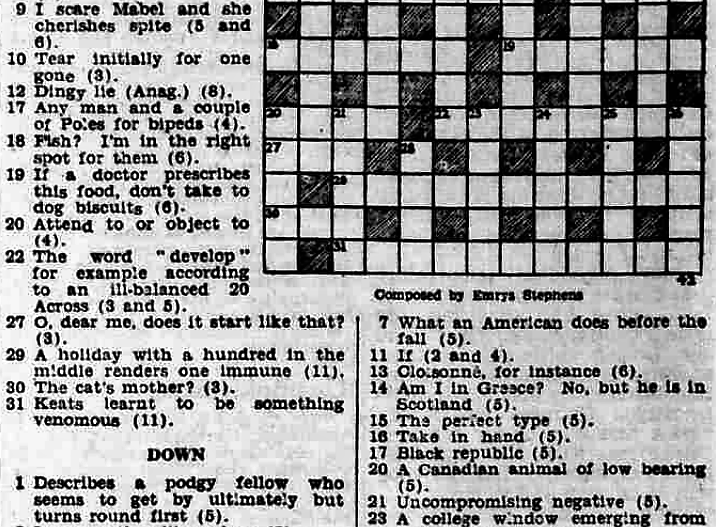
crossword in The Yorkshire Post and Leeds Mercury of 23rd January 1950 30 across: The cat’s mother? (3). The phrase who’s ‘she’—the cat’s mother? and variants are said to a person, especially a child, who uses the feminine third person singular pronoun impolitely or with inadequate reference. The earliest use of the phrase that I found is from The White […]
The proverb every cloud has a silver lining means that every difficult or sad situation has a comforting or more hopeful aspect, even though this may not be immediately apparent—cf. also the pessimistic reversal every silver lining has a cloud. In 1840, the Irish novelist known as Mrs S. C. Hall (Mrs Samuel Carter Hall, […]
The phrase like a cat on hot bricks and its American-English equivalent like a cat on a hot tin roof mean very agitated or anxious. An earlier form of the phrase was recorded by the English naturalist and theologian John Ray (1627–1705) in A Collection of English Proverbs (2nd edition – 1678): To go like […]
The phrase not a cat in hell’s chance means no chance at all—synonyms: a snowball’s chance (in hell) and a Chinaman’s chance. It is a shortening of the more explicit no more chance than a cat in hell without claws. The earliest instance of this phrase that I have found is from Jackson’s Oxford Journal of 29th September 1753: Poor […]
The Italian noun gianduia (improperly gianduja) appeared in the 19th century to denote a soft confection made with chocolate and ground hazelnuts, first produced in Turin, the capital of Piedmont, a region in north-western Italy, in the foothills of the Alps. (The Italian name is Piemonte, from piede, foot, and monte, mount.) This confection was […]
In The Tragedie of Macbeth (around 1603), by the English poet and playwright William Shakespeare (1564-1616), Gray-Malkin is the name of a fiend in the shape of a grey she-cat, the cat being the form most generally assumed by the familiar spirits of witches according to a common superstition: (Folio 1, 1623) […]