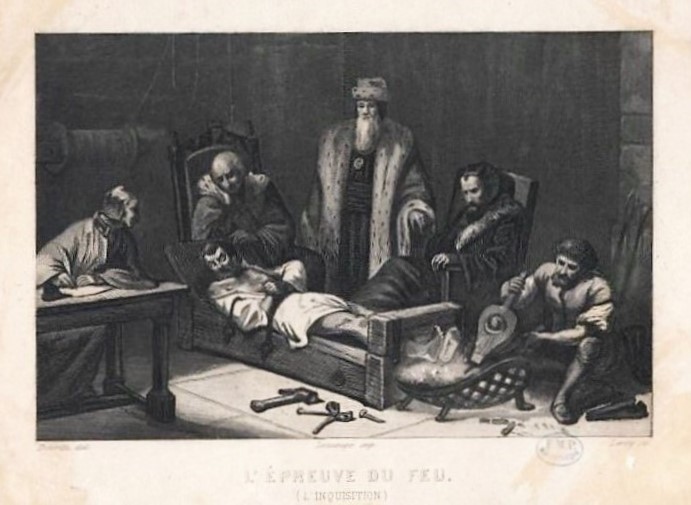
L’épreuve du feu (l’inquisition) by Devritz (painter) and Leroy (engraver) – date unknown source: BIU Santé The original meaning of the noun ordeal, from Old English ordāl, ordēl, is: an ancient test of guilt or innocence by subjection of the accused to severe pain, survival of which was taken as divine proof […]
The term old chestnut denotes a joke, story or subject that has become tedious and uninteresting through constant repetition. Here, the adjective old is simply an intensifier of the noun. The figurative use of chestnut originated in American-English theatrical slang. Diary of a Daly Débutante: being passages from the journal of a member of Augustin Daly’s […]
Originally meaning ‘person of ridiculous appearance’, ‘quiz’ (students’ slang, late 18th century) was jocularly derived from the Latin interrogative pronoun ‘quis’ in “Vir bonus est quis?” (“Who is a good man?”)—a good, ingenuous, harmless man being likely to become an object of ridicule or even of harassment.
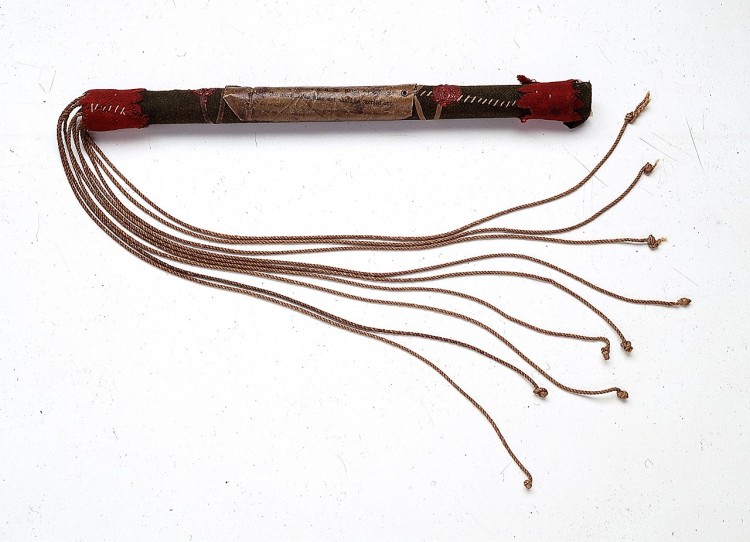
cat-o’-nine-tails (1866-79) – photograph: National Maritime Museum The noun cat-o’-nine-tails denotes a rope whip with nine knotted cords, formerly used, especially at sea, to flog offenders. This instrument of punishment was authorised in the British navy and army until 1881—cf. also to run the gauntlet. The word is first recorded in Love for […]
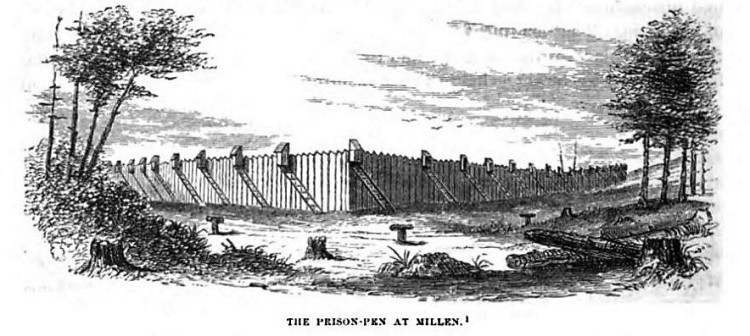
the prison-pen at Millen This pen was built of large logs driven in the ground, with sentry posts on the top, at short intervals. No shelter whatsoever was afforded the prisoners, and they were compelled to burrow in the earth, to avoid the scorching sun or the biting frost, for their captors robbed them […]
The proverb (what’s) one man’s meat is another (man)’s poison means that things liked or enjoyed by one person may be distasteful to another. In this proverb, meat has its original sense of food in general, anything used as nourishment, solid food as opposed to drink. This original sense survives in sweetmeat and in the phrase […]
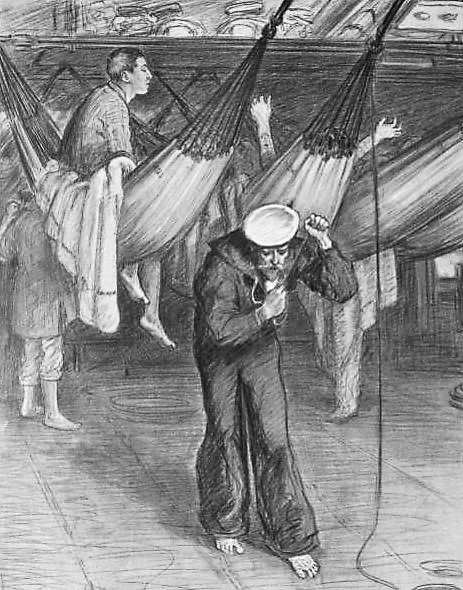
HOW A SAILOR BEGINS HIS DAY’S WORK A Scene on board H.M.S. “Trafalgar.” The boatswain blows his whistle at 5 o’clock in the morning and cries, “All hands.” Diving in and out beneath the hammocks he goes with bent head calling the same old cry of Nelson’s day: “Rise and shine. Show a leg—show […]
advertisement for Blotto brothers’ triporteurs Le Jardin des Modes nouvelles – 15th October 1913 The adjective blotto, which means drunk [however, cf. note 1], originated in British military slang during the First World War. It is first recorded in this sense in the chapter Slang in a War Hospital of Observations of an Orderly: […]
It is a circumstance rather remarkable, that the answer to Sir George Rodney’s summons of surrender, given by the respective Dutch Governours of the Islands of St. Eustatius and St. Martin’s, should be couched exactly in the same form of words without the smallest variation; from this we are either to suppose, that the […]