the collecting of a pool of money, to be used either to provide assistance to some (other) person(s) or cause, or to buy drinks for the contributors—USA, 1863—nautical origin: such funds were originally collected by having the ship’s crew drop their money onto a tarpaulin
USA, 1826, as ‘to flog somebody like seven bells’—to give a severe beating to somebody—‘seven’ is perhaps simply an arbitrary intensifier—cf. phrases such as ‘like seven bells half-struck’ (‘with as much speed as possible’) and ‘to blow seven bells’ (‘to blow a violent gale’)
to have something in reserve but ready for use; to have a chance or opportunity remaining—nautical, USA, 1789—‘shot’: a projectile designed for discharge from a firearm—‘locker’: the compartment for keeping ammunition on a ship
USA, 1815—not completely well; slightly ill or depressed—the image is of a ship caught in a storm (the noun ‘weather’ has long been used to denote a storm)
1809—U.S. nautical, obsolete: the two-fathom mark on a sounding-line—Samuel Langhorne Clemens chose it as his pen-name in 1863, but a pilot named Isaiah Sellers had first used it as his pen-name
literally (1618): a blanket dampened with water so as to extinguish a fire—figuratively (1775): a person or thing that has a subduing or inhibiting effect
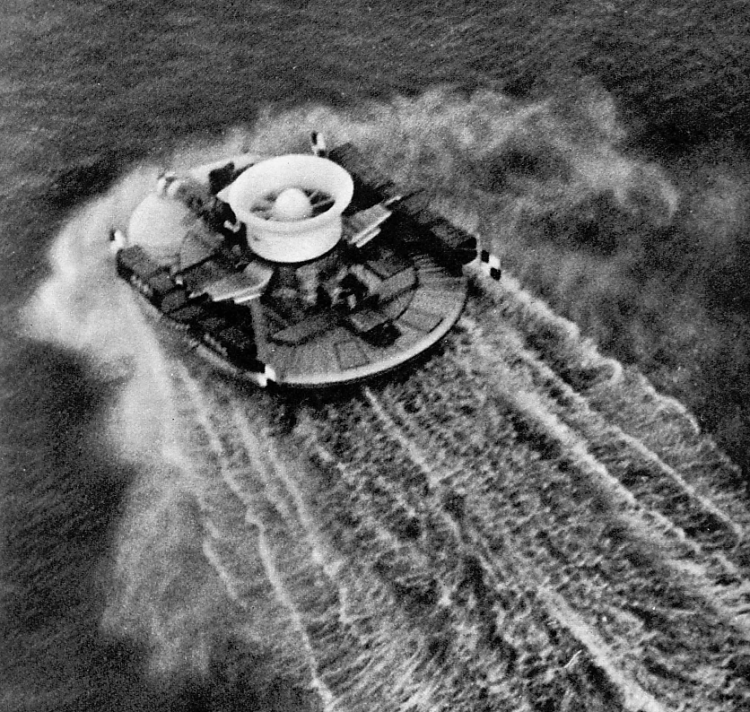
a vehicle which travels on a cushion of air—UK, 1958, apparently coined by engineer Christopher Sydney Cockerell—also, USA, 1958, in the sense of “a flying car”
to upset, to overturn—1777—origin unknown—perhaps based on Spanish ‘capuzar’, meaning ‘to sink (a ship) by the head’—or perhaps based on a Provençal compound of ‘cap’, meaning ‘head’

 word histories