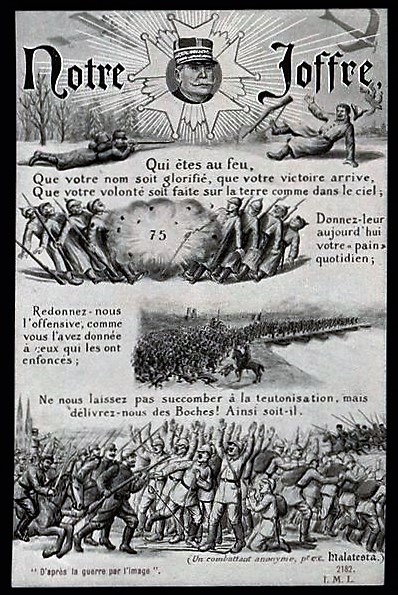
Notre Joffre (parody of the Lord’s Prayer) first published in 1914 in Le Radical de Marseille (75 refers to the French 75-mm field gun.) From 1914 to 1916, Joseph Joffre (1852-1931) was the commander in chief of the French armies on the Western Front. The following parody of the Lord’s Prayer is to be replaced […]
MEANINGS – attractive articles of little value or use – practices or beliefs that are superficially or visually appealing but have little real value or worth ORIGIN The noun trumpery, first recorded in the mid-15th century, is from the French noun tromperie, which means deception, trickery. This was one of the original meanings in […]
The phrase a horse that was foaled of an acorn denoted the gibbet, sometimes also called triple tree. In A Collection of English Proverbs (1678), the English naturalist and theologian John Ray (1627-1705) wrote: You’ll ride on a horse that was foal’d of an acorn. That is the gallows. Pelham; or, The Adventures […]
The noun myrmidon denotes a follower or subordinate of a powerful person, typically one who is unscrupulous or carries out orders unquestioningly. This word first appeared in the plural forms Mirmydanes and Murmindones in The Laud Troy book, a poem about the siege of Troy composed around 1400. It is from the classical Latin plural […]
The phrase to miss the bus, or the boat, etc., means to be too slow to take advantage of an opportunity. In A Concise Dictionary of Phrase and Fable (1993), B. A. Phythian explained: This expression is said to originate in an Oxford story of the 1840s about John Henry Newman, fellow of Oriel College, […]
The expression knight in shining armour denotes a person regarded as a medieval knight in respect of his chivalrous spirit, especially towards women. In A Concise Dictionary of Phrase and Fable (1993), B. A. Phythian explained: Despite its medieval feel, this is a twentieth-century phrase, first recorded in print in Victor Canning’s Whip Hand (1965). […]
The phrase at sixes and sevens means in a state of total confusion or disarray. Based on the language of dicing, the phrase was originally to set (all) on six and seven. It denoted the hazard of one’s whole fortune, or carelessness as to the consequences of one’s actions. From this earlier association with reckless behaviour came the idea that things in […]
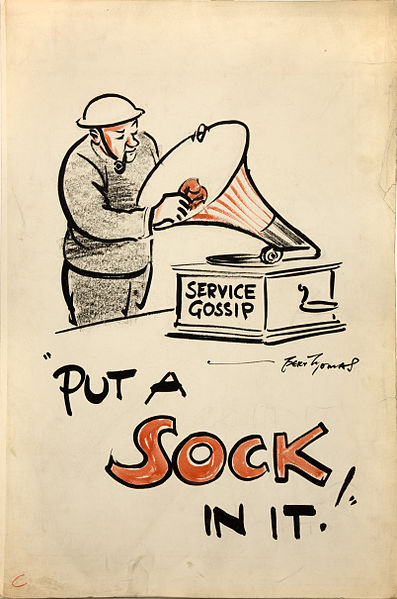
This cartoon by Bert Thomas (1883-1966) for the British Ministry of Information during World War II illustrates the folk etymology of the phrase. MEANING stop talking! ORIGIN The earliest known mention of this phrase is in a letter published by the London literary magazine The Athenæum of 8th August 1919: Sir, The […]
MEANING a persistent or desperate hope that is unlikely to be fulfilled, a faint hope, a ‘hope against hope’ ORIGIN On the face of it, this is a curious expression, because the adjective forlorn does not normally mean faint but miserable, lonely, forsaken or sad. The current sense of forlorn hope derives […]
“Go by Shanks’ pony – Walk short distances and leave room for those who have longer journeys” – a Second World War poster by Lewitt-Him for the Ministry of War Transport – image: Imperial War Museums The phrase Shanks’(s) pony, or mare, etc, means one’s own legs as a means of conveyance. It is […]