A New Song, sung by Mr. Champness in Harlequin’s Invasion from The Universal Magazine of Knowledge and Pleasure – March 1760 The phrase heart of oak denotes a person with a strong, courageous nature, especially a brave and loyal soldier or sailor, and a courageous or valorous spirit. Its literal meaning is the heartwood of the oak. The heartwood […]
Maconochie Brothers was a company set up in 1873 by Archibald (1854-1926) and James (1850-1895) Maconochie. (Maconochie is a surname derived from the Gaelic Macdonochie, the son of Duncan.) With food processing plants on the Isle of Dogs (London), in Lowestoft (Suffolk), in Fraserburgh (Aberdeenshire, Scotland) and other places, the company was a wholesale provision merchant and manufacturer of pickles, potted meat and […]
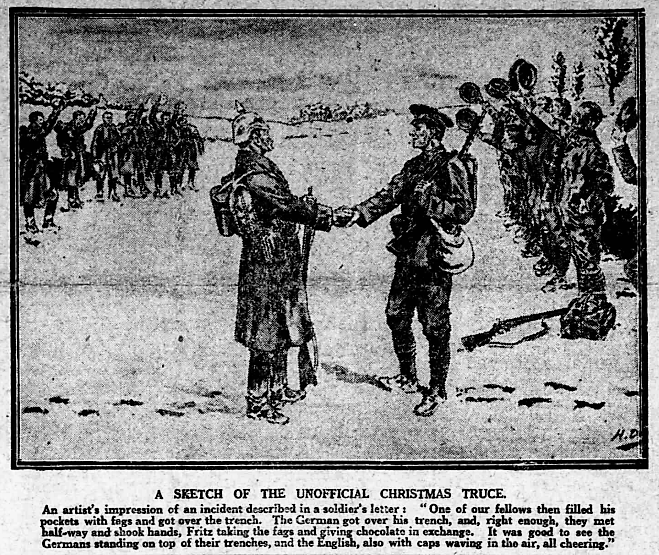
A SKETCH OF THE UNOFFICIAL CHRISTMAS TRUCE. An artist’s impression of an incident described in a soldier’s letter: “One of our fellows then filled his pockets with fags and got over the trench. The German got over his trench, and right enough, they met half-way and shook hands, Fritz taking the fags and giving […]
The phrase not a cat in hell’s chance means no chance at all—synonyms: a snowball’s chance (in hell) and a Chinaman’s chance. It is a shortening of the more explicit no more chance than a cat in hell without claws. The earliest instance of this phrase that I have found is from Jackson’s Oxford Journal of 29th September 1753: Poor […]
The adjective fed up means annoyed, unhappy or bored, especially with a situation that has existed for a long time. The original, literal meaning is simply sated with food, since to feed up an animal or a person is to supply them with rich and abundant food. For example, the author of Whether Love be a natural or fictitious Passion, published in Pope’s Bath Chronicle of 3rd May 1764, wrote: The […]
MEANING to pay excessively, to be charged exorbitantly PROBABLE ORIGIN The expression to pay through the nose is first recorded in Piazza universale di proverbi Italiani, or, A common place of Italian proverbs and proverbial phrases digested in alphabetical order (1666), by Giovanni Torriano (floruit 1640): Oft-times Rich men engrossing commodities, will make one pay through the […]
One of the earliest instances of posh is from a cartoon published in Punch, or The London Charivari (London, England) of 25th September 1918. An RAF officer is talking to his mother: “Oh, yes, Mater, we had a posh time of it down there.” “Whatever do you mean by ‘posh,’ Gerald?” “Don’t you know? […]
The phrase to take French leave means: to depart unnoticed or without permission.—Synonym: to take Dutch leave. The earliest (and most curious) occurrence of to take French leave that I have found is from the anonymous novel Benedicta (1741)—the heroine is about to get married: Mrs Butler, who on this extraordinary occasion, had taken French leave […]
The phrase ‘pour encourager les autres’ (‘in order to encourage the others’) was coined by Voltaire with reference to the execution of Admiral John Byng in 1757.
Figuratively, a loose cannon is an unpredictable or uncontrolled person who is liable to cause unintentional damage. But in practice, it was one inadequately lashed in place on the deck of a ship, which caused havoc by rolling dangerously and unpredictably. The first known mention of a loose cannon being tossed about the deck of […]