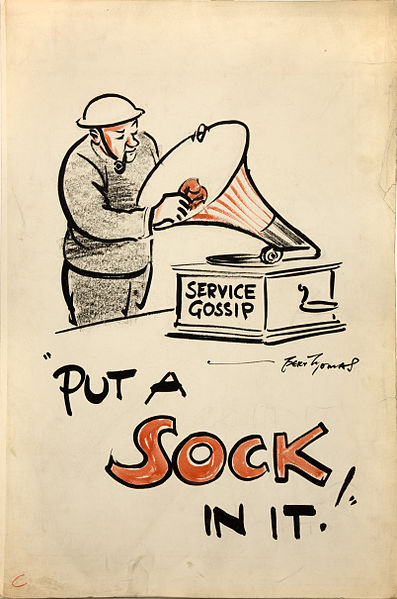
This cartoon by Bert Thomas (1883-1966) for the British Ministry of Information during World War II illustrates the folk etymology of the phrase. MEANING stop talking! ORIGIN The earliest known mention of this phrase is in a letter published by the London literary magazine The Athenæum of 8th August 1919: Sir, The […]
MEANING a persistent or desperate hope that is unlikely to be fulfilled, a faint hope, a ‘hope against hope’ ORIGIN On the face of it, this is a curious expression, because the adjective forlorn does not normally mean faint but miserable, lonely, forsaken or sad. The current sense of forlorn hope derives […]
“Go by Shanks’ pony – Walk short distances and leave room for those who have longer journeys” – a Second World War poster by Lewitt-Him for the Ministry of War Transport – image: Imperial War Museums The phrase Shanks’(s) pony, or mare, etc, means one’s own legs as a means of conveyance. It is […]
MEANING The Northern Daily Mail and South Durham Herald (Hartlepool, County Durham, England) of 14th July 1894 published an article titled Naval Slang. How Jack Re-christens Things, which contains the following: The preserved meat served out to him is known as “Fanny Adams” or “Harriet Lane.” But the term Harriet Lane was also […]
The exclamation OMG expresses astonishment, excitement, embarrassment, etc. It is from the initial letters of oh my God (the final element may sometimes represent gosh or goodness). This initialism is older than the Internet or even the Usenet (an early computer network established in 1980), since it is first found in a letter that the […]


 word histories