‘hell’s delight’: meaning and early occurrences
early 19th century—pandemonium, great trouble or difficulty—often in ‘to kick up hell’s delight’, meaning: to cause a great deal of trouble or difficulty
Read More
“ad fontes!”
early 19th century—pandemonium, great trouble or difficulty—often in ‘to kick up hell’s delight’, meaning: to cause a great deal of trouble or difficulty
Read MoreAustralia—1897: the typical bushman—1915: the typical Australian private soldier—a blend of the male forenames ‘Bill’ and ‘Jim’, as often used of bushmen
Read MoreUSA—1941 (slang of the Marines): a state of disorder or confusion—1959 (High-School slang): a prank in which the occupants of a vehicle which has temporarily come to a stop must jump out, run around the vehicle and get back in
Read MoreUK, 1848: a tendency to ‘talk shop’—UK, 1854: something that is characteristic of a shop displaying various kinds of goods (i.e., something that is composed of disparate commonplace elements)
Read Morea narrow escape from danger, disaster or mishap—UK, 1820—refers to the act of shaving with a cutthroat razor, which may result in injury
Read More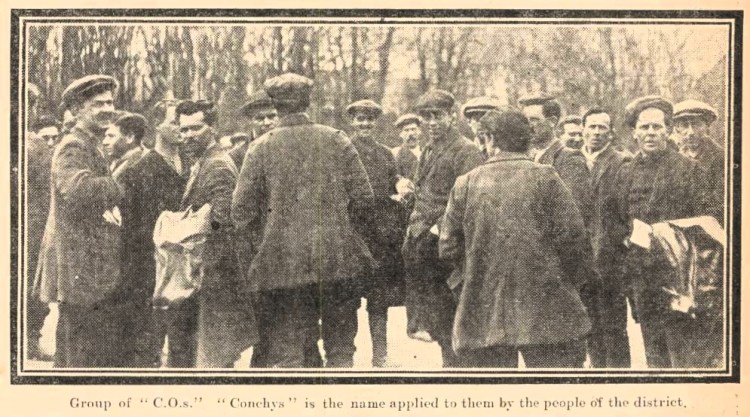
a conscientious objector—UK, 1916—from the initial syllable of the noun ‘conscientious objector’ and the suffix ‘-ie’, used to form familiar diminutives
Read Morethree daily meals plus a bed for the night (i.e., basic food and shelter)—USA, 1929—chiefly used in relation to the military, prison, and shelters for homeless people—‘hot’ designates a hot meal
Read MoreUSA, 1959—in reference to the Cuban Revolution (1953-59): a revolutionary soldier under the leadership of Fidel Castro—a borrowing from Spanish ‘barbudo’ (literally: a bearded one)
Read MoreUSA, 1898—a type of sandwich consisting of a long crusty roll filled with ham, pork, cheese, pickles and mustard, often toasted—originally: any of various types of sandwich associated with Cuban cuisine
Read More
USA, 1942—has often been attributed to the Irish author George Bernard Shaw—has occasionally been applied to the relations between Australia and the USA
Read More
