‘like a stunned mullet’: meaning and origin
Australia, 1918—dazed and uncomprehending—from the image of a mullet that has been stunned
Read More
“ad fontes!”
Australia, 1918—dazed and uncomprehending—from the image of a mullet that has been stunned
Read MoreUK, 1928—of a public-house: very basic and lacking in comforts—refers to the former practice of covering the floor of a public-house with sawdust into which customers spat
Read Moremilitary slang, derisive—of military medals and decorations: to be awarded automatically, without regard to merit—coined during the First World War
Read Morethe name of a decree issued in Nazi Germany in December 1941, under which individuals suspected of resistance or other underground activities were arrested and deported suddenly and without trace, frequently during the night—by extension: any situation, event, etc., characterised by mystery, obscurity or secrecy
Read MoreUK, 1890—the dated jocular exclamations ‘my giddy aunt!’, ‘my sainted aunt!’, etc., express surprise, consternation, etc.—they are extended forms of the exclamation ‘my aunt!’
Read More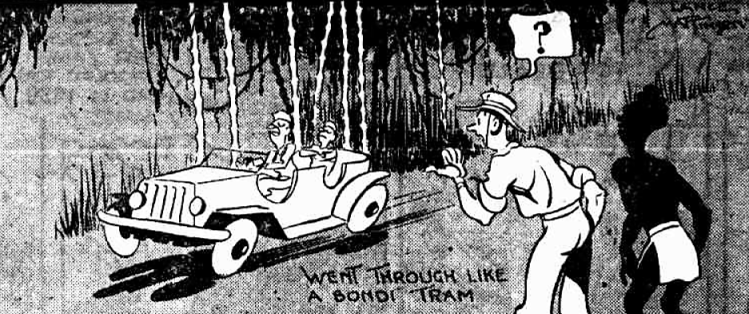
Australia, 1940—means ‘speedily’—refers to the tram service between Sydney, New South Wales, and Bondi Beach, a popular beach located 4 miles east of Sydney city centre
Read Morereply to any request for somebody’s whereabouts—Australia, 1944: slang of the Australian armed forces during WWII—original meaning: absent without leave
Read MoreAustralia and U.S.A, 1944—purportedly applied by the British and the Australians to the U.S. soldiers stationed in their respective countries during World War II—British self-deprecating retort: ‘underpaid, underdressed, undersexed and under Eisenhower’
Read MoreUK, 1938—old-fashioned informal British-English adjective meaning ‘in good order’, ‘fine’—origin obscure: perhaps from Hindi ‘ṭhīk hai’ (‘all right’) or from ‘the ticket’ (‘the correct thing’); or it may simply be a purely fanciful formation
Read More
derisive appellation given to Australian Rules (football), because the ball is often kicked high into the air, requiring players to leap and catch it—Australia, 1945—slang of the Australian armed forces during World War II
Read More word histories