Maconochie Brothers was a company set up in 1873 by Archibald (1854-1926) and James (1850-1895) Maconochie. (Maconochie is a surname derived from the Gaelic Macdonochie, the son of Duncan.) With food processing plants on the Isle of Dogs (London), in Lowestoft (Suffolk), in Fraserburgh (Aberdeenshire, Scotland) and other places, the company was a wholesale provision merchant and manufacturer of pickles, potted meat and […]
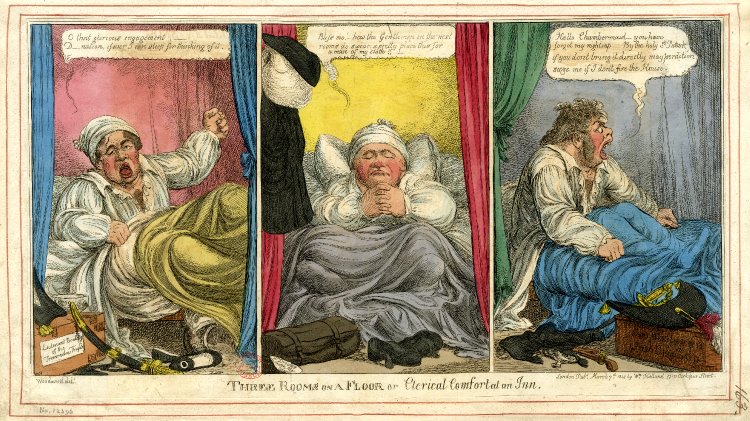
A nightcap is a cap worn in bed to keep one’s head warm. The word is first recorded in the description and valuation, made in 1378, of the articles that were in the shop of Thomas Trewe, haberdasher of London: one dozen of white caps, called “nightcappes”, was worth 2s. 3d.. The figurative […]
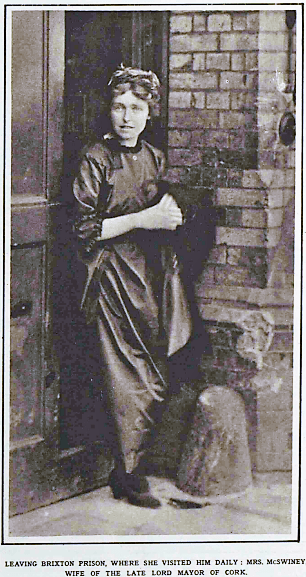
the Prisoners (Temporary Discharge for Ill-health) Act, 1913 – image: http://www.parliament.uk The Prisoners (Temporary Discharge for Ill-health) Act, 1913 was rushed through Parliament by Herbert Henry Asquith’s Liberal government in order to deal with the problem of hunger-striking suffragettes, who were force-fed, which led to a public outcry. The Act allowed for the […]
The proverb every cloud has a silver lining means that every difficult or sad situation has a comforting or more hopeful aspect, even though this may not be immediately apparent—cf. also the pessimistic reversal every silver lining has a cloud. In 1840, the Irish novelist known as Mrs S. C. Hall (Mrs Samuel Carter Hall, […]
One of the earliest instances of posh is from a cartoon published in Punch, or The London Charivari (London, England) of 25th September 1918. An RAF officer is talking to his mother: “Oh, yes, Mater, we had a posh time of it down there.” “Whatever do you mean by ‘posh,’ Gerald?” “Don’t you know? […]
MEANING The phrase (if you’ll) excuse (or pardon) my French is used as an apology for swearing. ORIGIN The current sense seems to derive from an actual apology for speaking French. (It is therefore unnecessary to invoke the centuries-old adversarial relationship between the English and the French.) The form pardon my French is first attested in Randolph, a Novel (1823), by the American […]
Aunt Sally – from The Modern Playmate: A book of games, sports, and diversions for boys of all ages (new revised edition – 1875?), by John George Wood (1827-89) The Oxford English Dictionary (first edition – 1885) thus defined Aunt Sally: a game much in vogue at fairs and races, in which […]
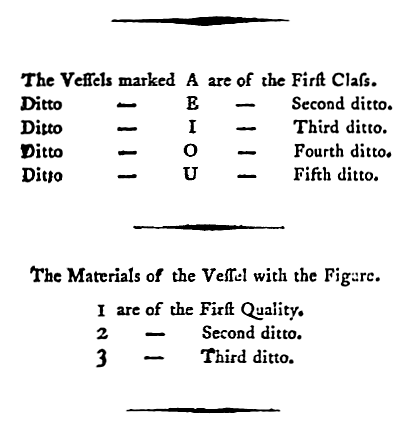
MEANING first class, outstanding ORIGIN Lloyd’s Register, historically Lloyd’s Register of Shipping, is an independent society formed in 1760 by a group of merchants operating at Lloyd’s coffee house in London, which surveys ships to ensure compliance with standards of strength and maintenance. The name also denotes an annual publication giving details […]
The proper name Guy is derived, via French, from the Old German Wido, either from wit, meaning wide, or from witu, wood. Wido has become Guy in French because in words of Germanic origin, when initial, the labio-velar approximant /w/ has regularly become the velar /g/. For instance, in the French noun loup-garou, the element garou corresponds to English werewolf—in fact, loup was added when the […]
The word Mayday, which dates from 1923, is used as an international radio distress signal, especially by ships and aircraft. It was supposedly coined by Frederick Stanley Mockford (1897-1962), a senior radio officer at London’s Croydon Airport, but this has not been substantiated: the fact that this story has often been repeated gives it a semblance […]




 word histories