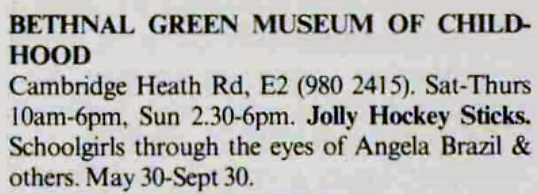
BETHNAL GREEN MUSEUM OF CHILDHOOD Cambridge Heath Rd, E2 (980 2415). Sat-Thurs 10am-6pm, Sun 2.30-6pm. Jolly Hockey Sticks. Schoolgirls through the eyes of Angela Brazil¹ & others. May 30-Sept 30. from The Illustrated London News – May 1984 (¹ Angela Brazil (1868-1947), British author of schoolgirls’ stories) The exclamation jolly hockey stick(s) is […]
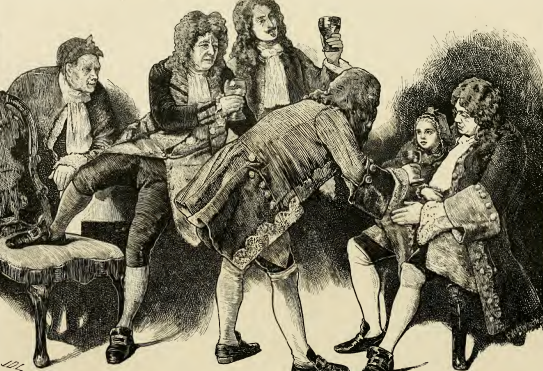
Lady Mary Wortley Montagu and the Kit-Kats – illustration from Old and New London: A Narrative of its History, its People, and its Places (1873), by Walter Thornbury (The Kit-Cat, or Kit-Kat, Club in London was a club of Whig politicians and men of letters founded in the reign (1685-8) of James II; its […]
There are two Valentines, both Italian, one a priest and the other a bishop, who were martyred and used to be commemorated in the Roman Catholic calendar on 14th February. However, they have no romantic associations and the modern customs linked with St Valentine’s Day arise from a tradition according to which it is the day when the […]
In the United Kingdom, especially in the mid-1950s, a Teddy boy was a young man characterised by a style of dress and appearance held to be characteristic of Edward VII’s reign (1901-10), typically a long velvet-collared jacket, drainpipe trousers and sideburns (Teddy is a pet form of Edward (VII)). The term first appeared in print […]
The noun marrowsky, which has also been spelt Marouski, Marowsky, morowski and mowrowsky, denotes a variety of slang, or a slip in speaking, characterised by the transposition of the initial letters or syllables of two words. The more usual term is spoonerism (cf. also malapropism and eggcorn). The word is first recorded in the verbal form Marrowskying in […]
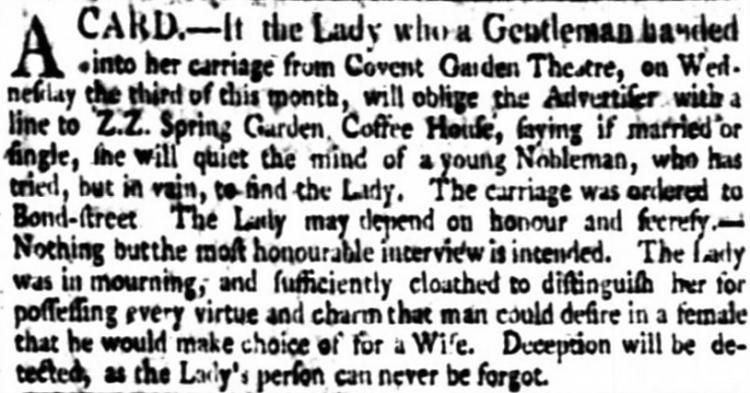
advertisement published in The Times (London) on 18th December 1800: A CARD.—If the Lady who a Gentleman handed into her carriage from Covent Garden Theatre, on Wednesday, the third of this month, will oblige the Advertiser with a line to Z. Z., Spring Garden Coffee House, saying if married or single, she will […]
detail from the frontispiece to The Life of an Actor (1825), by Pierce Egan The phrase to get, or to give, the bird means to receive, or to show, derision, to be dismissed, or to dismiss. It originated in theatrical slang and referred to the ‘big bird’, that is, the goose, which hisses as people do when they make a sound of disapproval […]
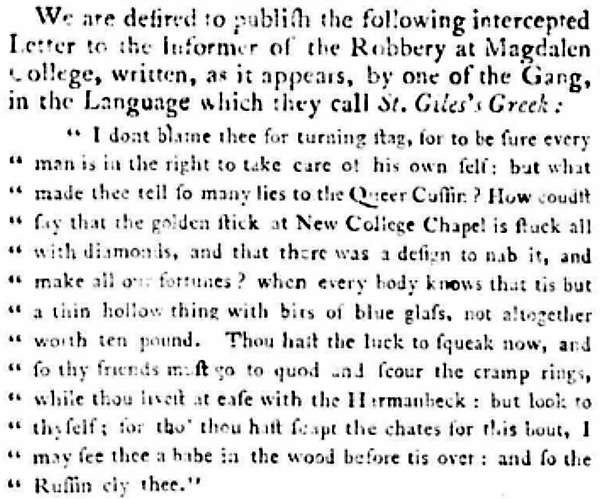
The noun Greek has long been used in the sense of unintelligible speech or language, gibberish, and the phrase it’s (all) Greek to me means I can’t understand it at all. This expression is well known from The Tragedie of Julius Cæsar (1599), by the English playwright and poet William Shakespeare (1564-1616): (Folio […]
“Tell me, man, how goes the enemy?” cartoon published in the Sunday Pictorial (London) of 23rd August 1942 The colloquial phrase How goes the enemy? means What is the time?. Its origin was explained in the text where it is first recorded, published in the Brighton Gazette, and Lewes Observer (Sussex) of 26th October 1826: THE VAMPIRE. N° LVIII. My dear […]
A New Song, sung by Mr. Champness in Harlequin’s Invasion from The Universal Magazine of Knowledge and Pleasure – March 1760 The phrase heart of oak denotes a person with a strong, courageous nature, especially a brave and loyal soldier or sailor, and a courageous or valorous spirit. Its literal meaning is the heartwood of the oak. The heartwood […]



 word histories