MEANING a man unduly concerned with looking stylish and fashionable ORIGIN As it was originally in use on the Scottish Border at the end of the 18th century, dandy represents perhaps the name Andrew. (From Dandie Dinmont (i.e. Andrew Dinmont), the name of a character in Guy Mannering; or, The Astrologer (1815), […]
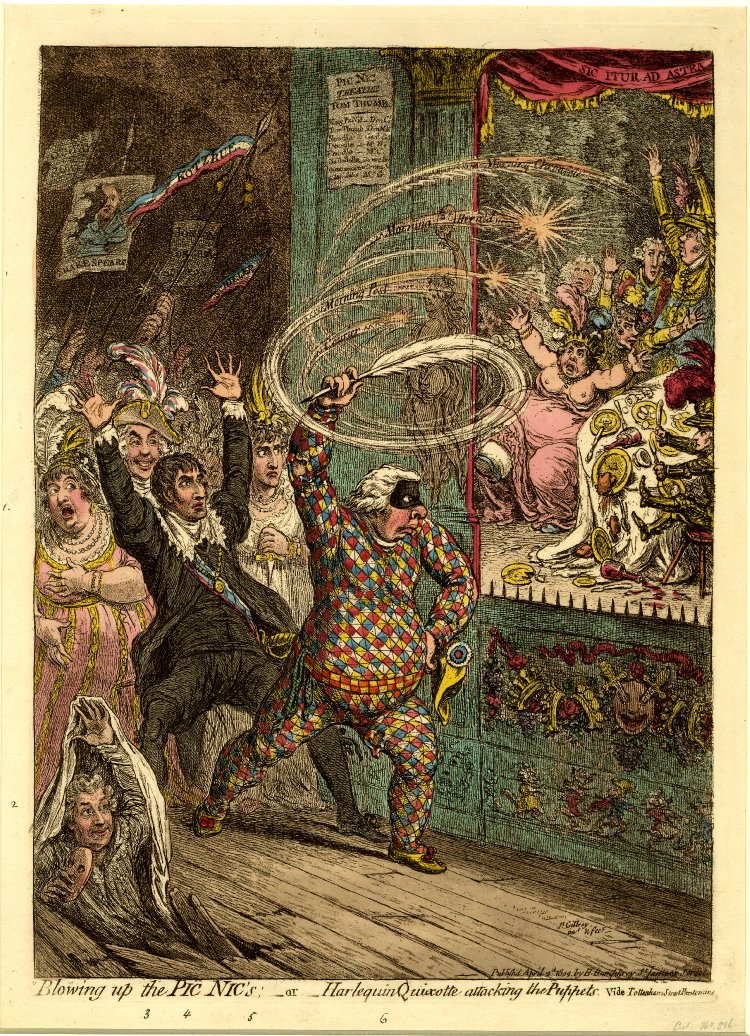
Blowing up the PIC NIC’s:—or—Harlequin Quixotte attacking the Puppets. Vide Tottenham Street Pantomime (1802), by James Gillray (1756-1815) — image: The British Museum MEANING a meal eaten outdoors ORIGIN This word is from French pique-nique, probably formed with reduplication from the verb piquer, to pick. (Similarly, pêle-mêle, the origin […]
The word tennis in its current sense is short for lawn tennis. The original form of tennis (known as real tennis to distinguish it from the later lawn tennis) was played with a solid ball on an enclosed court divided into equal but dissimilar halves, the service side (from which service was always delivered) and […]
The verb to sack (someone) means to dismiss (someone) from employment. This verb seems to have appeared in the first half of the 19th century. For example, the Perthshire Courier (Scotland) of Thursday 29th April 1841 reported that at the Glasgow assizes, during the trial for the murder of a superintendent of Railway labourers, one […]
“Go by Shanks’ pony – Walk short distances and leave room for those who have longer journeys” – a Second World War poster by Lewitt-Him for the Ministry of War Transport – image: Imperial War Museums The phrase Shanks’(s) pony, or mare, etc, means one’s own legs as a means of conveyance. It is […]
The phrase to carry coals to Newcastle means to supply something to a place where it is already plentiful; hence, figuratively, to do something wholly superfluous or unnecessary—cf. also to sell refrigerators to the Eskimos and to sell sand in the Sahara. This phrase (in which coals is an obsolete plural) refers to Newcastle upon Tyne, in […]
MEANING The Northern Daily Mail and South Durham Herald (Hartlepool, County Durham, England) of 14th July 1894 published an article titled Naval Slang. How Jack Re-christens Things, which contains the following: The preserved meat served out to him is known as “Fanny Adams” or “Harriet Lane.” But the term Harriet Lane was also […]
First recorded circa 1629 as ‘to rain dogs and cats’, this phrase is based on a cat-and-dog fight as a metaphor for a storm or hard rain; the theory that Jonathan Swift coined the phrase is ludicrous.


 word histories