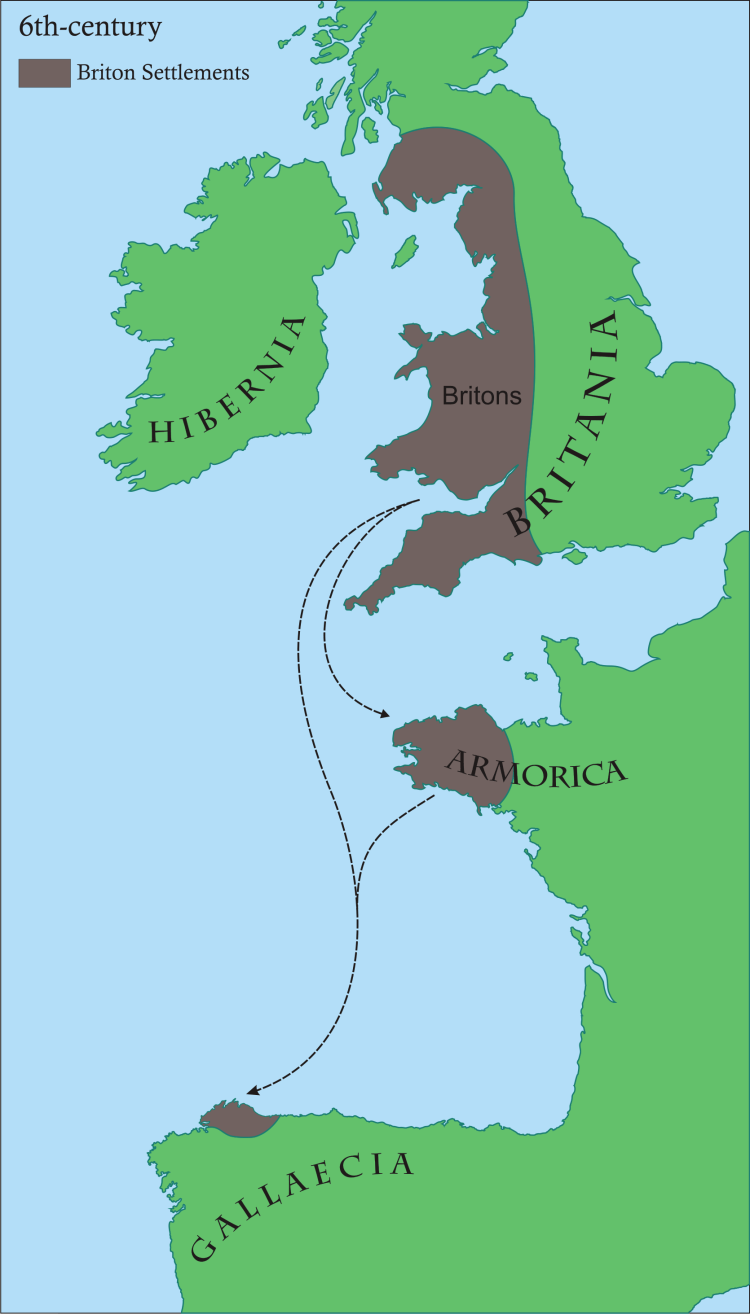
Briton settlements in the 6th century – settlements of the Angles, Saxons and Jutes in Britain, circa 600 In the following, Briton will refer to the Celtic Brittonic-speaking peoples who inhabited Britain south of the Firth of Forth, and who, following the arrival of the Anglo-Saxons in the 5th century, gradually retreated until the […]
The Anglo-Saxons were the Germanic inhabitants of England before the Conquest, i.e. the invasion and assumption of control by William of Normandy in 1066. Known as William the Conqueror, William I (circa 1027-87) defeated Harold II at the Battle of Hastings. He introduced Norman institutions and customs, including feudalism, and instigated the Domesday Book. […]
The English adjective pregnant has several meanings: carrying a fetus or fetuses within the womb, full of meaning or significance, inventive or imaginative, prolific or fruitful. It is from the Latin adjective praegnans/praegnant-, with child, pregnant, variant of praegnas/praegnat-, probably from the prefix prae-, before, and the stem of the verb gnasci (past participle gnatus), […]
cloak: twin roses designs The nouns clock and cloak are doublets, or etymological twins: they are of the same derivation but have different forms and meanings. Despite the notion of ‘two’ implied by doublet, the term is also applied to sets of more than two words. In this case, cloche, a borrowing from French, […]
The English nouns lobster and locust are doublets. Doublets (or etymological twins) are words in one given language that go back to the same etymological source but differ in form and meaning—cf. also turban – tulip, clock – cloak, pastiche – pastis and fawn – fetus. The word lobster is from Old English […]
the 1905 edition of Le Petit Larousse illustré, a French-language encyclopaedic dictionary published by the Éditions Larousse In 1890, Eugène Grasset (1845-1917) designed the image of la Semeuse (the Sower) blowing dandelion seeds, which accompanies the motto of the Éditions Larousse, Je sème à tout vent (I sow to the four winds). The word […]
MEANING to stay up very late in order to study or do some other work ORIGIN The word oil was used in various phrases referring to the use of oil in a lamp for nocturnal study. For example, to lose one’s oil meant to study or labour in vain; the English historian […]
The word tennis in its current sense is short for lawn tennis. The original form of tennis (known as real tennis to distinguish it from the later lawn tennis) was played with a solid ball on an enclosed court divided into equal but dissimilar halves, the service side (from which service was always delivered) and […]
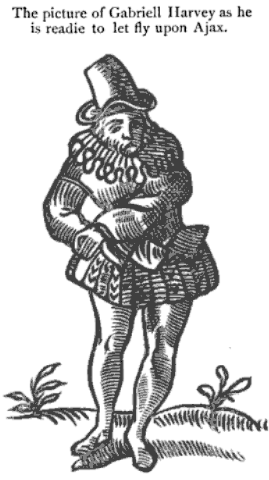
Caricature of Gabriel Harvey from Haue with you to Saffron-walden. Or, Gabriell Harueys hunt is vp (1596), by Thomas Nashe. Entitled The picture of Gabriell Harvey as he is readie to let fly upon Ajax, this caricature depicts him rushing to the toilet at the thought of Nashe’s publication. Ajax was a pun on […]
In early use, apple was a general term for all kinds of fruits other than berries, including even nuts. In fact, apple and berry are the only Anglo-Saxon fruit names, the rest being of Latin or ‘exotic’ origin. This is why apple was commonly used in describing foreign fruits, which explains for example the word […]




 word histories