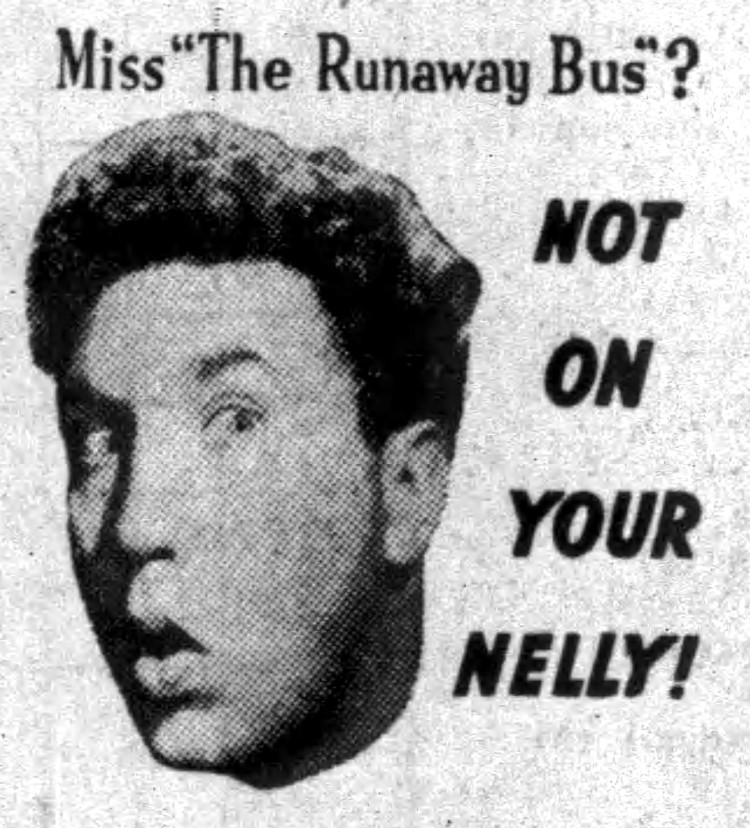
‘not under any circumstances’—Royal Air Force slang, 1942—short for ‘not on your Nelly Duff’, i.e., ‘not on your life’, ‘Nelly Duff’ being rhyming slang for ‘puff’ as used colloquially in the sense of ‘life’
USA, 1900: to get a stage act ready—Canada, 1961: to organise oneself to undertake or achieve something—from ‘to get together’ (i.e., to organise, put in order, harmonise)
also ‘to shoot the red light’, ‘to shoot the amber’, etc.—to drive past a traffic-light when it indicates that one should stop—UK, 1934, as ‘to shoot the lights’
also ‘to shoot the red light’, ‘to shoot the amber’, etc.—to drive past a traffic-light when it indicates that one should stop—USA, 1926, as ‘to shoot the yellow’
Australia, 1943—a foolish or silly person—from the synonymous noun ‘dill’ (1933), itself apparently a back-formation from the adjective ‘dilly’, meaning ‘foolish’, ‘silly’
USA, 1871: a person who frequently uses or coins slang words and phrases—USA, 1926: a person who studies the use and historical development of slang—blend of the nouns ‘slang’ and ‘linguist’
UK—a ball game for three players, in which the middle player tries to intercept the ball as it passes between the other two—hence: a person, party, etc., caught between others in a conflict, dispute, etc.
a person embodying the civilised qualities supposedly characteristic of both an officer in the armed forces and a gentleman—UK, 1749, in the Articles of War
indicates that a place or event is one to which guests may or should bring their own alcoholic drink—UK, 1858—USA, 1910—in early U.S. use, often referred to the prohibition of alcohol

 word histories